
Koreatown in Los Angeles in Los Angeles County, California — The American West (Pacific Coastal)
Wilshire Boulevard Temple
Photographed by Craig Baker
1. Wilshire Boulevard Temple Marker
City's Oldest Jewish Community
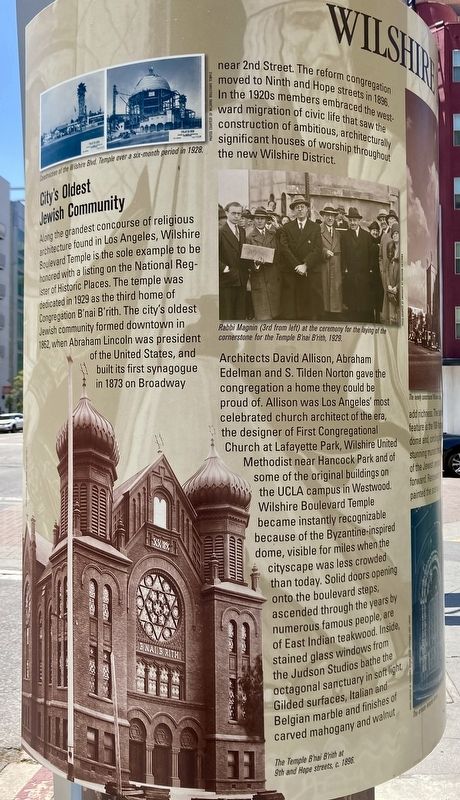
Along the grandest concourse of religious architecture found in Los Angeles, Wilshire Boulevard Temple is the sole example to be honored with a listing on the National Register of Historic Places. The temple was dedicated in 1929 as the third home of Congregation B'nai B'rith. The city's oldest Jewish community formed downtown in 1862, when Abraham Lincoln was president of the United States, and built its first synagogue in 1873 on Broadway near 2nd Street. The reform congregation moved to Ninth and Hope streets in 1896. In the 1920s members embraced the westward migration of civic life that saw the construction of ambitious, architecturally significant houses of worship throughout the new Wilshire District.
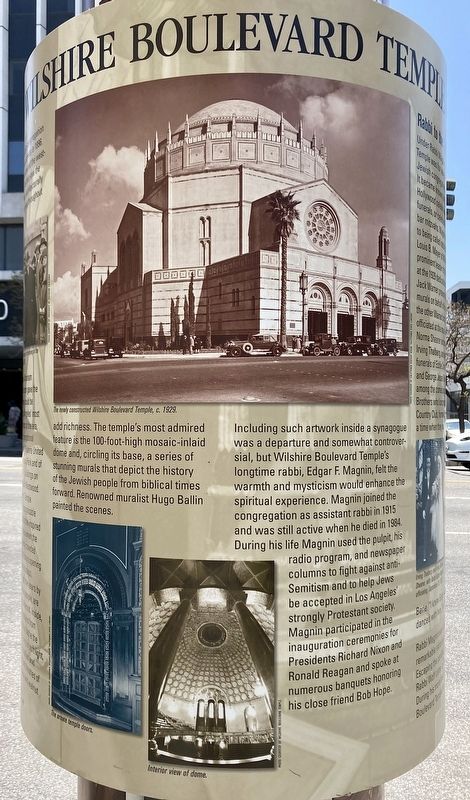
Architects David Allison, Abraham Edelman and S. Tilden Norton gave the congregation a home they could be proud of. Allison was Los Angeles' most celebrated church architect of the era, the designer of First Congregational Church at Lafayette Park, Wilshire United Methodist near Hancock Park and of some of the original buildings on the UCLA campus in Westwood. Wilshire Boulevard Temple became instantly recognizable because of the Byzantine-inspired dome, visible for miles when the cityscape was less crowded than today. Solid doors opening onto the boulevard steps, ascended through the years by numerous famous people, are of East Indian teakwood. Inside, stained glass windows from the Judson Studios bathe the octagonal sanctuary in softlight. Gilded surfaces, Italian and Belgian marble and finishes of carved mahogany and walnut add richness. The temple's most admired feature is the 100-foot-high mosaic-inlaid dome and, circling its base, a series of stunning murals that depict the history of the Jewish people from biblical times forward. Renowned muralist Hugo
this page online
Including such artwork inside a synagogue was a departure and somewhat controversial, but Wilshire Boulevard Temple's longtime rabbi, Edgar F. Magnin, felt the warmth and mysticism would enhance the spiritual experience. Magnin joined the congregation as assistant rabbi in 1915 and was still active when he died in 1984. During his life Magnin used the pulpit, his radio program, and newspaper columns to fight against anti-Semitism and to help Jews be accepted in Los Angeles’ strongly Protestant society. Magnin participated in the inauguration ceremonies for Presidents Richard Nixon and Ronald Reagan and spoke at numerous banquets honoring his close friend Bob Hope.
Rabbi to the Stars
Under Rabbi Magnin, Wilshire Boulevard Temple was for several decades the largest Jewish congregation in the western US. It became known as the synagogue where Hollywood celebrities got married, had funerals, or celebrated their children's bar mitzvahs. Magnin didn't object to being called rabbi to the stars. Louis B. Mayer of MGM was a prominent leader of the temple, and at the 1929 dedication studio chief
Photographed by Craig Baker
2. Wilshire Boulevard Temple Marker
Rabbi Magnin was assisted by an equally remarkable rabbi named Alfred Wolf. Escaping the pending Holocaust in Germany, Rabbi Wolf came to Southern California. During his more than 50 years at Wilshire Boulevard Temple Wolf became a leader in the crucial work of inter-religious dialogue. His greatest vision became realized when he founded the Wilshire Boulevard Temple camps in Malibu which are
Photographed by Craig Baker, May 17, 2023
3. Wilshire Boulevard Temple Marker
Erected by City of Los Angeles, and U.S. Department of the Interior. (Marker Number 116.)
Topics and series. This historical marker is listed in these topic lists: Architecture • Religion & Religious Structures. In addition, it is included in the Synagogues series list. A significant historical year for this entry is 1929.
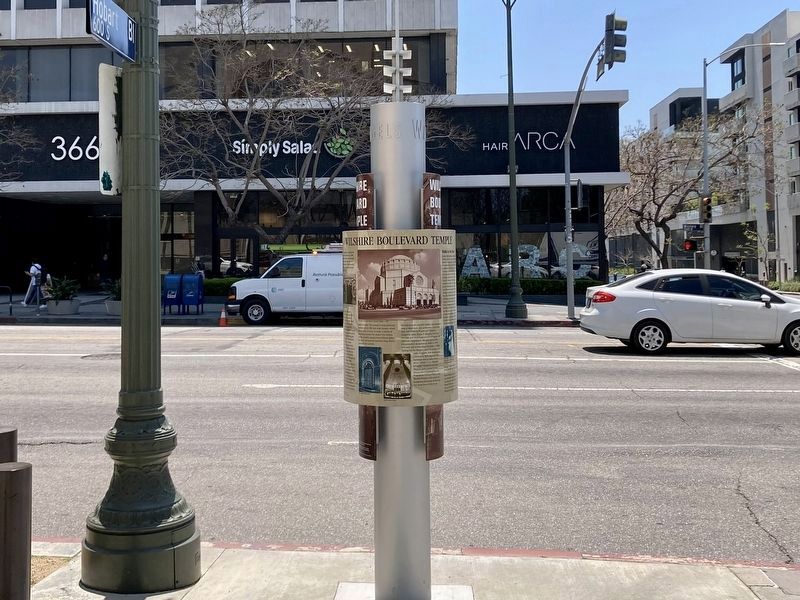
Location. 34° 3.713′ N, 118° 18.312′ W. Marker is in Los Angeles, California, in Los Angeles County. It is in Koreatown. It is at the intersection of Wilshire Boulevard and Hobart Boulevard, on the left when traveling east on Wilshire Boulevard. Touch for map. Marker is at or near this postal address: 3663 Wilshire Blvd, Los Angeles CA 90010, United States of America. Touch for directions.

Regionally, this marker is in California’s Transverse Ranges. It is also on the American Pacific Coast. Globally, it is in North America, on the Ring of Fire, in the Pacific Rim, in the Western Hemisphere, in the Western World, and in the Anglosphere. Historically, it finds itself in what was once New Spain and also Mexico’s Alta California.

Photographed by Craig Baker
4. Wilshire Boulevard Temple Markers
Other nearby markers. At least 8 other markers are within walking distance of this marker: Wiltern Theatre (approx. 0.2 miles away); Haddon Hall (approx. half a mile away); Founder’s Church (approx. 0.7 miles away); 221 St Andrews Place Residence (approx. 0.7 miles away); Thomas Churchill Residence (approx. 0.8 miles away); Cora B. Henderson House (approx. 0.8 miles away); Heart House (approx. 0.9 miles away); First See’s Candies (approx. 0.9 miles away). Touch for a list and map of all markers in Los Angeles.
Also see . . . Angels Walk L.A. Self-guided walking tours of historic neighborhoods in Los Angeles. This marker is part of the Wilshire walk. (Submitted on May 23, 2023.)
Photographed by Craig Baker
5. Wilshire Boulevard Temple Markers
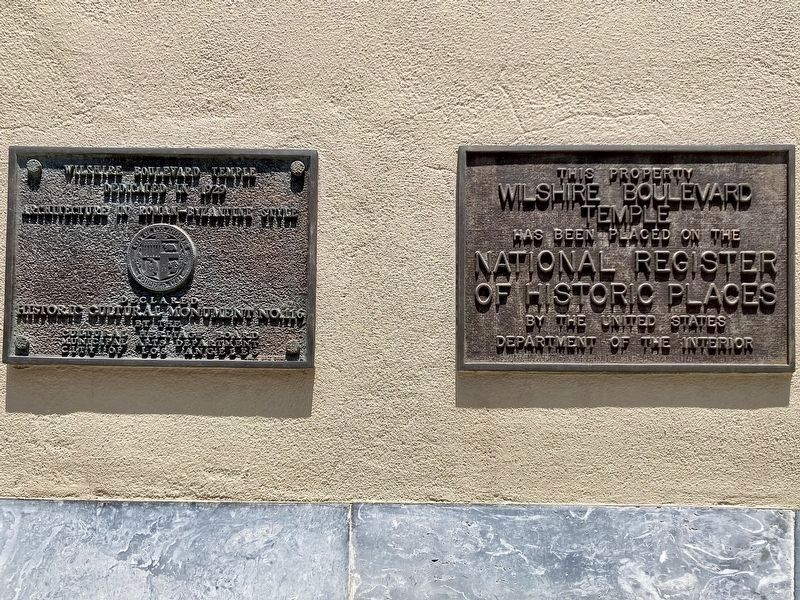
L.A. Historic-Cultural Monument No. 116, and National Register of Historic Places.
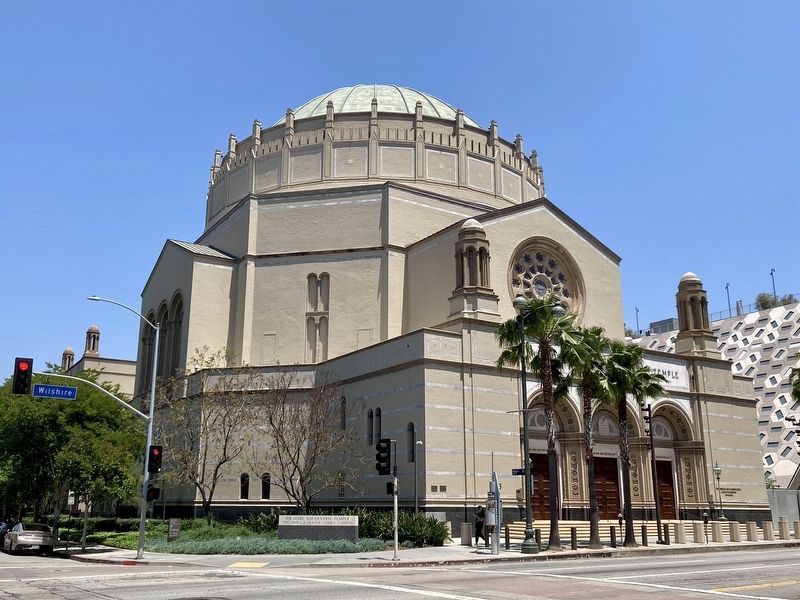
Photographed by Craig Baker
6. Wilshire Boulevard Temple

Photographed by Craig Baker, May 17, 2023
7. Wilshire Boulevard Temple
Credits. This page was last revised on August 16, 2025. It was originally submitted on May 23, 2023, by Craig Baker of Sylmar, California. This page has been viewed 872 times since then and 50 times this year. Photos: 1, 2, 3, 4, 5, 6, 7. submitted on May 23, 2023, by Craig Baker of Sylmar, California.
