Centrum in Den Haag, South Holland, Netherlands — Northwestern Europe
Martinus Nijhoff
Photographed by Andrew Ruppenstein, May 8, 2023
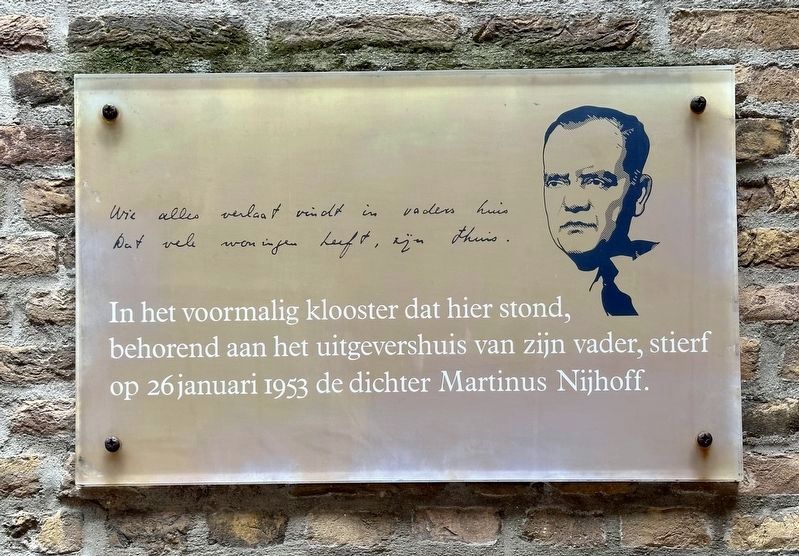
1. Martinus Nijhoff Marker

Wie alles verlaat vindt in vaders huis
Dat vele woningen heeft, zijn thuis.
In het voormalig klooster dat hier stond, behorend aan het uitgevershuis van zijn vader, stierf op 26 januari 1953 de dichter Martinus Nijhoff.
Whoever leaves everything finds in the Father's house,
that of many dwellings, a home of their own.
In the former monastery that stood here, belonging to his father's publishing house, the poet Martinus Nijhoff died on January 26, 1953.
Topics. This historical marker is listed in this topic list: Arts, Letters, Music. A significant historical date for this entry is January 26, 1953.
Location. 52° 4.933′ N, 4° 18.627′ E. Marker is in Den Haag, Zuid-Holland (South Holland). It is in Centrum. It is at the intersection of Korte Kazernestraat and Lange Voorhout, on the right when traveling north on Korte Kazernestraat. Touch for map. Marker is at or near this postal address: Lange Voorhout 10, Den Haag, Zuid-Holland 2514 ED, Netherlands. Touch for directions.

Regionally, it is in Europe, the European Union, Atlantic Europe, the Benelux Low Countries, the Schengen
this page online
Other nearby markers. At least 8 other markers are within walking distance of this marker: Pageshuis (within shouting distance of this marker); Lange Voorhout 2-4 (within shouting distance of this marker); Lange Voorhout 9 (within shouting distance of this marker); Lange Voorhout 20 (within shouting distance of this marker); Kloosterkerk / Cloister Church (within shouting distance of this marker); General Headquarters of Supreme Commander General Winkelman (within shouting distance of this marker); Lange Voorhout 13 (within shouting distance of this marker); Lange Voorhout 24 (within shouting distance of this marker). Touch for a list and map of all markers in Den Haag.
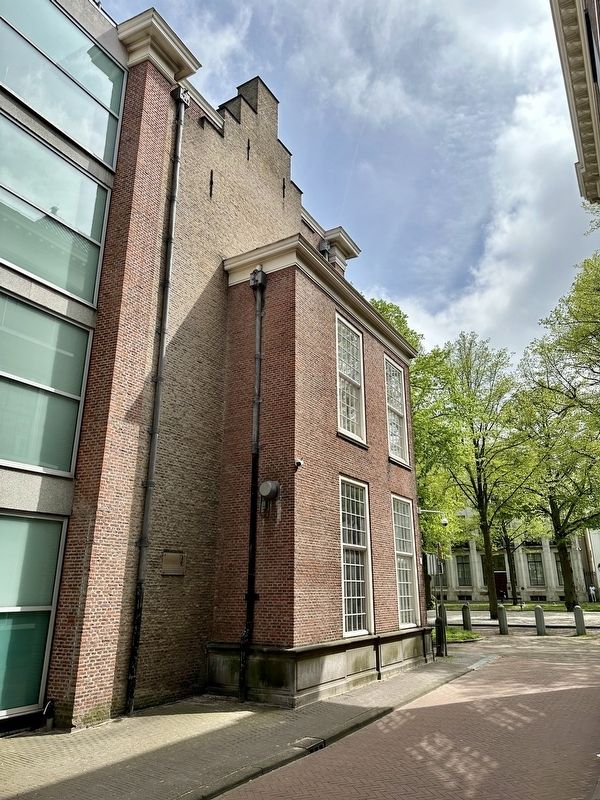
More about this marker. The marker is found in a semi-recess on the west side of the British Embassy. It’s easy to miss.
Regarding Martinus Nijhoff. The quote on the marker comes from Nijhoff’s poem Kinderkruistocht, literally, “The Children’s Crusade”, which is ostensibly about innocent children going
Photographed by Andrew Ruppenstein, May 8, 2023
2. Martinus Nijhoff Marker - wide view
Related marker. Click here for another marker that is related to this marker.
Also see . . . Martinus Nijhoff (Wikipedia).
Excerpt: Martinus Nijhoff (20 April 1894, in The Hague – 26 January 1953, in The Hague) was a Dutch poet and essayist. He studied literature in Amsterdam and law in Utrecht. His debut was made in 1916 with his volume De wandelaar ("The wanderer"). From that moment he gradually expanded his reputation by his unique style of poetry: not experimental, like Paul Van Ostaijen, yet distinguished by the clarity of his language combined with mystical content. He was a literary craftsman who employed skilfully various verse forms from different literary epochs.(Submitted on August 21, 2023.)
Some of his best-known works include Het Uur U ("H Hour", 1936) and the long poem Awater (1934). A number of individual sonnets also rose to fame, particularly De Moeder de Vrouw ("The Mother the Woman/Wife") commemorating the opening of a bridge over the river Waal near Zaltbommel. Joseph Brodsky considered the poem Awater one of the grandest poems of the 20th century. He was awarded Constantijn Huygens Prize posthumously in 1953.
Credits. This page was last revised on July 23, 2024. It was originally submitted on May 26, 2023, by Andrew Ruppenstein of Lamorinda, California. This page has been viewed 330 times since then and 28 times this year. Photos: 1, 2. submitted on May 26, 2023, by Andrew Ruppenstein of Lamorinda, California.
