Near Shiloh in Hardin County, Tennessee — The American South (East South Central)
Chickasaw Homeland
A message from the Chickasaw Nation
Photographed by David Austin
1. Chickasaw Homeland Marker
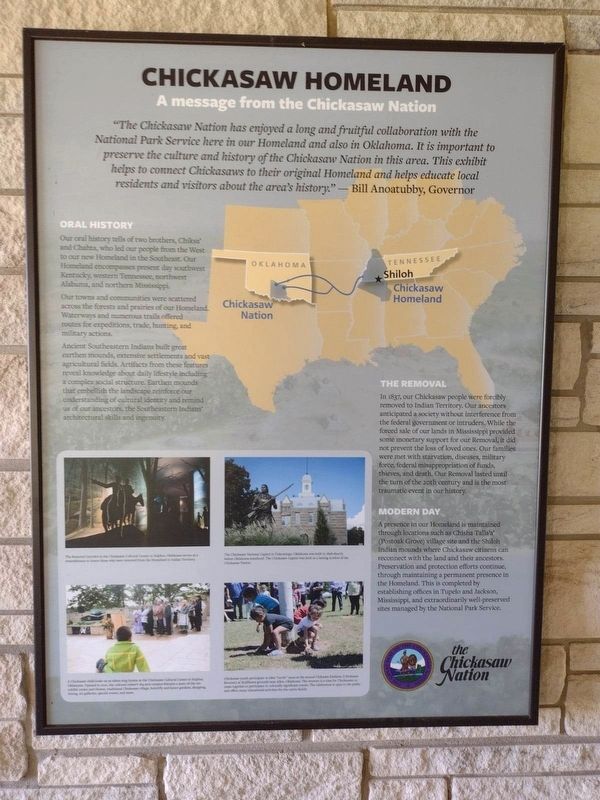
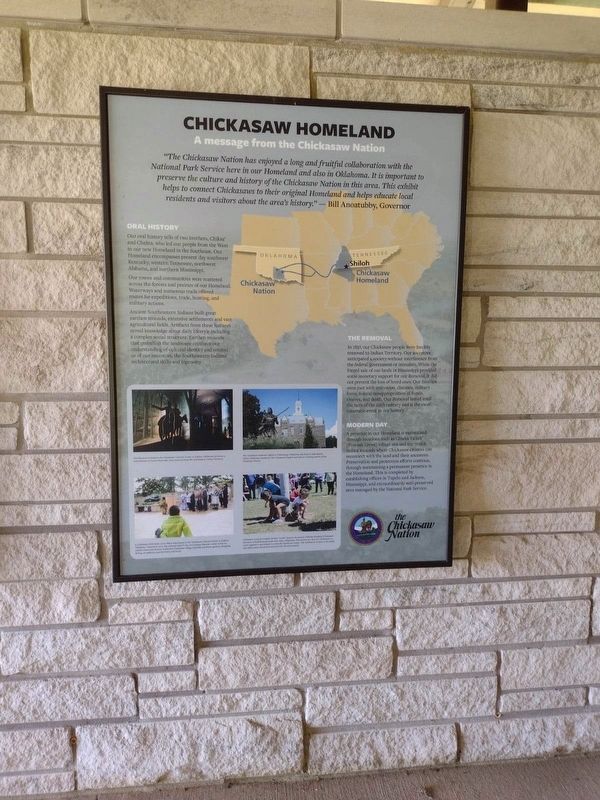
The Chickasaw Nation has enjoyed a long and faithful collaboration with the National Park Service here in our homeland and also in Oklahoma. It is important to preserve the culture and history of the Chickasaw Nation in tis area. This exhibit helps to connect Chickasaws to their original homeland and helps to educate local residents and visitors about the local history. – Bill Anoutubby, Governor.
Oral History
Our oral history tells of two brothers, Chilksa’ and Chaltra, who led our people from the West to our new homeland in the Southeast. Our homeland encompasses present day southwest Kentucky, Western Tennessee, northwest Alabama and northern Mississippi. Our towns and communities were scattered across the forests and prairies of our homeland. Waterways and numerous trails offered routes for expeditions, trade, hunting, and military actions. Ancient Southeastern Indians built great earthen mounds, extensive settlements and vast agriculture fields. Artifacts from these features reveal knowledge about daily lifestyle including a complex social structure. Earthen mounds that embellish the landscape reinforce our
this page online
The Removal
In 1837, our Chickasaw people were forcibly removed to Indian Territory. Our ancestors anticipated a society without inference from the federal government or intruders. While the forced sale of our lands in Mississippi provided some monetary support for our removal, it did not prevent the loss of loved ones. Our families were met with starvation, diseases, military force, and federal misappropriation of funds, thieves and death. Our removal lasted until the turn of the 20th Century and is the most traumatic event in our history.
Modern Day
A presence in our Homeland is maintained through locations such as Chisha Talla’a (Postoak Grove), village site and the Shiloh Indian Mounds where Chickasaw citizens can reconnect with the land and their ancestors. Preservation and protection efforts continue, through maintaining a permanent presence in the Homeland. This is completed by establishing offices in Tupelo and Jackson, Mississippi and extraordinarily well-preserved sites managed by the National
Photographed by David Austin
2. Chickasaw Homeland Marker
Erected by The Chickasaw Nation.
Topics. This historical marker is listed in these topic lists: Indigenous Peoples and Communities • Settlements & Settlers. A significant historical year for this entry is 1837.
Location. 35° 8.486′ N, 88° 19.609′ W. Marker is near Shiloh, Tennessee, in Hardin County. It can be reached from Browns Landing Road ¼ mile east of Hamburg-Savannah Road, on the left when traveling east. The marker is located at the Interpretive Shelter. Touch for map. Marker is in this post office area: Shiloh TN 38376, United States of America. Touch for directions.

Regionally, this marker is in West Tennessee. It is also in the American South and specifically in the Upper South. Globally, it is in North America, the Western Hemisphere, the Western World, and the Anglosphere. Historically, it finds itself in what was once the territory of the Mississippian Culture, one of the Confederate States of America, and the Antebellum South.
Other nearby markers. At least 8 other markers are within walking distance of this marker: Sifting the Evidence (here, next to this marker); Mississippian Indians (here, next to this marker); Camp of 17th Kentucky Infantry (a few steps from this marker); Shiloh Indian Mounds (within shouting distance of this marker); A Temporary Wall (within shouting distance of this marker); Kentucky Regiments at Battle of Shiloh (within shouting distance of this marker); Crossing the Palisade (about 400 feet away, measured in a direct line); Signs of Dwellings (about 500 feet away). Touch for a list and map of all markers in Shiloh.
Credits. This page was last revised on August 13, 2025. It was originally submitted on June 2, 2023, by David Austin of Scotts Hill, Tennessee. This page has been viewed 560 times since then and 57 times this year. Photos: 1, 2. submitted on June 2, 2023, by David Austin of Scotts Hill, Tennessee. • James Hulse was the editor who published this page.
