Trainer in Delaware County, Pennsylvania — The American Northeast (Mid-Atlantic)
The Refining Industry along the Delaware River
A thriving riverfront industry for over a century

Photographed by Carl Gordon Moore Jr., June 4, 2023
1. The Refining Industry along the Delaware River Marker
Next 2 photos were taken to help with sun glare turning up here.
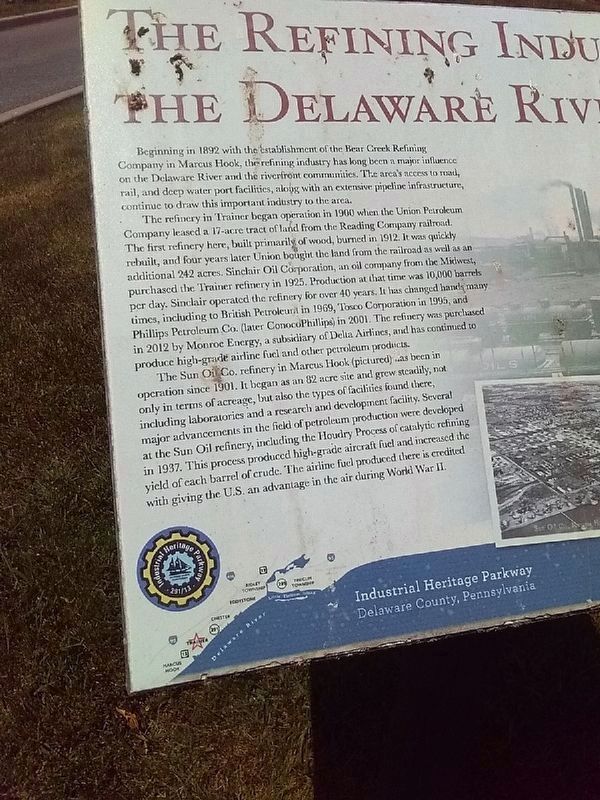
Beginning in 1892 with the establishment of the Bear Creek Refining Company in Marcus Hook, the refining industry has long been a major influence on the Delaware River and the riverfront communities. The area's access to road, rail, and deep water port facilities, along with an extensive pipeline infrastructure, continue to draw this important industry to the area.
The refinery in Trainer began operation in 1900 when the Union Petroleum Company leased a 17-acre tract of land from the Reading Company railroad. The first refinery here, built primarily of wood, burned in 1912. It was quickly rebuilt, and four years later Union bought the land from the railroad as well as an additional 242 acres. Sinclair Oil Corporation, an oil company from the Midwest, purchased the Trainer refinery in 1925. Production at that time was 10,000 barrels per day. Sinclair operated the refinery for over 40 years. It has changed hand many times, including to British Petroleum in 1969, Tosco Corporation in 1995, and Phillips Petroleum Co. (later ConocoPhillips) in 2001. The refinery was purchased in 2012 by Monroe Energy, a subsidiary
this page online
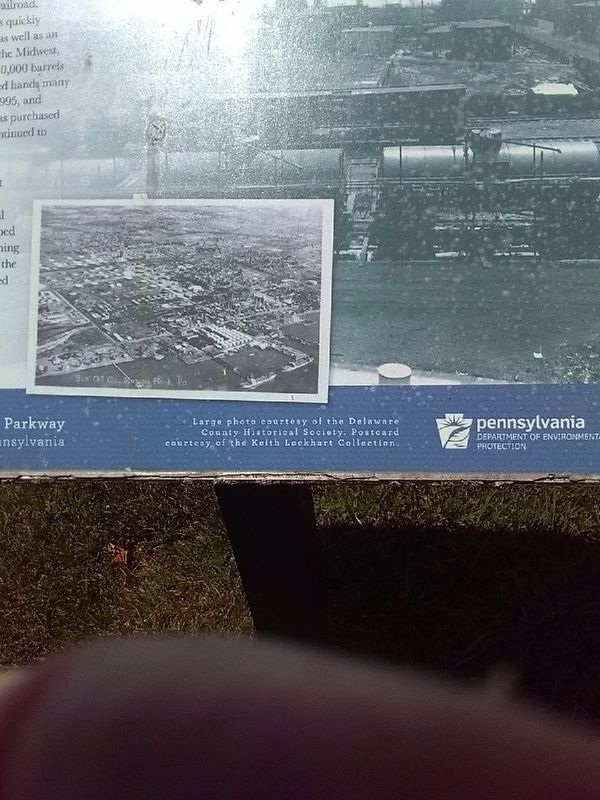
The Sun Oil Co. refinery in Marcus Hook (pictured) has been in operation since 1901. It began as an 82 acre site and grew steadily, not only in terms of acreage, but also the types of facilities found there, including laboratories and a research and development facility. Several major advancements in the field of petroleum production were developed at the Sun Oil refinery, including the Houdry Process of catalytic refining in 1937. This process produced high-grade aircraft fuel and increased the yield of each barrel of crude. The airline fuel produced there is credited with giving the U.S. an advantage in the air during World War II.
Industrial Heritage Parkway
Delaware County, Pennsylvania
Large photo courtesy of the Delaware
County Historical Society. Postcard
courtesy of the Keith Lockhart Collection.
Pennsylvania
Department of Environmental
Protection
Erected by Industrial Heritage Parkway, Delaware County, Pennsylvania.
Topics. This historical marker is listed in this topic list: Industry & Commerce. A significant historical year for this entry is 1892.
Location. 39° 49.587′ N,
Photographed by Carl Gordon Moore Jr., June 4, 2023
2. The Refining Industry along the Delaware River Marker

Regionally, this marker is in Southeast Pennsylvania and in Greater Philadelphia. It is also in the American Northeast and in the Mid-Atlantic. Globally, it is in North America, the Western Hemisphere, the Western World, and the Anglosphere. Historically, it finds itself in what was once the Haudenosaunee (Iroquois) Confederacy, New Netherland, and one of the original Thirteen Colonies.
Other nearby markers. At least 8 other markers are within walking distance of this marker: The Factory and the Village (approx. half a mile away); Marcus Hook, PA (approx. half a mile away); American Viscose Co. (approx. half a mile away); Marcus Hook World War I Memorial (approx. 0.8 miles away); Marcus Hook World War II Veterans (approx. 0.8 miles away); James B. ‘Mickey’ Vernon (approx. 0.8 miles away); The Soldier and Sailor Walk Memorial
Photographed by Carl Gordon Moore Jr., June 4, 2023
3. The Refining Industry along the Delaware River Marker

Photographed by Carl Gordon Moore Jr., June 4, 2023
4. The Refining Industry along the Delaware River Marker
View from across US 13. On the right, obscured by vegetation, is stone plaque engraved "Trainer School".
Credits. This page was last revised on June 22, 2023. It was originally submitted on June 6, 2023, by Carl Gordon Moore Jr. of North East, Maryland. This page has been viewed 497 times since then and 98 times this year. Photos: 1, 2, 3, 4. submitted on June 6, 2023, by Carl Gordon Moore Jr. of North East, Maryland. • Bill Pfingsten was the editor who published this page.
