Segundo in Ponce in Municipio de Ponce, Puerto Rico — The Caribbean (The West Indies)
La Danza Puertorriqueña
[The Puerto Rican Danza]
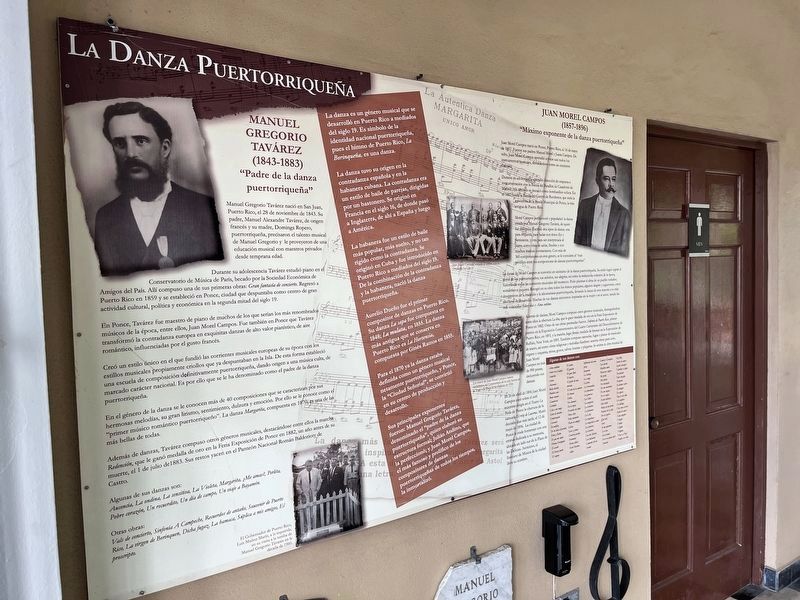

La danza es un género musical que se desarrolló en Puerto Rico a mediados del siglo 19. Es símbolo de la identidad nacional puertorriqueña, pues el himno de Puerto Rico, La Borinqueña, es una danza.
La danza tuvo su origen en la contradanza española y en la habanera cubana. La contradanza era un estilo debaile de parejas, dirigidas por un bastonero. Se originó en Francia en el siglo 16, de donde pasó a Inglaterra, de ahí a España y luego a América.
La habanera fue un estilo de baile más popular, más suelto, y no tan rígido como la contradanza. Se originó en Cuba y fue introducido en Puerto Rico a mediados del siglo 19. De la combinación de la contradanza y la habanera, nació la danza puertorriqueña.
Aurelio Dueño fue el primer compositor de danzas en Puerto Rico. Su danza La sapa fue compuesta en 1848; La mulata, en 1855. La danza más antigua que se conserva en Puerto Rico es La Hortensia, compuesta por Ginés Ramos en 1855.
Para el 1870 y la danza estaba definida como un género musical netamente puertorriqueño, y Ponce, la "Ciudad Señorial", se convirtió en su centro de producción y desarrollo.
Sus
this page online
(1843 - 1883)
"Padre de la danza puertorriqueña"
Durante su adolescencia Tavárez estudió piano en el Conservatorio de Música de Paris, becado por la Sociedad Económica de Amigos del País. Allí compuso una de sus primeras obras: Gran fantasia de concierto. Regresó a Puerto Rico en 1859 y se estableció en Ponce, ciudad que despuntaba como centro de gran actividad cultural, política y económica en la segunda mitad del siglo 19.
En Ponce, Tavárez fue maestro de piano de muchos de los que serían

Photographed by Unknown [Courtesy of Wikimedia Commons]
2. Portrait of Puerto Rican composer Manuel Gregorio Tavárez
Creó un estilo único en el que fundió las corrientes musicales europeas de su época con los estillos musicales propiamente criollos que ya despuntaban en la Isla. De esta forma estableció una escuela de composición definitivamente puertorriqueña, dando origen a una música culta, de marcado carácter nacional. Es por ello que se le ha denominado como el padre de la danza puertorriqueña.
En el género de la danza se le conocen más de 40 composiciones que se caracterizan por sus hermosas melodías, su gran lirismo, sentimiento, dulzura y emoción. Por ello se le conoce como el "primer músico romántico puertorriqueño". La danza Mararita, compuesta en 1870, es una de las más bellas de todas.
Además de danzas, Tavárez compuso otros géneros musicales, destacándose entre ellos la marcha Redención, que le ganó medalla de oro en la Feria Exposición de Ponce en 1882, un año antes de su muerte, el 1 de julio de 1883. Sus restos yacen en el Pantéon Nacional Román Baldorioty de Castro.
Algunas de sus danzas son: Ausencia, La ondina, La sensitiva, La Violeta, Margarita, ¿Me amas?, Perlita, Pobre corazón, Un recuerdito, Un día campo, Un viaje a Bayamón.
Otras obras:
Vals de concierto, Sinfonía A Campeche, Recuerdaos de antaño, Souvenir de Puerto Rico, La virgen de Borinquen, Dicha fugaz, La hamaca, Súplica a mis amigos, El proscripto.
(1857 - 1896)
"Máximo exponente de la danza puertorriqueña"
Durante su adolescencia aprendió dirección de orquesa e instrumentación con la Banda del Batallón de Cazadores de Madrid. Allí tambien se destacó como bombardino solista. En el 1882 fundó la Banda del Cuerpo de Bomberos, que sería la antecesora de la Banda Municipal de Ponce, la más antigua de Puerto Rico.
Morel Campos perfeccionó y popularizó la danza creada por Manuel Gregorio Tavárez, de quien fue discípulo. Escribió dos tipos de danza: una para orquesta, para bailar con ritmo fijo y persistente, y otra para ser interpretada al pianocomo obra de salón, flexible y con muchos matíces contrastantes. Con más de 360 composiciones en este género, se le considera el "más prolífico entre los compositores de danzas puertorriqueñas".
La danza de Morel Campos se convertió en sinónimo de la danza puertorrequeña. Su estilo logró captar el sentir de los puertorriqueños, sus anhelos, sus alegrías, así como la melancolía colectiva de la época, fusionando todas las corrientes musicales del momento. Pudo plasmar el alma de un pueplo soñador, romántico e inquieto. Recogió en su obra todos los ritmos populares algunos alegres y juguetones, otros descriptivos de la tradición y la idiosincrasia puertorriqueña, llevando la danza de esta manera a su más alto nivel de desarrolo. Mucas de sus danzas estuvieron inspiradas en la mujer y en el amor, siendo las más conocidas Felices días y Alma sublime.
Además de danzas, Morel Campos compuso otros géneros musicales, distinguiéndose entre ellos la obertura La lira, que le ganó medalla de oro en la Feria Exposición de Ponce en 1882. Otras de sus obras premiadas fueron: Sinfonia de Puerto Rico, su primer premio en la Exposición Conmemorativa del Cuarto Centenario del Descubrimiento de Puerto Rico, en 1893, y la marcha Juegas florales, medalla de bronce en la Exposición de Buffalo, New York, en 1895. También compuso zarzuelas, fugas y piezas de musicales de teatro, así como obras religiosas y melodías, fúnebres: sesenta obras para coro, órgano y orquesta, misas, gozos, salves, letanías y plegarias. Se estima la obra musical de Juan Morel Campos en más de 900 piezas, incluyendo sus danzas.
El 26 de abril de 1896 Juan Morel Campos cayó sobre el atril mientras dirigía en el Teatro La Perla de Pocne la obertura de la zarzuela El reloj de Lucerna. Murió dieciséis días más tarde, el 12 de mayo de 1896. La ciudad de Ponce le rinde homenaje con una estatua dedicada a su memoria, ubicada en lado sur de la Plaza de las Delicias. Asimismo, el Instituto de Música de la ciudad lleva su nombre.
Danza is a musical genre that developed in Puerto Rico in the mid-19th century. It is a symbol of Puerto Rican national identity, since the Puerto Rican anthem, La Borinqueña, is a danza.
The danza had its origin in the Spanish contradanza and the Cuban habanera. The contradanza was a danza style for couples, led by a bastonero. It originated in France in the 16th century, from where it passed to England, from there to Spain and then to America.
The habanera was a more popular danza style, looser, and not as rigid as the contradanza. It originated in Cuba and was introduced to Puerto Rico in the mid-19th century. From the combination of the contradanza and the habanera, the Puerto Rican danza was born.
Aurelio Dueño was the first danza composer in Puerto Rico. The danza of his, La sapa, was composed in 1848; La mulata, in 1855. The oldest danza preserved in Puerto Rico is La Hortensia, composed by Ginés Ramos in 1855.
By 1870, danza was defined as a purely Puerto Rican musical genre, and Ponce, the "Ciudad Señorial", became its center of production and development.
Its main composers were: Manuel Gregorio Tavárez, called the "father of Puerto Rican danza", who elaborated its formal structure; Julián Andino, who perfected it; and Juan Morel Campos, the most famous and prolific of Puerto Rican danza composers of all time, immortalized it.
(1843 - 1883)
"Father of Puerto Rican Danza"
During his adolescence, Tavárez studied piano at the Paris Conservatory of Music, with a scholarship from the Sociedad Económica de Amigos del País. There he composed one of his first works: Great concert fantasy. He returned to Puerto Rico in 1859 and settled in Ponce, a city that was emerging as a center of great cultural, political, and economic activity in the second half of the 19th century.
In Ponce, Tavárez taught piano to many who would become the most renowned musicians of their time, including Juan Morel Campos. It was also in Ponce that Tavárez transformed the European contradanza into exquisite danzas of high piano value, with a romantic air, influenced by French taste.
He created a unique style in which he fused the European musical currents of his time with the typical Creole musical styles that were already emerging on the Island. In this way, he established a uniquely Puerto Rican school of composition, giving rise to cultured music, with a marked character. national. That is why he has been called the father of Puerto Rican danza.
In the danza genre, more than 40 compositions are known, characterized by their beautiful melodies, their great lyricism, feeling, sweetness and emotion. For this reason he is known as the "first Puerto Rican romantic musician". The danza Mararita, composed in 1870, is one of the most beautiful of all.
In addition to danzas, Tavárez composed other musical genres, among them the Redemption march, which won him a gold medal at the Ponce Exhibition Fair in 1882, one year before his death on July 1. from 1883. His remains lie in the Román Baldorioty de Castro National Pantheon.
Some of his danzas are: Absence, The undine, The sensitive, La Violeta, Margarita, Do you love me?, Perlita, Poor heart, A little memory, A field day, A trip to Bayamón.
Other works:
Concert waltz, A Campeche Symphony, Remember from yesteryear, Souvenir from Puerto Rico, The Virgin of Borinquen, Fleeting joy, The hammock, Plead to my friends, The outlaw.
(1857 - 1896)
"Most prolific composer of Puerto Rican danza"
During his adolescence he learned orchestra conducting and instrumentation with the Madrid Hunters Battalion Band. There he also stood out as a soloist euphonium. In 1882 he founded the Fire Department Band, which would be the predecessor of the Ponce Municipal Band, the oldest in Puerto Rico.
Morel Campos perfected and popularized the danza created by Manuel Gregorio Tavárez, of whom he was a disciple. He wrote two types of danza: one for orchestra, to be danced with a fixed and persistent rhythm, and another to be performed on the piano as a flexible salon work with many contrasting nuances. With more than 360 compositions in this genre, he is considered the "most prolific composer of Puerto Rican danzas."
Morel Campos's danza became synonymous with Puerto Rican danza. His style captured the feelings of Puerto Ricans, their desires, their joys, as well as the collective melancholy of the time, fusing all the musical currents of the moment. He was able to capture the soul of a dreamy, romantic and restless people. He captured in his work all the popular rhythms, some cheerful and playful, others descriptive of the Puerto Rican tradition and idiosyncrasy, thus taking danza to its highest level of development. Many of his danzas were inspired by women and love, the best known being Happy days and Sublime soul .
Besides danzas, Morel Campos composed other musical genres, among them the overture La lira, which won him a gold medal at the Ponce Exhibition Fair in 1882. Other of his awarded works were: Sinfonia de Puerto Rico, its first prize at the Commemorative Exposition of the Fourth Centennial of the Discovery of Puerto Rico, in 1893, and the march Juegas florales, bronze medal at the Buffalo Exposition, New York, in 1895. He also composed zarzuelas, fugues and pieces of theater musicals, as well as religious works and melodies, funerals: sixty works for choir, organ and orchestra, masses, joys, salves, litanies and prayers. The musical work of Juan Morel Campos is estimated at more than 900 pieces, including his danzas.
On April 26, 1896, Juan Morel Campos fell on the lectern while directing the overture to the zarzuela El reloj de Lucerna at the Teatro La Perla in Ponce. He died sixteen days later, on May 12, 1896. The city of Ponce honors him with a statue dedicated to his memory, located on the south side of the Plaza de las Delicias. Likewise, the city's Music Institute bears his name.
Topics. This historical marker is listed in these topic lists: Arts, Letters, Music • Entertainment. A significant historical date for this entry is April 26, 1896.
Location. 18° 0.931′ N, 66° 37.065′ W. Marker is in Ponce in Municipio de Ponce, Puerto Rico. It is in Segundo. It is at the intersection of Calle Frontispicio and Simon de la Torre, on the right when traveling west on Calle Frontispicio. The marker hangs on the wall in an open-air structure. Touch for map. Marker is at or near this postal address: Calle Frontispicio 38, Ponce PR 00730, United States of America. Touch for directions.

Regionally, this marker is on the Southern Coastal Zone. Globally, it is one of the Greater Antilles on the Caribbean Sea, on in the Atlantic Ocean, in North America, in the Western Hemisphere, in the Western World, and in the Anglosphere. Historically, it finds itself in what was once a Spanish colony.
Other nearby markers. At least 8 other markers are within walking distance of this marker: Antiguo Cementario de las Calles Frontisipicio y Simón de la Torre (a few steps from this marker); Primera Iglesia Buatista de Ponce (approx. 0.4 kilometers away); José Luis "Cheo" Feliciano Vego (approx. 0.4 kilometers away); Puerto Rico Quincentenary Memorial (approx. half a kilometer away); a different marker also named Puerto Rico Quincentenary Memorial (approx. half a kilometer away); Luis Muñoz Rivera (approx. half a kilometer away); Don Julio Stenacher (approx. 0.6 kilometers away); The Building / El Edificio (approx. 0.6 kilometers away). Touch for a list and map of all markers in Ponce.
Credits. This page was last revised on January 5, 2026. It was originally submitted on June 10, 2023, by Devry Becker Jones of Washington, District of Columbia. This page has been viewed 1,747 times since then and 189 times this year. Photos: 1. submitted on June 10, 2023, by Devry Becker Jones of Washington, District of Columbia. 2. submitted on January 5, 2026.
Editor’s want-list for this marker. A wide shot of the marker in context. • Can you help?
