Historic District in Wilmington in New Hanover County, North Carolina — The American South (South Atlantic)
Hogg-Anderson House
c.1813

Photographed by Cosmos Mariner, May 15, 2023
1. Hogg-Anderson House Marker
Federal style house built for John Hogg (1765-1826), native of Scotland, merchant, legislator and banker. Purchased in 1829 by Alexander Anderson (1785-1844), native of Scotland, merchant. Addition built c.1844 by formerly enslaved builder, Soloman W. Nash. Inherited in 1844 by son, James Anderson (1813-1889), merchant. The house remained in the family until 1889. Between 1917 and 1926 it served as the Salvation Army Home for Unwed Mothers. In 1968 it was purchased and preserved by co-founders of Historic Wilmington Foundation, Inc. Thomas H. and Elizabeth Wright.
Preservation Leadership since 1966
Erected by Historic Wilmington Foundation, Inc.
Topics and series. This historical marker is listed in these topic lists: African Americans • Architecture • Charity & Public Work • Industry & Commerce. In addition, it is included in the North Carolina, Historic Wilmington Foundation series list. A significant historical year for this entry is 1813.
Location. 34° 13.966′ N, 77° 56.866′ W. Marker is in Wilmington, North Carolina, in New Hanover County. It is in the Historic District.
this page online

Regionally, this marker is in the Coastal Plain and on the Cape Fear Coast. It is also in the American South, specifically in the Upper South, in the Tidewater, and on the Eastern Seaboard. Globally, it is in the North Atlantic Region, North America, the Western Hemisphere, the Western World, and the Anglosphere. Historically, it finds itself in what was once the territory of the Mississippian Culture, one of the original Thirteen Colonies, one of the Confederate States of America, and the Antebellum South.
Other nearby markers. At least 8 other markers are within walking distance of this marker: Dr. Anderson's Office (within shouting distance of this marker); St. John's Lodge (within shouting distance of this marker); Mitchell-Anderson House (within shouting distance of this marker); Cowan House
Photographed by Cosmos Mariner, May 15, 2023
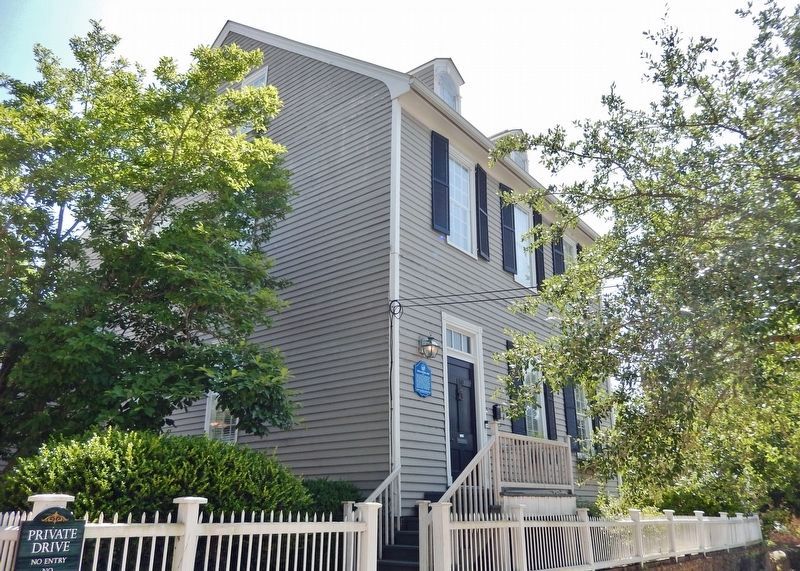
2. Hogg-Anderson House (northeast elevation)
Regarding Hogg-Anderson House. Contributing Property, Wilmington Historic and Archeological District, National Register of Historic Places #74001364.
From the National Register Nomination:
2½ story Federal, side passage house, supposedly incorporating an 18th century house. Three light transom, 9 over 9 sash, attic dormers with arched windows surrounded by pilasters and keystone motif. House has been heavily restored.
Also see . . .
1. Hogg-Anderson House.
Wilmington memoirist Nicholas Schenck noted the house as that of “Jas. Anderson, built by Sol. Nash.” Schenck’s account (ca. 1905) recalled his youth in antebellum Wilmington, when James Anderson was living in the house, so his information seems credible. It is possible that Nash built this house (and(Submitted on June 25, 2023, by Cosmos Mariner of Cape Canaveral, Florida.)others) while he was still a slave, or he might have built it ca. 1829 (after Nash was freed in 1827) for James Anderson.Photographed by Cosmos Mariner, May 15, 20233. Hogg-Anderson House (north/front elevation)

2. Solomon W. Nash.
Solomon Waddell Nash, Sr. (1779-1846) was an African-American carpenter in antebellum Wilmington before and after he was emancipated in 1827. During his career as a builder, especially in the 1830s, Nash worked and spent time in both Wilmington and Fayetteville, port cities linked by trade along the Cape Fear River, both known for their many free people of color.(Submitted on June 25, 2023, by Cosmos Mariner of Cape Canaveral, Florida.)
3. Wilmington Historic and Archeological District. (Submitted on June 25, 2023, by Cosmos Mariner of Cape Canaveral, Florida.)
Credits. This page was last revised on June 25, 2023. It was originally submitted on June 24, 2023, by Cosmos Mariner of Cape Canaveral, Florida. This page has been viewed 1,459 times since then and 123 times this year. Photos: 1, 2, 3. submitted on June 25, 2023, by Cosmos Mariner of Cape Canaveral, Florida.
