Mystic in Stonington in Southeastern Region, Connecticut — The American Northeast (New England)
The History of the Charles W. Morgan
Charles W. Morgan
| — | Mystic Seaport Museum | — |
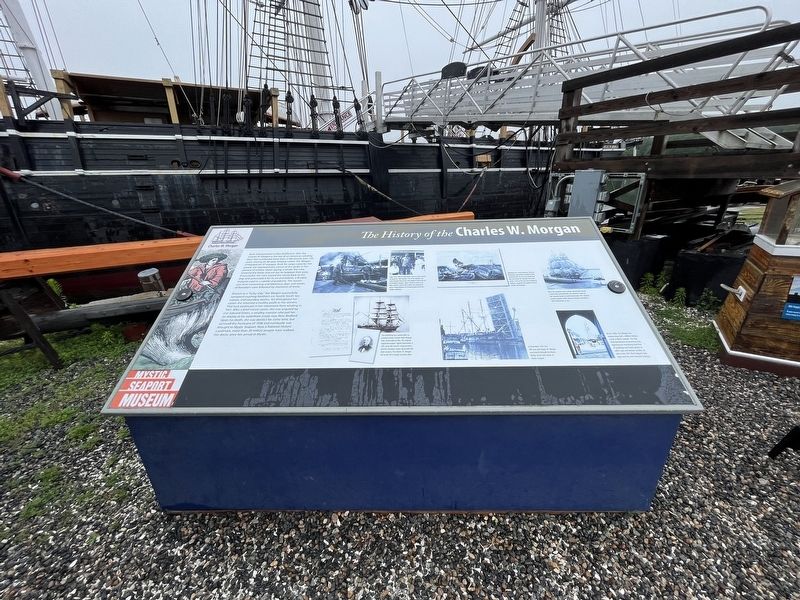
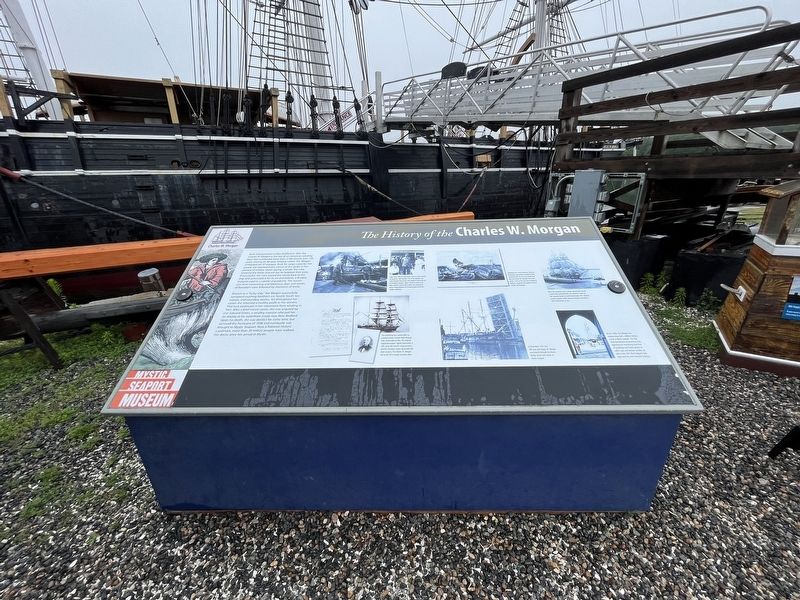
Built and launched in New Bedford in 1841, the Charles W. Morgan is the last of an American whaling fleet that numbered more than 2,700 vessels over 150 years. During an 80-year whaling career, the Morgan embarked on 37 voyages. Built for cargo capacity, not speed, she roamed every corner of the globe in her pursuit of whales. Upon spying a whale, the crew lowered the boats and set out to harpoon their prey. If successful, the men towed the whale back to the ship and processed it for its oil and baleen, a flexible material used in a variety of products. The search was time-consuming and laborious; days and weeks of boredom were followed by moments of terror.
Known as a "lucky ship," the Morgan successfully navigated crushing Northern ice, hostile South Sea natives, and countless storms. Yet throughout her career she returned a healthy profit for her owners. that luck continued in her retirement from whaling in 1921. After a brief movie career, she was acquired by Col. Edward Green, a wealthy investor who put her on display at his waterfront estate near New Bedford. Upon his death, she was derelict for some time, but
this page online
[Captions:]
Capt. Earle with his wife Honor and son Jamie posed on board in 1903 (above). Five of the Morgan captains brought their wives and children with them on the lengthy voyages. Jamie stands on deck in his light summer suit (at left), while to whalemen mince whale blubber for rendering into oil in the smoky cauldrons.
The whaleship was named after its principal owner, Charles Waln Morgan (left, shown later in life). The original registeration paper, signed September 4, 1841, gives the vessel's measurements and lists Morgan's name along with the other owners. The Charles W. Morgan left on her first voyage two days later.
Whaling was a risky business. Disease, drowning, and bodily mutilation were common risks for men on whaleships like the Charles W. Morgan. Dramatic prints, such as this one by Cornelius B. Hulsart, depicted the battle between whales and humans.
After her whaling career ended, the Morgan found a new home at Round Hill, the summer estate of Col. Edward Green in South Dartmouth, MA. Retired whalers guided 1920s visitors onboard and told of their adventures at sea.
In November, 1941, the 100-year-old Charles W. Morgan was towed through the Mystic Bridge to her new home at Mystic Seaport.
By the 1960s, the Morgan was helping draw half a millions visitors a year to Mystic Seaport. The ship itself had become an American icon, appearing on everything from fine art paintings and family photos to coffee cups and kitchen curtains, as well as this 1961 New England roadmap cover by artist Howard Terpning.
Erected by Mystic
Topics and series. This historical marker is listed in these topic lists: Animals • Industry & Commerce • Landmarks • Waterways & Vessels. In addition, it is included in the National Historic Landmarks series list. A significant historical date for this entry is September 4, 1841.
Location. 41° 21.737′ N, 71° 57.902′ W. Marker is in Stonington in Southeastern Region, Connecticut. It is in Mystic. It can be reached from Greenmanville Avenue (Connecticut Route 27) south of Hinckley Street, on the left when traveling north. Touch for map. Marker is at or near this postal address: 75 Greenmanville Avenue, Mystic CT 06355, United States of America. Touch for directions.

Regionally, this marker is on the Connecticut Shoreline, in Greater New London, in Mystic and the Eastern Shore, and in the Thames River Valley. It is also in the American Northeast, in New England, and on the Eastern Seaboard. Globally, it is in the North Atlantic Region, North America, the Western Hemisphere, the Western World, and the Anglosphere. Historically, it finds itself in what was once New London County and also one of the original Thirteen Colonies.
Other nearby markers. At least 8 other markers are within walking distance of this marker: Whaleship Charles W. Morgan (here, next to this marker); Connecting Cultures (here, next to this marker); Fishing Schooner L.A. Dunton (a few steps from this marker); Changing Perceptions of the Natural World (a few steps from this marker); Clara Tinkham’s Cabin (a few steps from this marker); Perils and Profits (a few steps from this marker); The Amistad – Flagship of Connecticut (within shouting distance of this marker); Research Submersible Asherah (within shouting distance of this marker). Touch for a list and map of all markers in Stonington.
Additional keywords. The History of the Charles W. Morgan
Credits. This page was last revised on May 19, 2026. It was originally submitted on June 28, 2023, by Devry Becker Jones of Washington, District of Columbia. This page has been viewed 199 times since then and 25 times this year. Photos: 1, 2. submitted on June 28, 2023, by Devry Becker Jones of Washington, District of Columbia.
