Beasley in Hamilton, Ontario — Central Canada (North America)
The City of Hamilton Cenotaph

Photographed by Tim Boyd, April 3, 2023
1. The Cenotaph Marker
[west side]
Our Glorious Dead
1914-18
1939-45
1950 Korea 1953
[south side]
Afghanistan
2001-2014
Erected 1923 by The Canadian Club of Hamilton.
Topics. This historical marker is listed in these topic lists: War, Afghanistan • War, Korean • War, World I • War, World II. A significant historical date for this entry is May 22, 1923.
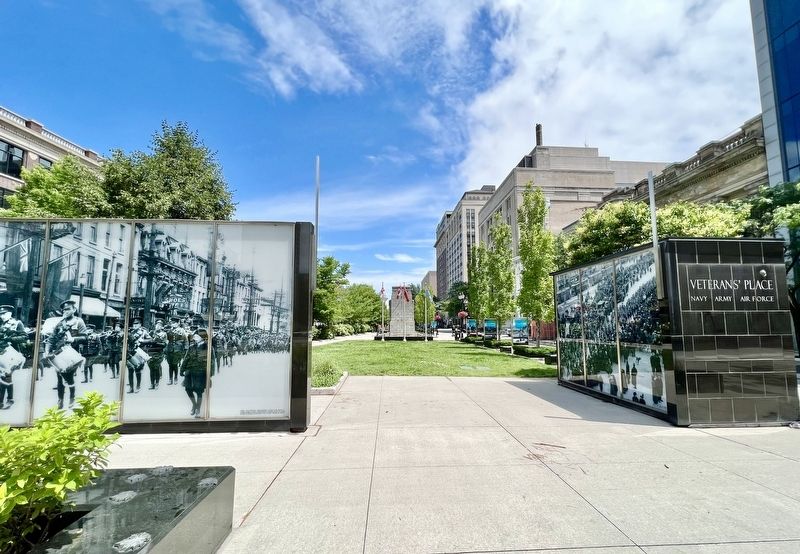
Location. 43° 15.355′ N, 79° 52.035′ W. Marker is in Hamilton, Ontario. It is in Beasley. It is at the intersection of King Street East and John Street South, on the left when traveling west on King Street East. The Cenotaph is in Veteran’s Place, part of Gore Park. Touch for map. Marker is in this post office area: Hamilton ON L8N 1A6, Canada. Touch for directions.

Regionally, this marker is on the Golden Horseshoe, in the Hamilton-Halton-Brant Area, and specifically in the Toronto Metropolitan Area. It is also in Central Canada. Globally, it is in North America, on the Great Lakes, in the Western Hemisphere, in the Western World, and in the Anglosphere. Historically, it finds itself in what was once a British colony, the Viceroyalty of New France, the Haudenosaunee (Iroquois) Confederacy, and Rupert’s Land.
Other nearby markers. At least 8 other markers are within walking distance of this marker: Former Dominion Public Building (within shouting distance of this marker); Sir John Morison Gibson (within shouting distance of this marker); The Right House (now Park Place) (within shouting distance of this marker); George Hamilton 1787-1836 (about 120 meters away, measured in a direct line); The United Empire Loyalists (about 150 meters away); Pigott Building (about 180 meters away); 47 James Street South (about 180 meters away); The First Telephone Exchange in the British Empire (about 180 meters away). Touch for a list and map of all markers
this page online
Also see . . . Hamilton Public Library- Cenotaph.
The Cenotaph was erected through the efforts of the Canadian Club of Hamilton to commemorate “Our Glorious Dead” who sacrificed their lives during the First World War. The plan to construct the Cenotaph was initially proposed by John Stephen, President of the Canadian Club of Hamilton on Thursday, June 23, 1921. It was to replace the Canadian Club flag pole. The architect who was chosen to design the Cenotaph was William Russell Souter (1894-1971). Souter was an up and coming architect who was a partner in the Hutton and Souter architectural firm. The monument was estimated to cost between five and six thousand dollars. President Stephen felt the funds required could be raised by all of the Canadian Clubs in Hamilton.(Submitted on July 3, 2023, by Tim Boyd of Hamilton, Ontario.)

Photographed by Tim Boyd, July 3, 2023
2. The City of Hamilton Cenotaph, south side
Photographed by Tim Boyd, July 3, 2023
3. The City of Hamilton Cenotaph in Veteran’s Place, Gore Park

1923
4. The City of Hamilton Cenotaph at its unveiling, May 22, 1923
Hamilton Public Library archives
Credits. This page was last revised on July 9, 2023. It was originally submitted on July 3, 2023, by Tim Boyd of Hamilton, Ontario. This page has been viewed 348 times since then and 30 times this year. Photos: 1, 2, 3, 4. submitted on July 3, 2023, by Tim Boyd of Hamilton, Ontario. • Andrew Ruppenstein was the editor who published this page.
