Tha Ma Kham in Amphoe Mueang Kanchanaburi, Kanchanaburi, Thailand — ประเทศไทย (Southeast Asia, Indochinese Peninsula)
The Bridge Over the River Kwae
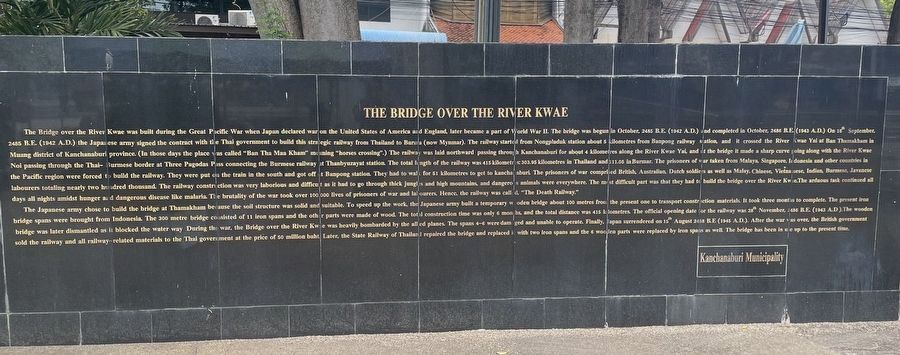
Photographed by Jj Karwacki, July 4, 2023
1. The Bridge Over the River Kwae Commemorative Wall
On 16 September, 2485 B.E. (1942 A.D.) the Japanese army signed the contract with the Thai government to build this strategic railway from Thailand to Burua (now Myanmar). The railway started from Nongpladuk station about 5 kilometres from Banpong railway station, and it crossed the River Kwae Yai at Ban Thamakham in Muang district of Kanchanaburi province. (In those days the place was called "Ban Tha Maa Kham" meaning "horses crossing".) The railway was laid northward passing through Kanchanaburi for about 6 kilometres along the River Kwae Yai, and at the bridge it made a sharp curve going along with the River Kwae Noi passing through the Thai- Burmese border at Three Pagodas Pass connecting the Burmese railway at Thanbyuzayat station. The total length of the railway was 415 kilometres,
this page online
The prisoners of war taken from Malaya, Singapore, Indonesia and other countries in the Pacific region were forced to build the railway. They were put on the train in the south and got off at Banpong station. They had to walk for 51 kilometres to get to Kanchanaburi. The prisoners of war comprised British, Australian, Dutch soldiers as well as Malay, Chinese, Vietnamese, Indian, Burmese, Javanese labourers totaling nearly two hundred thousand. The railway construction was very laborious and difficult as it had to go through thick jungles and high mountains, and dangerous animals were everywhere. The most difficult part was that they had to build the bridge over the River Kwae. The arduous task continued all days all nights amidst hunger and dangerous disease like malaria. The brutality of the war took over 100.000 lives of prisoners of war and labourers. Hence, the railway was called, “The Death Railway.”
The Japanese army chose to build the bridge at Thamakham because the soil structure was solid and suitable. To
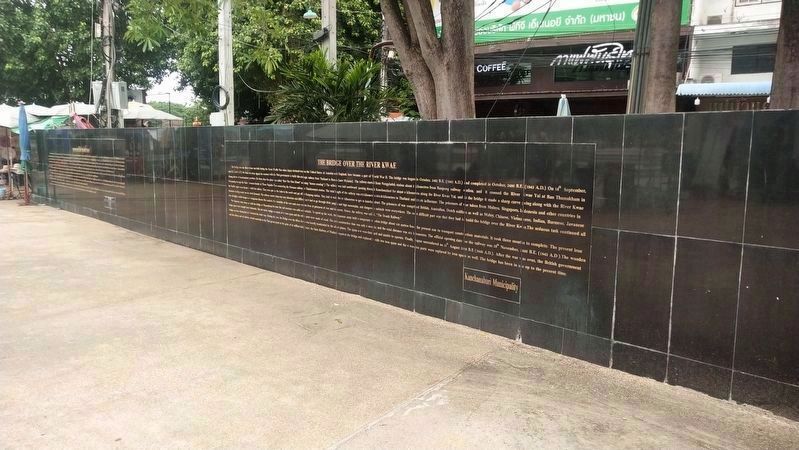
Photographed by Jj Karwacki, July 4, 2023
2. The Bridge Over the River Kwae Commemorative Wall
This granite-wall monument has the Thai inscription on the left (in the distance) and the English inscription on the right.
After the war was over, the British government sold the railway and all railway-related materials to the Thai government at the price of 50 million baht. Later, the State Railway of Thailand repaired the bridge and replaced it with two iron spans and the 6 wooden parts were replaced by iron spans as well. The bridge
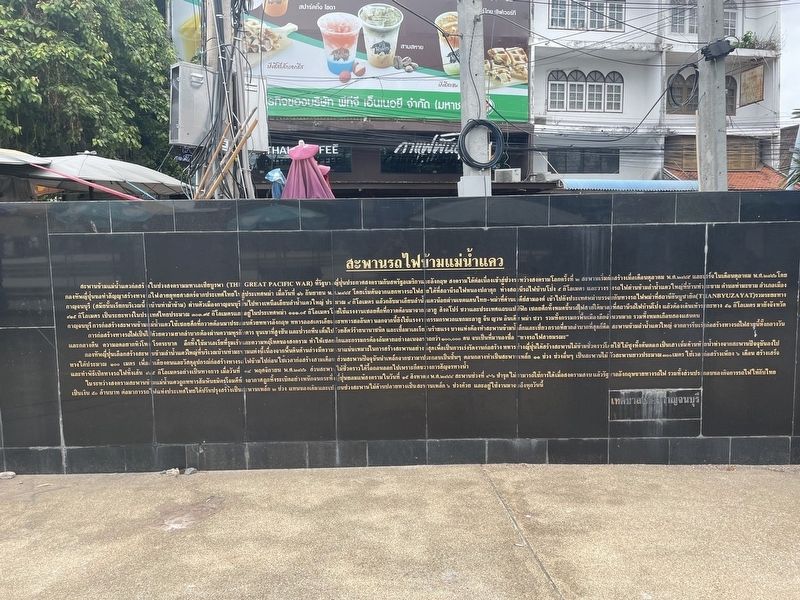
Photographed by Jj Karwacki
3. Thai Inscription, Bridge over the River Kwae Marker
Erected by Kanchanaburi Municipality.
Topics and series. This historical marker is listed in these topic lists: Railroads & Streetcars • War, World II. In addition, it is included in the The Thailand-Burma Railway series list. A significant historical date for this entry is November 28, 1943.
Location. 14° 2.567′ N, 99° 30.291′ E. Marker is in Tha Ma Kham, Kanchanaburi, in Amphoe Mueang Kanchanaburi. It is on New Zealand Alley north of River Kwai Road, on the left when traveling north. The black granite wall is visible from the road, but the text faces away from the road. It is at the railway station. Touch for map. Marker is at or near this postal address: 191 Khwae Yai Rd, Tha Ma Kham, Kanchanaburi 71000, Thailand. Touch for directions.

Regionally, it is in Asia, specifically in Southeast Asia, in IndoChina, on the Bay of Bengal, and on the Pacific Rim.
Other nearby markers. At least 8 other markers are within 3 kilometers of this marker, measured as the crow flies: Burma-Thai Railway (about 150 meters away, measured in a direct line);
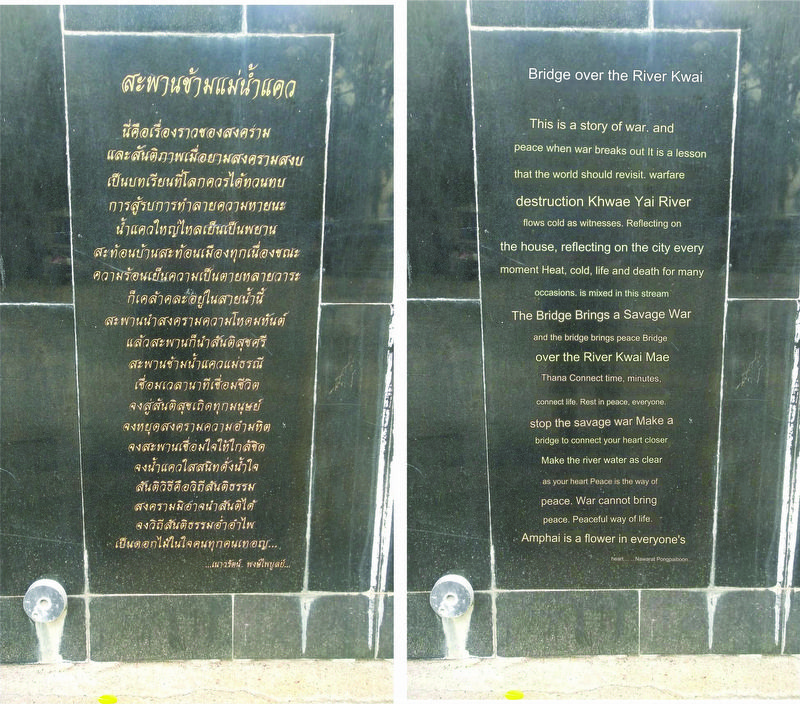
Photographed by Jj Karwacki, July 4, 2023
4. A Poem by Thai Poet Naowarat Phongphaibūn
It is titled “Bridge over the River Kwae.” On the left is the original photograph. The image on the right is Google Translate’s rough image translation. Click on image to enlarge.
Another marker is no longer nearby. Thai-Burma Railway Line (was within shouting distance of this marker but has been confirmed missing).
More about this marker. The neutral and careful language on this historical marker can be attributed to the fact Thailand became an Axis-allied country with Japan after the start of the war. Thailand, an independent country, was officially neutral at the start to World War II until December, 1941, when the country signed a military alliance treaty with the Japanese Empire in December, 1941,
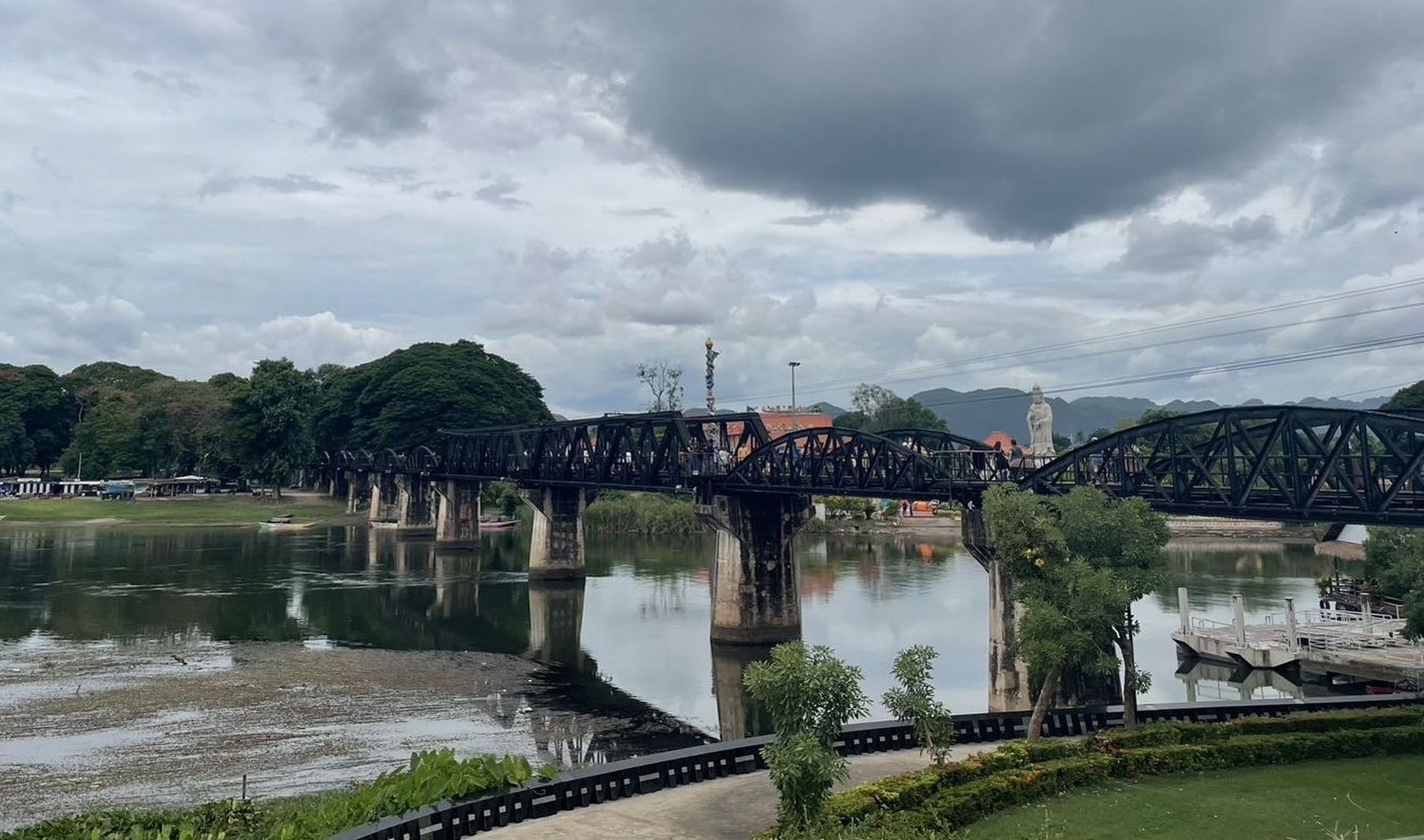
Photographed by Jj Karwacki, July 4, 2023
5. The Bridge Over the River Kwae Yai
Regarding The Bridge Over the River Kwae. The Bridge on the River Kwai is one of the few existing remnants of the Thai-Burma Railway. This iron structure was the second erected at this site by British and Dutch POWs from Nov 1942 to Apr 1943; the first being a wood/bamboo structure about 150m downstream.
This iron bridge is the longest of the 600 bridges that were needed to complete the rail link between Bangkok and Rangoon. It owes its name and fame to the fictional 1952 novel Bridge on the River Kwai by Pierre Boulle and the 1957 Columbia Pictures Technicolor film adaptation that won seven Academy Awards. In reality, there has never been a “River Kwai”. The bridges were built over the Mae Klong River which is joined a few hundred meters downstream from this point by the Kwae Noi River.
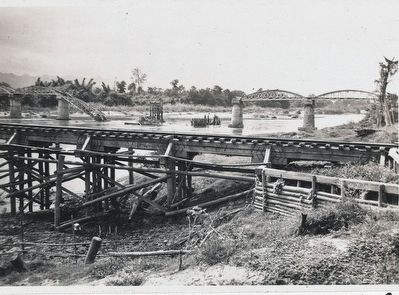
(Public Domain) in the collection of the British War Museum, London. Image No. 136803, 1945
6. Bridges at Tamarkand
The photo is captioned “Tamarkand bridge built by forced P.O.W. labour. Frequently bombed by Allied air craft.” It shows both of the bridges that were built here. In the foreground is the first bridge built, made of wood. The existing iron and concrete bridge, seen in the distance, has two spans down due to Allied attack. The following background is attached to the photograph.
Between October 1942 and December 1943, the Japanese used forced labour to build a railway that cut 260 miles (420 km) through mountainous jungle to link Burma and Siam (now Thailand). The project was designed to safeguard the passage of military supplies from Singapore and Bangkok to the Japanese armies fighting in Burma. The previously used sea route had become too risky.
Building the railway led to the deaths of around 15,000 Allied prisoners of war and over 80,000 Asian civilians from over-work, disease and starvation. The Japanese used the railway until April 1945, when parts of the line and the famous Tamarkand bridge over the River Kwai (Khwae Yai) were destroyed in Allied air raids.
Related marker. Click here for another marker that is related to this marker.
Also see . . . The TBR Story. Article by JJ Karwacki, Colonel (Retired) U.S. Army Medical Corps and Life Member of VFW Post 9951, Bangkok. This page includes maps of the railway and period photographs. Excerpt:
There was an efficient rail link between Bangkok and Singapore and also within Burma, but there was no railway from Thailand to Burma. Apparently, in the latter part of the 19th century, the British had explored the possibility of constructing such a link but surveyors deemed it too costly if not nearly impossible to span the 415-kilometers (248 miles) between NongPlaDuk, Thailand and Thanbyuzayat, Burma.(Submitted on July 10, 2023, by J. J. Prats of Powell, Ohio.)
But in early-1942, the Japanese found themselves in a rather unique position. They had tens of thousands of British and Australian POWs in Singapore. The first prisoners of war, about 3,000 Australians, left Changi Prison [Singapore] on 14 May 1942 and journeyed by sea to Tavoy. They worked on airfields and other infrastructure initially before construction of the railway in September 1942 near Thanbyuzayat was begun. The first to work in Thailand — about 3,000 British soldiers– left Changi by train in June 1942 to Ban Pong[1], the eastern terminus of the railway. More prisoners of war (including Americans) were imported from Java (via Singapore) as construction advanced.
Additional commentary.
1. About the Text on this Wall
This wall explanation reasonably accurately describes the structure and circumstances. Thais do seem to have a difficult time focusing their narratives. It is titled as the Bridge but wanders off to describe the entire Thai-Burma Railway! It also mixes the ‘three months’ (actually 4 months) period of the bridge construction with the 415km length of the entire TBR!
Another major flaw is that there were 61,000 Allied POWs and an additional 250,000 (minimum) Asian Forced Laborers (AFL) of many nationalities and ethic backgrounds. The inscription also fails to mention the 700 US POWs who are commemorated by the nearby memorial.
Contrary to the ’most difficult part’, the thousands of POWs (no AFL were involved) who labored to build these bridges had perhaps the least horrendous experience compared to those who labored elsewhere. There was actually nothing particularly ‘difficult’ about building these bridges.
As to deaths, about 12,000 (20%) of the POWs and at least 40% (more than 100,000) AFL died. Once construction was complete in Oct 1943, both the POWs and AFL were consolidated at ‘rest camps’ in the immediate area of these bridges. Hundreds more POWs and thousands of AFL died in the months up to and even after the end of the war.
SIDEBAR: Uncounted numbers of POWs died in other places like Singapore, Japan and French-Indo China where they were sent following completion of this project. The AFL languished in their camps long after war’s end.The 50 million baht figure is interesting. Because the Thais had indeed officially declared war on England (but not the USA), the British claimed the TBR as a war reparation and then sold it back to the Thais. Japan paid for the 1952 repairs to reopen the bridge. The three bombed center spans were replaced by 2 trapezoidal ones open space for river traffic.
In 1958, the SRT reopened about 130 kilometers of railway from BanPong to NamTok mainly to ferry tourists; it has minimum commercial value beyond that.
— Submitted July 9, 2023, by Jj Karwacki of Tha Maka, Kanchanaburi.
Credits. This page was last revised on July 15, 2023. It was originally submitted on July 9, 2023, by Jj Karwacki of Tha Maka, Kanchanaburi. This page has been viewed 474 times since then and 41 times this year. Photos: 1, 2, 3, 4, 5. submitted on July 9, 2023, by Jj Karwacki of Tha Maka, Kanchanaburi. 6. submitted on July 10, 2023, by J. J. Prats of Powell, Ohio. • J. J. Prats was the editor who published this page.
