Downtown Los Angeles in Los Angeles County, California — The American West (Pacific Coastal)
Pico House

Photographed by Craig Baker, July 9, 2023
1. Pico House Marker
Land, Luxury and the Last Mexican Governor
When Pio Pico, California's last Mexican governor, erected the city's most elegant hotel in 1870, its indoor plumbing, dramatic gas lighting and French restaurant suited the social and cultural ambitions of young Los Angeles.
The Pico House, an Italianate-style, three-story showplace, not only overshadowed the city's other three hotels, the Bella Union, Lafayette and United States, but was one of Los Angeles' most enduring edifices.
Born the son of an army sergeant in 1801 at the San Gabriel Mission, Pico became one of California's richest and most powerful men, whose life paralleled both the roller coaster growth and binational politics of the region during the Mexican period.
Pico was a gregarious man, and generous to a fault. Appointed governor for one month in 1832 and again from 1845 to 1846, he moved the state capital from Monterey to Los Angeles and was open-handed with friends and relatives who requested land grants. Criticized for taking $14,000 for selling former mission lands in the San Fernando Valley, Pico said he used the money to carry on the Mexican-American War that would soon transfer California from Mexican hands to Yankee ones.
Pico sat out most of the war in Mexico, playing cards. Returning in 1848, he continued to enjoy influence and prestige as a land baron. Elegantly dressed and clanking with medals and decorations, he often carried a cane with an ivory handle carved to resemble the leg of a comely can-can dancer. In 1853, he served briefly as a city councilman.
The Gold Rush population boom created a heavy demand for beef, which helped to make rancheros like Pico wealthy. He bought the 9,000-acre Rancho Paseo de Bartolo Viejo, which the Yankees called "Picoville," in what is now Whittier. It was small compared
this page online
Eastern Comforts, Western Ways
After the Civil War, as families from the east began visiting in Los Angeles, Pico decided there was money to be made, and civic pride to be enhanced, by offering tourists a hotel that would become the pride of the city, boasting “bathrooms and water closets for both sexes” on each floor. He sold his San Fernando Valley property for $115,000 in 1869 and bought his brother-in-law's house on Main Street, which he razed to build the Pico House at a cost of $48,000. He spent another $34,000 to furnish its 82 rooms lavishly.
On June 9, 1870, the hotel opened, with its grand double staircase, its gas-lit chandeliers, carved rosewood furniture, lace curtains and one bathroom per floor. The costliest rooms, at $3 per night, featured balconies overlooking a fountain in the courtyard.
Within months, the Methodist Church next door, built on the site of the El Dorado Saloon, was demolished and the Merced Theater rose in its place. The walkway

Photographed by Craig Baker, July 9, 2023
2. Pico House Marker
For ten years, the hotel fulfilled Pico's hopes, even as his fortunes began to wane. Gambling, bad investments and being hoodwinked by Yankee con men forced him to lose the hotel. Despite several lawsuits over the property, Pico continued to entertain at his former hotel as if he were still the owner.
From Powerful to Penniless
Pico had already lost his San Diego ranch to his English-born brother-in-law, John Forster, and also lost a lawsuit to get the land back. He, characteristically, held no grudge against his nephew, Chico, Forster's son. Chico was engaged to a beautiful singer named Lastania Abarta, who sang for Pico at a banquet at the Pico House. Their engagement was a secret until Abarta killed the philandering Chico. An all-male jury acquitted her on grounds of "menstrual madness."
The decline of Pico's fortunes paralleled the rise of Yankee power. Hopelessly in debt, he mortgaged his Whittier ranch. When he tried to repay the loan, the lender refused the money and took the land instead. Pico tried to recover

Photographed by Craig Baker, July 9, 2023
3. Pico House Marker
Pico House was condemned in 1922. More than three decades later, the state bought the dilapidated property as part of the historic plaza park. Its facelift, like those of its neighbors, the Merced Theater and the 1856 Masonic Temple, restored the glories of the bygone to the city's historic heart.
Erected 2000 by City of Los Angeles.
Topics. This historical marker is listed in these topic lists: Architecture • Industry & Commerce • Settlements & Settlers. A significant historical date for this entry is June 9, 1870.
Location. 34° 3.356′ N, 118° 14.393′ W. Marker is in Los Angeles, California, in Los Angeles County. It is in Downtown Los Angeles. It is at the intersection of Main Street and Arcadia Street, on the right when traveling north on Main Street. Touch for map. Marker is at or near this postal address: 444 N Main St, Los Angeles CA 90012, United States of America. Touch for directions.

Regionally, this marker is in California’s Transverse Ranges. It is also on the

Photographed by Craig Baker, July 9, 2023
4. Pico House Marker
Pico House is to the right, hidden behind the trees.
Other nearby markers. At least 8 other markers are within walking distance of this marker: Merced Theatre (within shouting distance of this marker); a different marker also named Pico House (within shouting distance of this marker); a different marker also named Pico House (within shouting distance of this marker); Garnier Building (within shouting distance of this marker); a different marker also named The Garnier Building (within shouting distance of this marker); Chinese Massacre (about 300 feet away, measured in a direct line); Sun Wing Wo & Company (about 300 feet away); 425 North Los Angeles Street (about 300 feet away). Touch for a list and map of all markers in Los Angeles.
Also see . . . Pico House. Wikipedia entry (Submitted on March 24, 2026, by Larry Gertner of New York, New York.)

Photographed by Craig Baker, July 9, 2023
5. Pico House
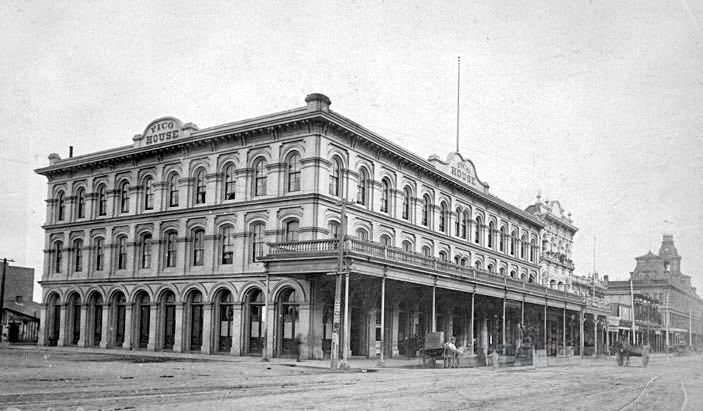
courtesy Water & Power Associates
6. Pico House - 1891

Public Domain
7. Pio Pico
Credits. This page was last revised on March 24, 2026. It was originally submitted on July 9, 2023, by Craig Baker of Sylmar, California. This page has been viewed 645 times since then and 57 times this year. Photos: 1, 2, 3, 4, 5. submitted on July 9, 2023, by Craig Baker of Sylmar, California. 6. submitted on January 29, 2026, by Craig Baker of Sylmar, California. 7. submitted on July 9, 2023, by Craig Baker of Sylmar, California.
