Tha Ma Kham in Amphoe Mueang Kanchanaburi, Kanchanaburi, Thailand — ประเทศไทย (Southeast Asia, Indochinese Peninsula)
Burma-Thai Railway
The Bridge on the River Kwai – Tha Markham
| — | Relief Map of the Railway | — |
Photographed by Jj Karwacki, July 4, 2023
1. Burma-Thai Railway Marker
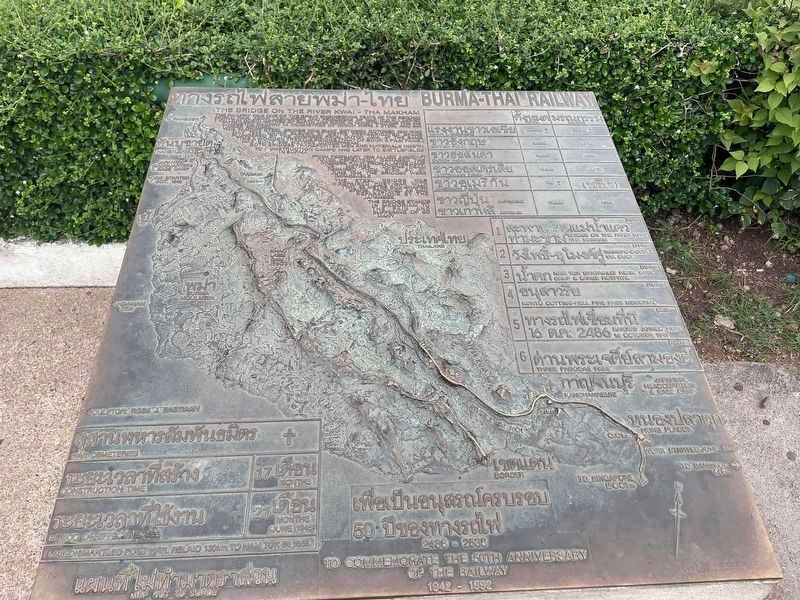
This tablet was designed and sculpted by Ross J. Bastiaan, a periodontist and Colonel in the Royal Australian Army Dental Corps Reserve. Dr. Bastiaan is well known for his commitment to Australian military history with his internationally recognized bronze hand-sculpted information plaques like this one in over 240 places around the world.
To Commemorate the 50th Anniversary of the Railway, 1942 – 1992.
The railway was one of the great engineering feats of the Second World War. Asian labourers and prisoners of war (P.O.W.) moved 7 million cubic metres of earth and rock in constructing the 415 kilometre railway. 14 kilometres of which were 6 steel and 630 timber bridges.
This famous steel bridge was built between October 1941 and May 1942, using eleven prefabricated spans plundered by the Japanese from Dutch Java, at the same time a wooden trestle bridge (that of book and film fame) was built 100 metres downstream.
Both bridges transported men and materials north to construction camps and later to battlefields in Burma.
From February 1945 Allied aircraft raids repeatedly damaged the bridges. P.O.W. from a large camp 500 metres downstream repaired them. Even so by June 1945 the bridges were impassable.
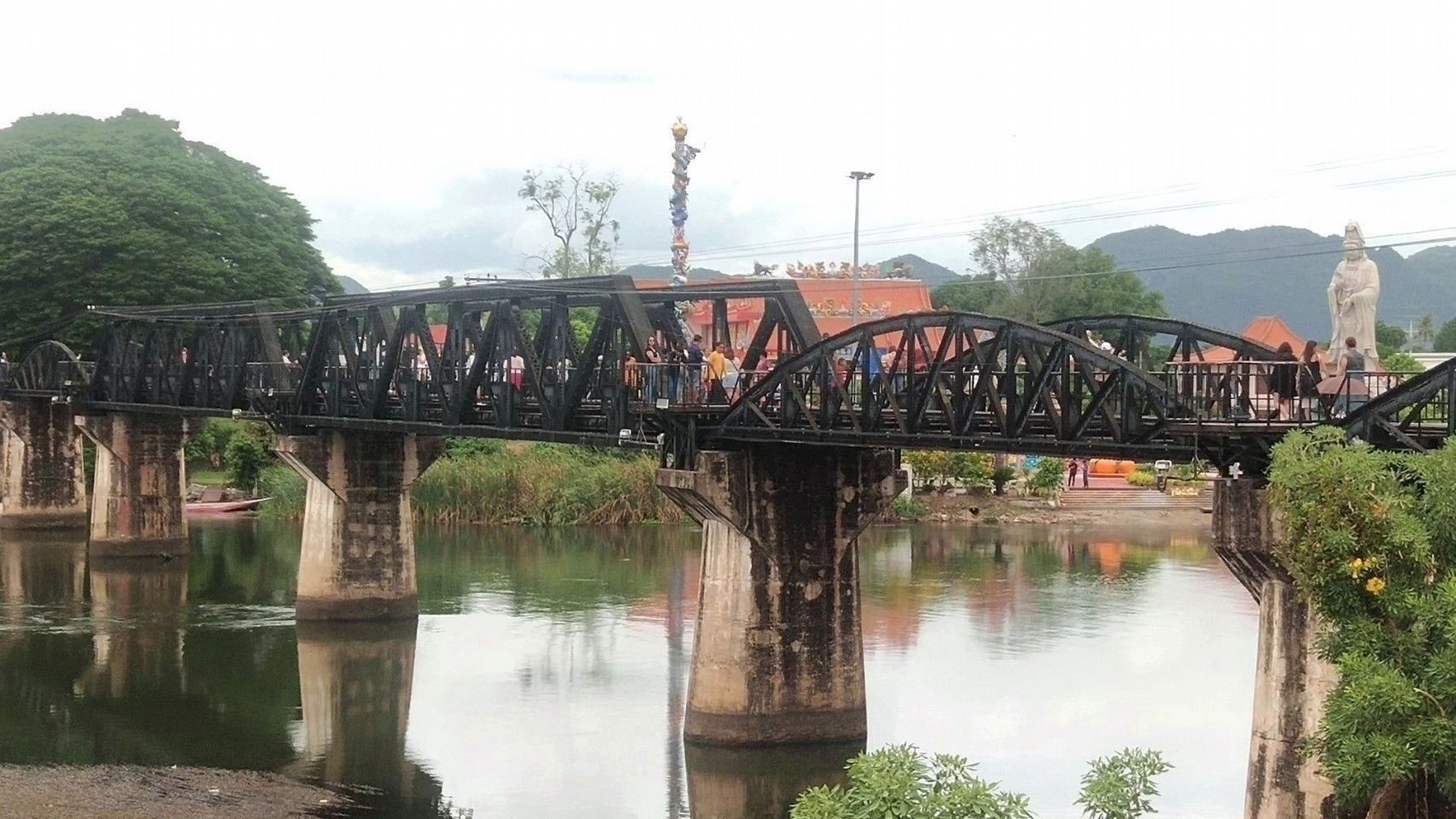
The steel bridge was repaired post-war with two box-shaped spans provided as war reparations by the Japanese.
The bridge stands in memoriam to the pain and suffering of so many.
this page online
(map legend)
1. 55km —“Bridge on the River Kwai” Tha Makham
2. 114 km — VWangpo double viaduct
3. 124 km — Nam Tok, originally P.O.W. base camp & large hospital.
4. 150 km — Konyo cutting – Hell Fire Pass Memorial
5. 263 km — Railway joined here, 16 October 1943
6. 297 km — Three Pagodas Pass
Kanchanaburi — Japanese Headquarters & base camp
Nong Pladuk — Work started June 19, 1942. 1300 km to Singapore, 64km to Bangkok.
Thanbyuzayat, 415 km — Work started 12 Oct. 1942. Japanese Headquarters & base camp. 242 km to Rangoon.
War Cemeteries are marked with ✝
Construction time: 17 months
Period of effective use: 21 months (June 1945)
Line dismantled post war. Relaid 130 km to Nam Tok in 1956.
Map not to scale
Erected 1992 by the sculptor, Ross J. Bastiaan, Member of the Order of Australia, to commemorate the 50th anniversary of the railway, 1942–1992.
Topics and series.
Photographed by Jj Karwacki, August 4, 2023
2. Burma-Thai Railway Marker
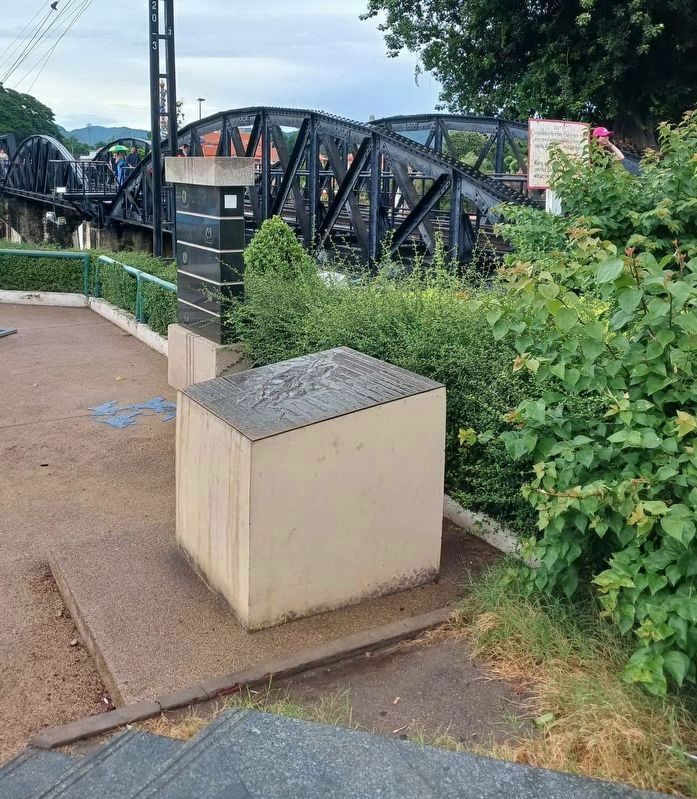
The bridge, the subject of this marker, is in the background.
Location. 14° 2.502′ N, 99° 30.252′ E. Marker is in Tha Ma Kham, Kanchanaburi, in Amphoe Mueang Kanchanaburi. It is on River Kwai Road, on the right when traveling west. The sculpture is on the eastern side of the northern end of the Bridge on the River Kwai. Touch for map. Marker is in this post office area: Tha Ma Kham, Kanchanaburi 71000, Thailand. Touch for directions.

Regionally, it is in Asia, specifically in Southeast Asia, in IndoChina, on the Bay of Bengal, and on the Pacific Rim.
Other nearby markers. At least 8 other markers are within 3 kilometers of this marker, measured as the crow flies: VFW POW Kanchanaburi Memorial (a few steps from this marker); The Bridge Over the River Kwae (about 150 meters away, measured in a direct line); Thai-Anusorn (about 150 meters away); The Kanchanaburi Memorial (approx. 2.6 kilometers away); Kanchanaburi War Cemetery (approx. 2.6 kilometers away); That Valiant Company Who Perished While Building the Railway
(Public Domain) in the collection of the British War Museum, London. Image No. 136803, 1945
3. Bridges at Tamarkand
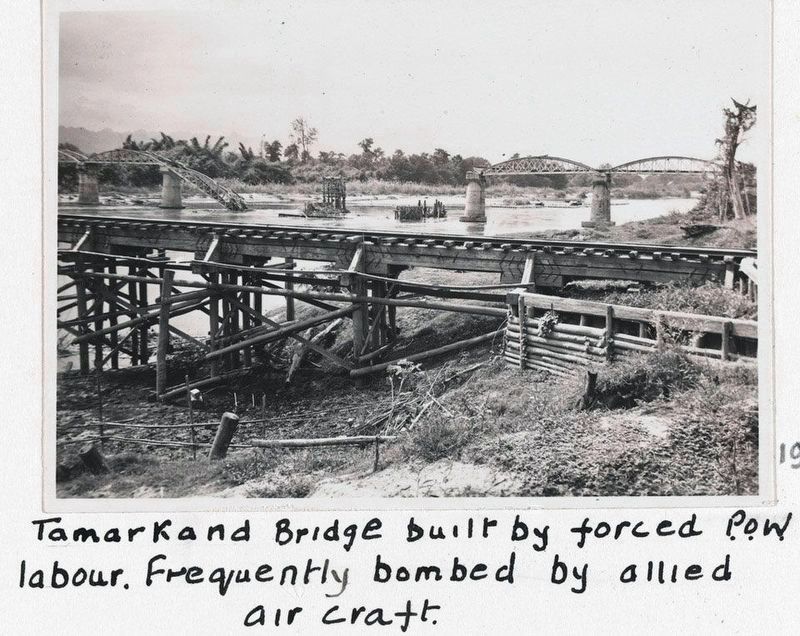
The trestle bridge is in the foreground. 100 meters upstream is the ferro-steel bridge, with two spans down after a bombing raid.
Another marker is no longer nearby. Thai-Burma Railway Line (was about 210 meters away but has been confirmed missing).
More about this marker. More than 240 bronze relief plaques sculpted by Dr. Ross Bastiaan, a Colonel in the Royal Australian Army Dental Corps Reserve, have been placed worldwide at Australian Armed Forces sites-of-action. It has been reported that a number of these are at various places along the Thai-Burma Railway.
As years progress, dates and the horrible statistics of body counts are researched anew and revised. As this is written in 2023 the following revisions to dates and numbers on this marker are offered: The bridge was built between November 1942 and April 1943. Allied air raids began November 1944. It is now believed that Asian laborers totaled 250,000, more or less, with some 100,000 dying. The American POW death count
Photographed by Jj Karwacki, July 4, 2023
4. The “Bridge Over the River Kwai” Bridge Today
This view is from the plaza where this marker is located. It shows an original curved span and the replacement spans provided by Japan as a war reparation after the war.
Regarding Burma-Thai Railway. The wooden trestle bridge of book and film fame looked nothing like the one depicted in David Lean’s 1957 epic war film The Bridge on the River Kwai starring William Holden and Alec Guinness. That bridge was built as a film prop in Sri Lanka. There is a photograph on this page showing a portion of the wooden trestle bridge that was built here. It was dismantled post-war. The steel bridge was repaired in 1952. The two box-shaped spans provided by the Japanese replaced three spans, easing traffic flow on the river.
The Japanese called this the Burma-Thailand Link Railway because it would link the existing tracks of Burma’s railway system at Thanbyuzayat to existing tracks of Thailand’s railway system at Nong Pladuk. Thailand’s railways were already linked with Malaya’s, providing for a continuous railway all the way to Singapore. For 21 months during the war passengers and cargo flowed by rail to and from Rangoon, Bangkok, and Singapore. After the war, the British colonial government ordered the link severed to protect shipping interests in Singapore.
Also see . . .
1. Wikipedia entry for Burma Railway. Excerpt:
One of the most notable portions of the entire railway line is Bridge 277, the so-called "Bridge on the River Kwai", which was built over a stretch of the river that was then known as part of the Mae Klong River. ... On 26 October 1942, British prisoners of war arrived at Tamarkan to construct the bridge. Initially, 1,000 prisoners worked on the bridge and were commanded by Colonel Philip Toosey. In February 1943, 1,000 Dutch prisoners of war were added to Tamarkan. An unknown number of Malayan workers were housed in a nearby camp.(Submitted on July 12, 2023.)
2. Synopsys for season 4, episode 2, “Bridge on the River Kwai”. This episode was first shown on the U.S. Public Broadcasting Service television documentary series Secrets of the Dead in 2003. It was also shown on the BBC in the UK. Excerpt:
“Throughout history, engineers have done much bigger, much grander, much longer, on a one-time basis,” [Structural Engineer Bashar] Altabba says. “What makes this an engineering feat is the totality of it, the accumulation of factors. The total length of miles, the total number of bridges — over 600, including six to eight long-span bridges — the total number of people who were involved (one-quarter of a million), the very short time in which they managed to accomplish it, and the extreme conditions they accomplished it under. They had very little transportation to get stuff to and from the workers, they had almost no medication, they couldn’t get food let alone materials, they had no tools to work with except for basic things like spades and hammers, and they worked in extremely difficult conditions — in the jungle with its heat and humidity. All of that makes this railway an extraordinary accomplishment.”(Submitted on July 13, 2023.)
Credits. This page was last revised on August 7, 2023. It was originally submitted on July 10, 2023, by Jj Karwacki of Tha Maka, Kanchanaburi. This page has been viewed 340 times since then and 68 times this year. Photos: 1. submitted on July 10, 2023, by Jj Karwacki of Tha Maka, Kanchanaburi. 2. submitted on August 7, 2023, by Jj Karwacki of Tha Maka, Kanchanaburi. 3. submitted on July 10, 2023, by J. J. Prats of Powell, Ohio. 4. submitted on July 12, 2023, by Jj Karwacki of Tha Maka, Kanchanaburi. • J. J. Prats was the editor who published this page.
