Royal Naples in Napoli in Città Metropolitana di Napoli, Naples Region, Italy — Southern Italy (Tyrrhenian Coast)
Chiesa di S. Ferdinando
⎯⎯⎯
Church of S. Ferdinando
Photographed by James Hulse, June 12, 2023
1. Chiesa di S. Ferdinando / Church of S. Ferdinando Marker

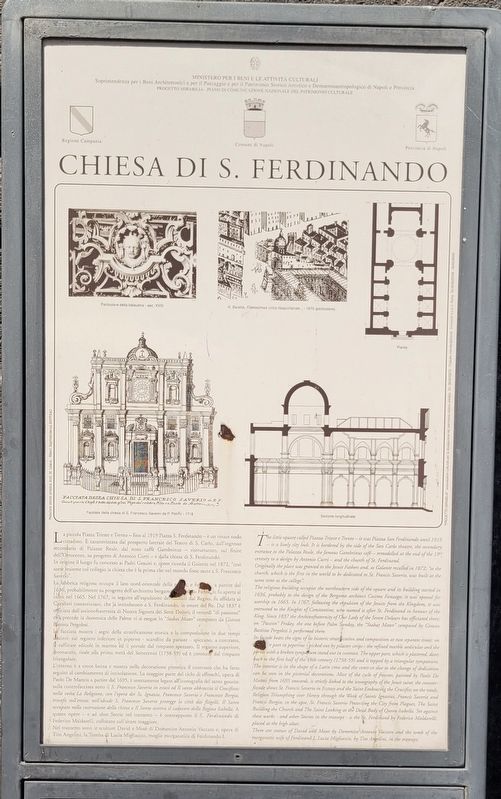
La fabbrica religiosa occupa il lato nord-orientale della piazza, e fu a partire dal 1636, probabilmente su progetto dell'architetto bergamasco Cosimo Fanzago; fu aperta al culto nel 1665. Nel 1767, in seguito all'espulsione dei Gesuiti dal Regno, fu affidata ai Cavalieri costantiniani, che la intitolarono a S. Ferdinando, in onore del Re. Dal 1837 è officiata dall'arciconfraternita di Nostra Signora dei Sette Dolori; il venerdi "di passione" che precede la domenica delle Palme vi si esegue lo "Stabat Mater" composto da Giovan Bartista Pergolesi.
La facciata mostra i segni della stratificazione storica e la composizione in due tempi distinti: sul registro inferiore in piperno - scandito da paraste - spiccano, a contrasto, le raffinate edicole in marmo ed il portale dal timpano spezzaro. Il registro superiore. intonacato, risale alla prima metà del Settecento (1738-59) ed è coronate dal timpano triangolare.
L'interno è a croce latina e mostra nella decorazione pittorica il contrasto che ha fatto seguito al cambiamento di intitolazione. La maggior parte del ciclo di affreschi, opera di Paolo De Matteis a partire dal 1695, è strettamente legato all'iconografia del santo gesuita: sulla controfacciata sono il S. Franceico Saverio in estasi ed Il santo abbraccia il Crocifissa: nella volta La Religione, con l'opera dei St. Ignazio, Francesco Saverio e Francesco Borgia, trionfa sull'eresia; nell'abside S. Francesco Saverio protegge la città dai flagelli. Il Santo occupato nella costruzione della chiesa e Il Santo osserva il cadavere della Regina Isabella. A
this page online
Didascalie
Particolare della balaustra - sec. XVIII
A. Baratta, Fidelissimae Urbis Neapolitanae - 1670 (particolare)
Facciata dela chiesa di S. Francesco Saveño da P. Petrini - 1718
Seasone longitudinale
The little square called Piazza Trieste e Trento - it was Piazza San Ferdinando until 1919 - is a lively city hub. It is bordered by the side of the San Carlos theatre, the secondary entrance to the Palazzo Reale, the famous Gambrinus cafe - remodelled at the end of the 19 century to a design by Antonio Curri - and the church of St. Ferdinand.
Originally the place was granted to the Jesuit Fathers and, as Galante recalled in 1872, “so the church, which is the first in the world to be dedicated to St. Francis Saverio, was built at the same time as the college."
The religious building occupies the northeastern side

Photographed by James Hulse, June 12, 2023
2. The Church of S. Ferdinando Marker
Its facade bears the signs of its historic stratification and composition at two separate times; on the lower part in peperino - picked out by pilaster strips - the refined marble aediculae and the portal with a broken tympanum stand out in contrast. The upper part, which is plastered, dates back to the first half of the 18th century (1738-59) and is topped by a triangular tympanum. The interior is in the shape of a Latin cross and the contrast due to the change of dedication can be seen in the pictorial decorations. Most of the cycle of frescoes, painted by Paolo De Matteis from 1695 onwards, is strictly linked

Photographed by James Hulse, June 12, 2023
3. The view of the Church of S. Ferdinando and Marker from across the piazza
There are statues of David and Moses by Domenico Antonio Vaccaro and the tomb of the morganatic wife of Ferdinand I. Lucia Migliaccio, by Tito Angelini, in the transept.
Captions
Detail of the balustrade - sec. 18
A. Baratta, Fidelissimae Urbis Neapolitanae - 1670 (particolare)
Façade of the church of S. Francesco Saveño by P. Petrini - 1718
Longitudinal season
Erected by Ministero Per I Beni E Le Attività Culturali, Soprintendenza per i Beni Architettonici e per il Paesaggio, per il Patrimonio Storico Artistico e Demoetnoantropologico di Napoli e Provincia, Progetto Mirabilia Piano di Comunicazione del Patrimonio Culturale Nazionale and Comune di Napoli.
Topics. This historical marker is listed in these topic lists: Architecture • Religion & Religious Structures. A significant historical year for this entry is 1919.
Location. 40° 50.249′ N, 14° 14.924′ E. Marker is in Napoli, Campania (Naples Region), in Città Metropolitana di Napoli. It is in Royal Naples. It is at the intersection of Piazza Trieste e Trento and Via Toledo, on the left when traveling north on Piazza Trieste e Trento. The marker is located at the right side of the entrance to the church. Touch for map. Marker is at or near this postal address: Piazza Trieste e Trento 5, Napoli, Campania 80132, Italy. Touch for directions.

Regionally, it is in Europe, the European Union, the Schengen Area, a coastal Mediterranean country, and the Western World. Historically, it finds itself in what was once the Roman Empire.
Other nearby markers. At least 8 other markers are within walking distance of this marker: Palazzo Salerno e Gambrinus / Salerno and Gambrinus Palace (within shouting distance of this marker); Palazzo Reale / Royal Palace (within shouting distance of this marker); Il Caffè Sospeso / The Suspended Coffee (within shouting distance of this marker); Palazzo Cirella / Cirella Palace (about 90 meters away, measured in a direct line); Palazzo Berio / Berio Palace (about 120 meters away); Galleria Umberto I (about 120 meters away); Basilica di S. Francesco di Paola / Basilica of St. Francis of Paola (about 240 meters away); Palazzo Zevallos Stigliano / Zevallos Stigliano Palace (approx. 0.3 kilometers away). Touch for a list and map of all markers in Napoli.
Also see . . . San Ferdinando (church), Naples. Wikipedia
The original church at the site was dedicated by the Jesuits to Saint Francis Xavier, and was built in 1636. Reconstruction in mid 1650s was entrusted to Cosimo Fanzago. In 1767, with the expulsion of the Jesuits from the realm, the church was granted to the Sacred Military Constantinian Order of Saint George who dedicated the church to Saint Ferdinand III of Castile, the patron saint of the reigning king of Naples Ferdinand IV.(Submitted on July 16, 2023, by James Hulse of Medina, Texas.)
Credits. This page was last revised on July 16, 2023. It was originally submitted on July 15, 2023, by James Hulse of Medina, Texas. This page has been viewed 317 times since then and 40 times this year. Photos: 1, 2, 3. submitted on July 16, 2023, by James Hulse of Medina, Texas.
