Cedar Bluff in Tazewell County, Virginia — The American South (Mid-Atlantic)
Mill Industries
Photographed by Duane and Tracy Marsteller, June 18, 2023
1. Mill Industries Marker
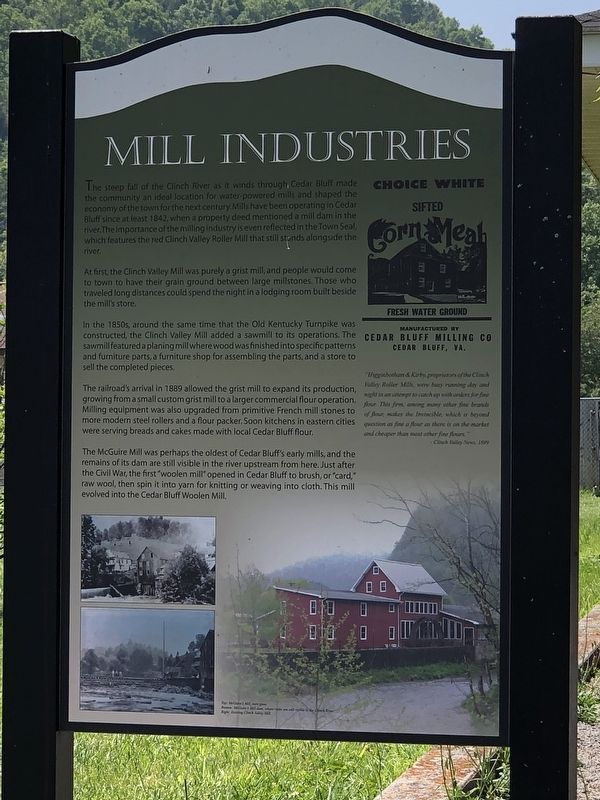
At first, the Clinch Valley Mill was purely a grist mill, and people would come to town to have their grain ground between large millstones. Those who traveled long distances could spend the night in a lodging room built beside the mill's store.
In the 1850s, around the same time that the Old Kentucky Turnpike was constructed, the Clinch Valley Mill added a sawmill to its operations. The sawmill featured a planing mill where wood was finished into specific patterns and furniture parts, a furniture shop for assembling the parts, and a store to sell the completed pieces.
The railroad's arrival in 1889 allowed the grist mill to expand its production, growing
this page online
The McGuire Mill was perhaps the oldest of Cedar Bluff's early mills, and the remains of its dam are still visible in the river upstream from here. Just after the Civil War, the first “woolen mill” opened in Cedar Bluff to brush, or “card,” raw wool, then spin it into yarn for knitting or weaving into cloth. This mill evolved into the Cedar Bluff Woolen Mill.
“Higginbotham & Kirby, proprietors of the Clinch Valley Roller Mills, were busy running day and night in an attempt to catch up with orders for fine flour. This firm, among many other fine brands of flour, makes the Invincible, which is beyond question as fine a flour as there is on the market and cheaper than most other fine flours.” – Clinch Valley News, 1899
Cation: Top: McGuire's Mill, now gone. Bottom: McGuire's Mill dam, whose ruins are still visible in the Clinch River. Right: Existing
Photographed by Duane and Tracy Marsteller, June 18, 2023
2. Mill Industries Marker
Topics. This historical marker is listed in these topic lists: Industry & Commerce • Waterways & Vessels. A significant historical year for this entry is 1842.
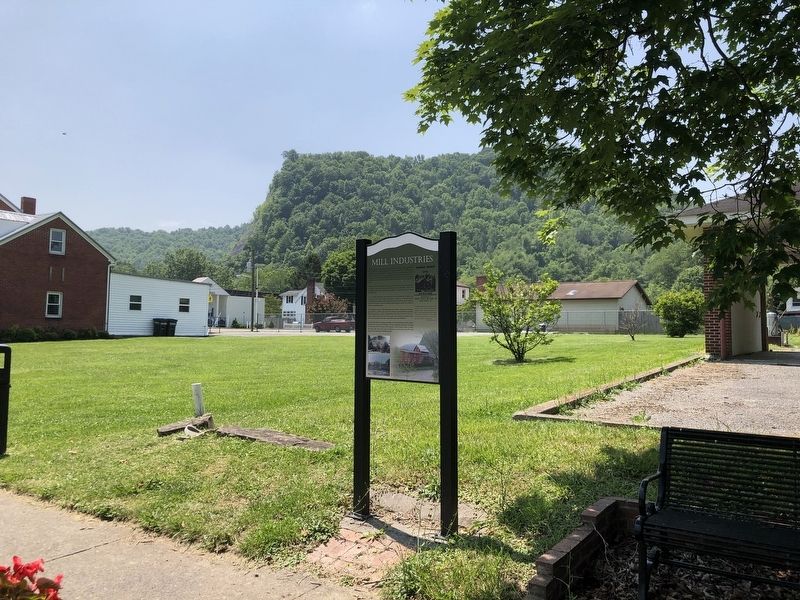
Location. 37° 5.303′ N, 81° 45.873′ W. Marker is in Cedar Bluff, Virginia, in Tazewell County. It is on Cedar Valley Drive (Business U.S. 460) east of River Road, on the right when traveling east. Touch for map. Marker is at or near this postal address: 1125 Cedar Valley Dr, Richlands VA 24641, United States of America. Touch for directions.

Regionally, this marker is in Southwest Virginia. It is also in the American South, specifically in the Upper South, in Appalachia, and specifically in Southern Appalachia. Globally, it is in North America, the Western Hemisphere, the Western World, and the Anglosphere. Historically, it finds itself in what was once the territory of the Mississippian Culture, one of the original Thirteen Colonies, one of the Confederate States of America, and the Antebellum South.
Other nearby markers. At least 8 other markers are within 2 miles of this marker, measured as the crow flies: Railroad & Resort (within shouting
Brian Stansberry via Wikimedia Commons (CC BY 4.0), May 12, 2018
3. Clinch Valley Roller Mills
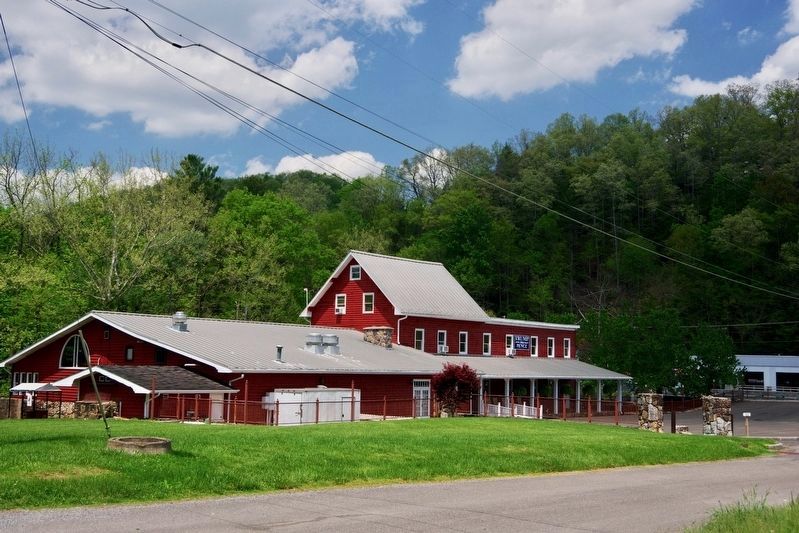
The mill, which dates to 1856, is on the National Register of Historic PLaces.
Also see . . . Clinch Valley Roller Mills (PDF). National Register of Historic Places nomination and photographs submitted for the mill, which was listed in 1984. (National Archives) (Submitted on July 16, 2023, by Duane and Tracy Marsteller of Murfreesboro, Tennessee.)
Credits. This page was last revised on July 16, 2023. It was originally submitted on July 16, 2023, by Duane and Tracy Marsteller of Murfreesboro, Tennessee. This page has been viewed 657 times since then and 71 times this year. Photos: 1, 2, 3. submitted on July 16, 2023, by Duane and Tracy Marsteller of Murfreesboro, Tennessee.
