Geuzenveld-Slotermeer in Amsterdam, North Holland, Netherlands — Northwestern Europe
Willem Molengraaff
Photographed by Andrew Ruppenstein, May 5, 2023
1. Willem Molengraaff Marker

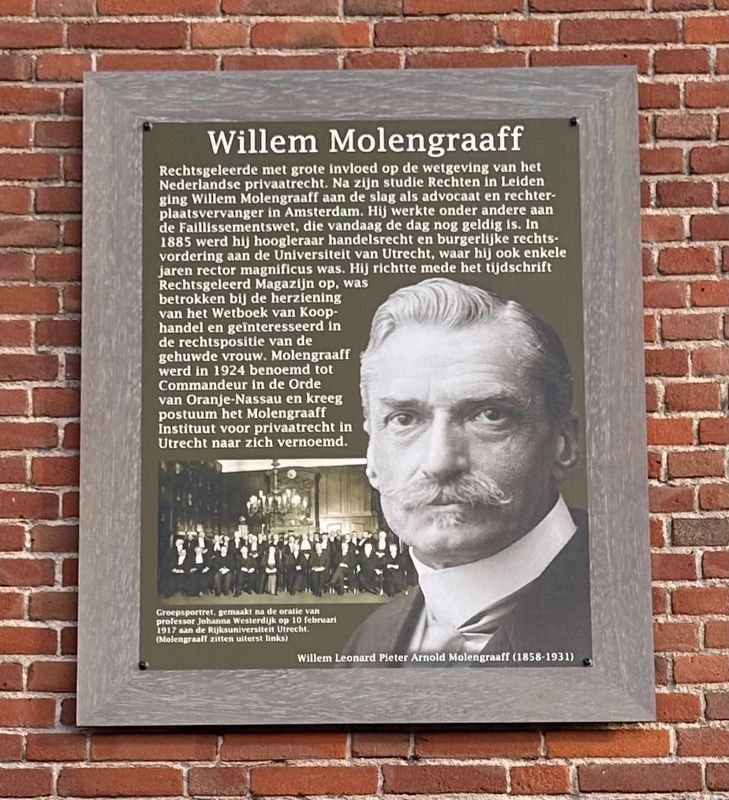
Willem Leonard Pieter Arnold Molengraaff (1858-1931)
Rechtsgeleerde met grote invloed op de wetgeving van het Nederlandse privaatrecht. Na zijn studie Rechten in Leiden ging Willem Molengraaff aan de slag als advocaat en rechterplaatsvervanger in Amsterdam. Hij werkte onder andere aan de Faillissementswet, die vandaag de dag nog geldig is. In 1885 werd hij hoogleraar handelsrecht en burgerlijke rechtsvordering aan de Universiteit van Utrecht, waar hij ook enkele jaren rector magnificus was. Hij richtte mede het tijdschrift Rechtsgeleerd Magazijn op, was betrokken bij de herziening van het Wetboek van Koophandel en geïnteresseerd in de rechtspositie van de gehuwde vrouw. Molengraaff werd in 1924 benoemd tot Commandeur in de Orde van Oranje-Nassau en kreeg postuum het Molengraaff Instituut voor privaatrecht in Utrecht naar zich vernoemd.
Legal scholar with major influence on Dutch legislation of civil law. After studying law in Leiden, Willem Molengraaff started working as a lawyer and deputy judge in Amsterdam. Among other things, he worked on the Bankruptcy Act, which
this page online
Erected by Geef Straten Een Gezicht.
Topics and series. This historical marker is listed in this topic list: Arts, Letters, Music. In addition, it is included in the Give Streets a Face / Geef Straten Een Gezicht series list. A significant historical year for this entry is 1885.
Location. 52° 23.037′ N, 4° 48.975′ E. Marker is in Amsterdam, Noord-Holland (North Holland). It is in Geuzenveld-Slotermeer. It is on Willem Molengraaffstraat, on the left when traveling west. Touch for map. Marker is at or near this postal address: Willem Molengraaffstraat 2III, Amsterdam, Noord-Holland 1063 LE, Netherlands. Touch for directions.

Regionally,

Photographed by Andrew Ruppenstein, May 5, 2023
2. Willem Molengraaff Marker - wide view
Other nearby markers. At least 8 other markers are within walking distance of this marker: Josephus Jitta (about 120 meters away, measured in a direct line); Anthony Modderman (about 150 meters away); Tobias Asser (about 210 meters away); Lou Jansen (approx. 0.2 kilometers away); Jan Zwanenburg (approx. 0.3 kilometers away); Paul Scholten (approx. 0.3 kilometers away); Bernard Loder (approx. 0.4 kilometers away); Suze Groeneweg (approx. half a kilometer away). Touch for a list and map of all markers in Amsterdam.
Also see . . . Willem Molengraaff (Wikipedia, in Dutch).
Overview (in translation): Willem Leonard Pieter Arnold Molengraaff (Nijmegen, 10 May 1858 - The Hague , 7 July 1931) was one of the most influential lawyers in the field of civil law in the Netherlands at the end of the 19th century and the beginning of the 20th century. Molengraaff was far ahead of his time. More than thirty years before the Supreme Court changed tack, Molengraaff already advocated a broader application of the tort in liability law. His pursuit of a uniform private law of which the abolition of the distinction between civil law and commercial law formed an important part, would only be completed when the remaining parts of the Commercial Code have been incorporated into the Civil Code. His ideas about harmonizing private law at an international level are also relevant to this day.(Submitted on July 18, 2023.)
Credits. This page was last revised on December 31, 2023. It was originally submitted on July 18, 2023, by Andrew Ruppenstein of Lamorinda, California. This page has been viewed 145 times since then and 20 times this year. Photos: 1, 2. submitted on July 18, 2023, by Andrew Ruppenstein of Lamorinda, California.
