Crumpler in Ashe County, North Carolina — The American South (South Atlantic)
The Cabins at Healing Springs
National Register of Historic Places October 22, 1976
| — | for its “historic and archeological significance” | — |
Photographed by Duane and Tracy Marsteller, June 24, 2023
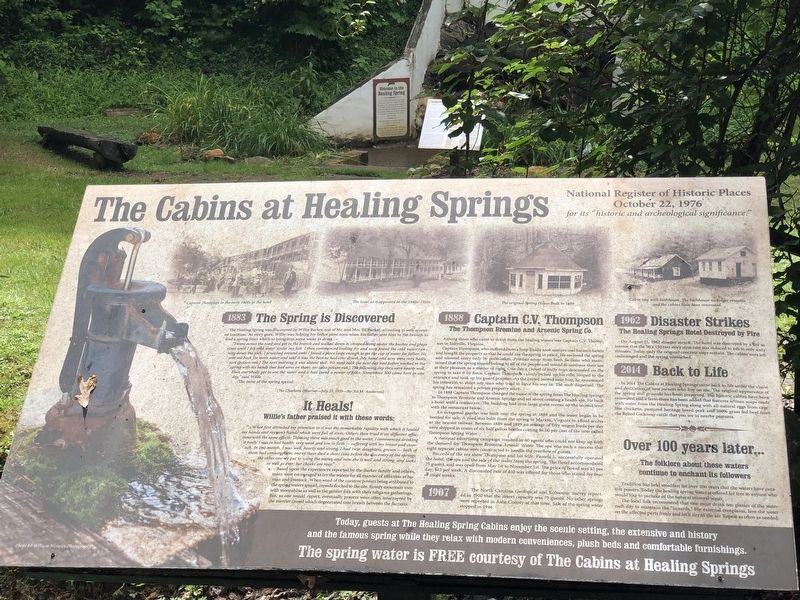
1. The Cabins at Healing Springs Marker
“I went across the road and got in the branch and walked down it, stopped along under the bushes and grape vines until I felt cold water under my feet. I then commenced looking for and soon found the cold water running down the rock. I scratched around until I found a place large enough to get the cup of water for father. He sent me back for more water and said it was the best he had ever drunk. My hand and arm were very badly sore (poison oak). The next morning it was almost well. We went back the next day and father worked in the spring with his hands that had sores on them too (also poison oak). The following day they were nearly well. Then everybody got to use the water and it had cured a power of folks. Sometimes 300 came here in one day,” said Willie.The fame of the spring spread.
[The Charlotte Observer – July 23, 1939 – By Ed M. Anderson]
Willie's father praised it with these words:
“… What first attracted my attention to it was the remarkable rapidity with which it healed my hands and my son's hands which were full of sores. Others then tried it on different affections with the same effects. Thinking there was much good in the water, I commenced drinking it freely. I was in bad health, very weak, and low in flesh – suffering with my breast and stomach. In one month, I was well, hearty and strong. I had twin daughters, grown – both of them had consumption; one of them died a short time before the discovery of the springs, the other one we put to using the water, and now she is well and strong, and looks as well as ever; her checks are rosy.”Based
this page online
The Thompson Bromine and Arsenic Spring Co.
Captain Thompson, who suffered from a limp finally took matters into his own hands and bought the property so that he could use the spring in peace. He enclosed the spring and allowed entry only by permission. Protests arose from both factions who maintained that the spring should belong to all of the people and vowed to continue their use at their pleasure as a matter of right. One day a crowd of bully boys descended on the spring to take it by force. Captain Thompson
Photographed by Duane and Tracy Marsteller, June 23, 2023
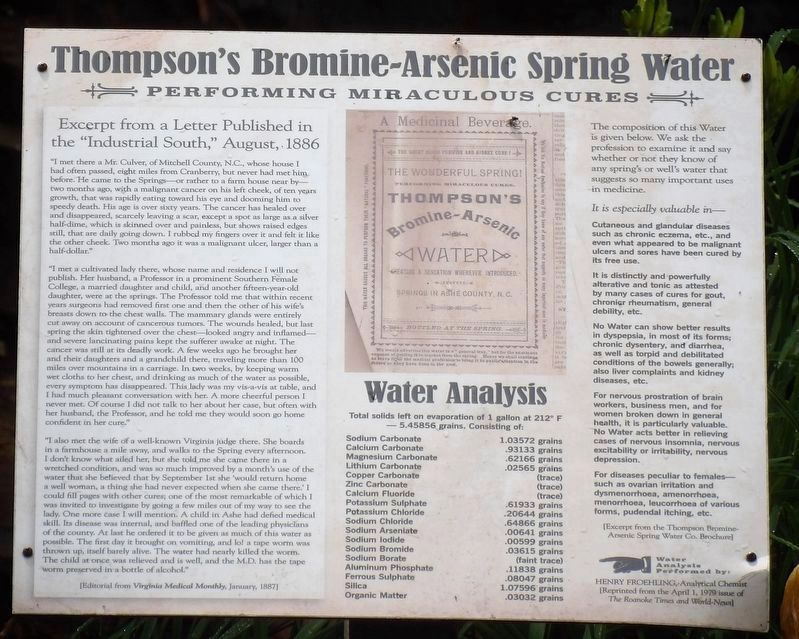
2. Ad for Thompson's Bromide Arsenic Spring Water
It is the marker next to the spring (see photo #4).
In 1888 Captain Thompson changed the name of the spring from The Healing Springs to Thompson Bromine and Arsenic Springs and set about creating a health spa. He built a hotel with a restaurant. The building had nine large guest rooms on the second level with the restaurant below.
An octagonal gazebo was built over the spring in 1889 and the water began to be bottled for sale. A road was built from the spring to Marion, Virginia to afford access to the nearest railway. Between 1889 and 1899 an average of fifty wagon loads per day were shipped in crates of six half gallon bottles costing $6.00 per case of the now called Thompson Spring Water.
A national advertising campaign resulted in 60 agents who could not keep up with the demand for Thompson Bromine Arsenic Water. The spa was such a success that eight separate cabins were constructed to handle the overflow of guests.
Records
Photographed by Duane and Tracy Marsteller, June 24, 2023
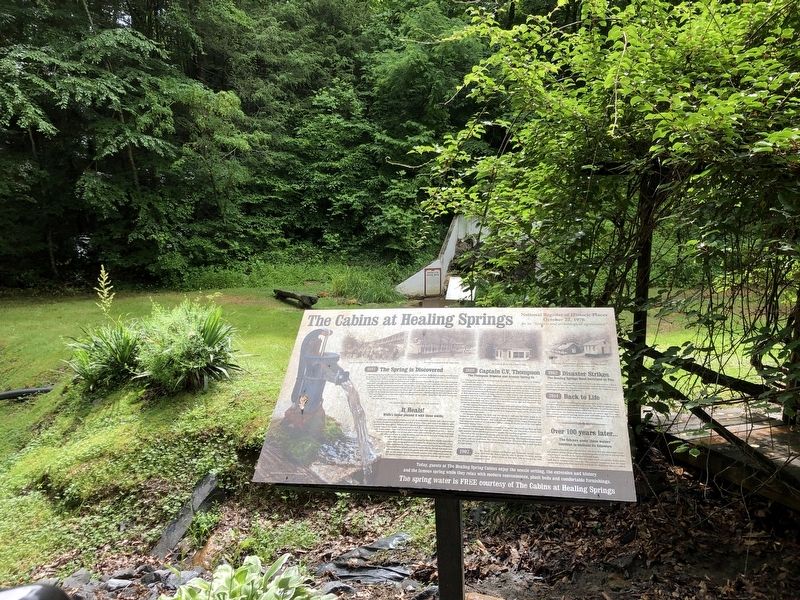
3. The Cabins at Healing Springs Marker
1907 The North Carolina Geological and Economic Survey reported in 1907 that the resort capacity was 75 guests. No other springs were reported in Ashe County at that time. Sale of the spring water stopped in 1946.
The Healing Springs Hotel Destroyed by Fire
Photographed by Duane and Tracy Marsteller, June 24, 2023
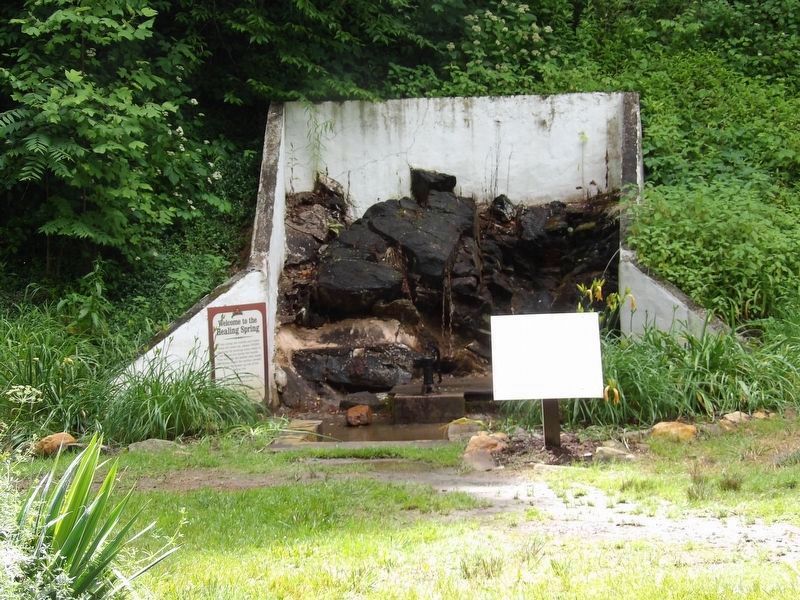
4. The Healing Springs
The marker by the spring displays a Thompson's Bromine Arsenic Spring Water advertisement (see photo #2). The sign on the wall are the rules for use of the spring.
The folklore about these waters continue to enchant its followers
The local folk recommend that one must drink ten glasses of the water each day to maintain the “innards.” For external complaints, lave the water on the affected parts freely and let it dry in the air. Repeat as often as needed.
Today guests at The Healing Spring Cabins enjoy the scenic setting, the extensive and history and the famous spring while they relax with modern conveniences, plush beds and comfortable furnishings.
The spring water is free courtesy of The Cabins at Healing Springs.
Topics and series. This historical marker is listed in these topic lists: Industry & Commerce
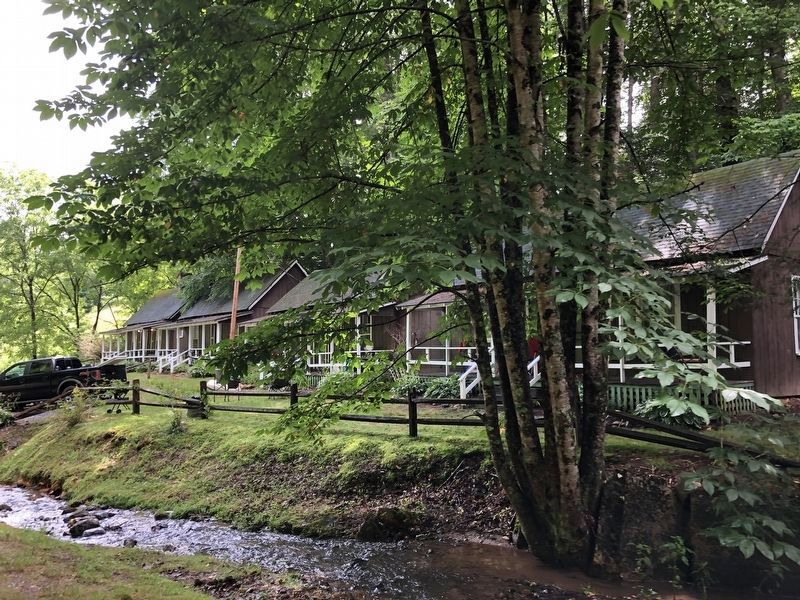
Photographed by Duane and Tracy Marsteller, June 24, 2023
5. Some of The Cabins at Healing Springs
Some cabins date back to the turn of the 20th century.
Location. 36° 30.148′ N, 81° 23.759′ W. Marker is in Crumpler, North Carolina, in Ashe County. It is on Healing Springs Road East 0.3 miles east of Old Highway 16, on the right when traveling east. Touch for map. Marker is at or near this postal address: 1151 Healing Springs Rd E, Crumpler NC 28617, United States of America. Touch for directions.

Regionally, this marker is in andspecifically he Mountains in the High Country. It is also in the American South, specifically in the Upper South, in Appalachia, and specifically in Southern Appalachia. Globally, it is in North America, the Western Hemisphere, the Western World, and the Anglosphere. Historically, it finds itself in what was once the original Cherokee Nation, the territory of the Mississippian Culture, one of the original Thirteen Colonies, one of the Confederate States of America, and the Antebellum South.
Other nearby markers. At least 8 other markers are within 7 miles of this marker, measured as the crow flies: Grayson County, Virginia / North Carolina (approx. 5 miles away); Lansing School (approx. 6.1 miles away); North Carolina / Virginia (approx. 6.3 miles away); Ashe County War Memorial (approx. 6.8 miles away); The Charters of Freedom (approx. 6.8 miles away); Asa Gray (approx. 6.9 miles away); Ashe County Victory Garden (approx. 7 miles away); Old Ashe County War Memorial (approx. 7 miles away).
Also see . . . Thompson's Bromine and Arsenic Springs (PDF). National Register nomination for the property, which was listed in 1976. (National Archives) (Submitted on July 19, 2023, by Duane and Tracy Marsteller of Murfreesboro, Tennessee.)
Credits. This page was last revised on July 19, 2023. It was originally submitted on July 19, 2023, by Duane and Tracy Marsteller of Murfreesboro, Tennessee. This page has been viewed 1,649 times since then and 274 times this year. Photos: 1, 2, 3, 4, 5. submitted on July 19, 2023, by Duane and Tracy Marsteller of Murfreesboro, Tennessee.
