Highland Park in Los Angeles in Los Angeles County, California — The American West (Pacific Coastal)
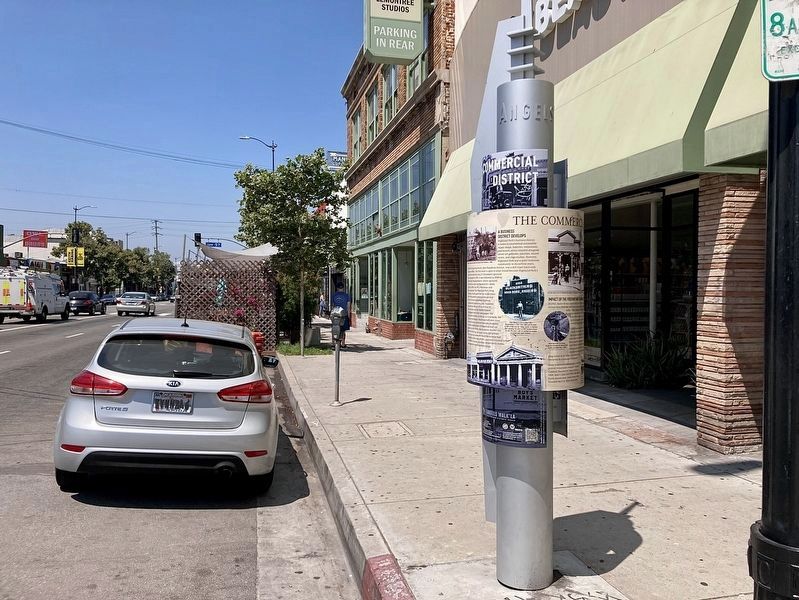
The Commercial District

Photographed by Craig Baker, July 7, 2023
1. The Commercial District Marker
A Business District Develops
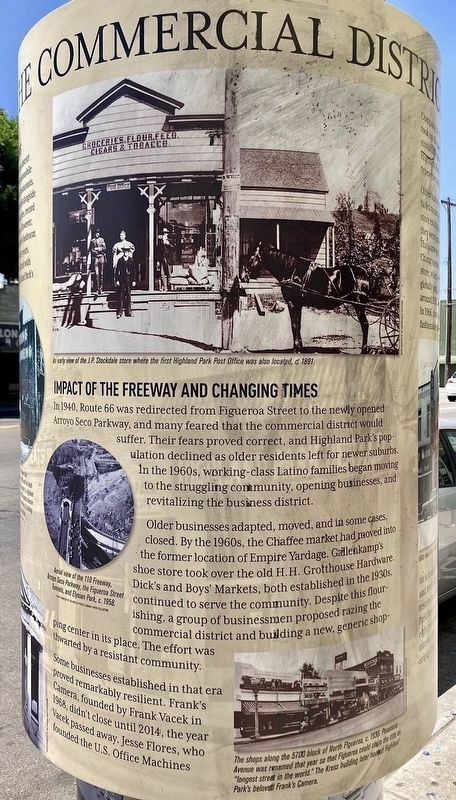
Highland Park's business district is home to established automobile repair shops, bakeries, restaurants, and beauty salons situated alongside newer art galleries, juiceries, record stores, and yoga studios. However, Highland Park was a quiet bedroom community in its earliest years, and North Figueroa Street, then Pasadena Avenue, was a dirt road lined with majestic homes. The first store to open in what would become Highland Park's commercial district was J.P. Stockdale's general store, opened in 1891. It was followed in 1898 by Albert Nies' blacksmithery, which operated on the street until the blacksmith's death in 1954. In 1903, Mr. W.S. Prettyman and his son opened The Highland Park Drug Company, which survived for many years after. 1906 proved to be a milestone year for the "Greatest Suburban Highway," as plans were secured to pave Pasadena Avenue from Avenue 50 to Avenue 61. That year also saw the establishment of Highland Park's first newspaper, the Highland Park Herald, as well as its first bank, the Highland Park Bank, which opened next door. A Pacific Electric streetcar brought shoppers from the communities of Pasadena and Los Angeles. By the 1920s, the business district was positively thriving. In most cases, the private homes that had formerly lined the avenue had relocated to quiet side streets, and their vacated lots were filled by banks, cinemas, department stores, and numerous small specialty shops.
Impact of the Freeway and Changing Times
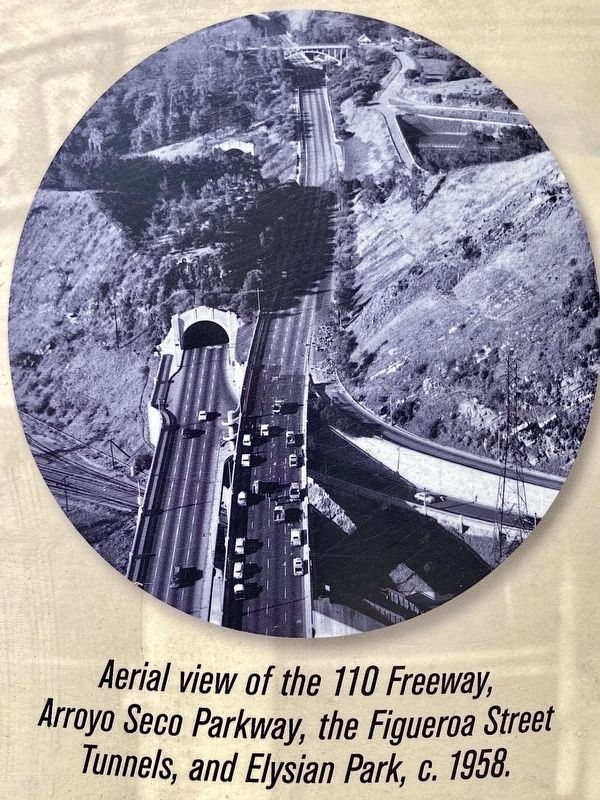
In 1940, Route 66 was redirected from Figueroa Street to the newly opened Arroyo Seco Parkway, and many feared that the commercial district would suffer. Their fears proved correct, and Highland Park's population declined as older residents left for newer suburbs. In the
this page online
Older businesses adapted, moved, and in some cases, closed. By the 1960s, the Chaffee market had moved into the former location of Empire Yardage. Gallenkamp's shoe store took over the old H.H. Grotthouse Hardware. Dick's and Boys' Markets, both established in the 1930s, continued to serve the community. Despite this flourishing, a group of businessmen proposed razing the commercial district and building a new, generic shopping center in its place. The effort was thwarted by a resistant community.
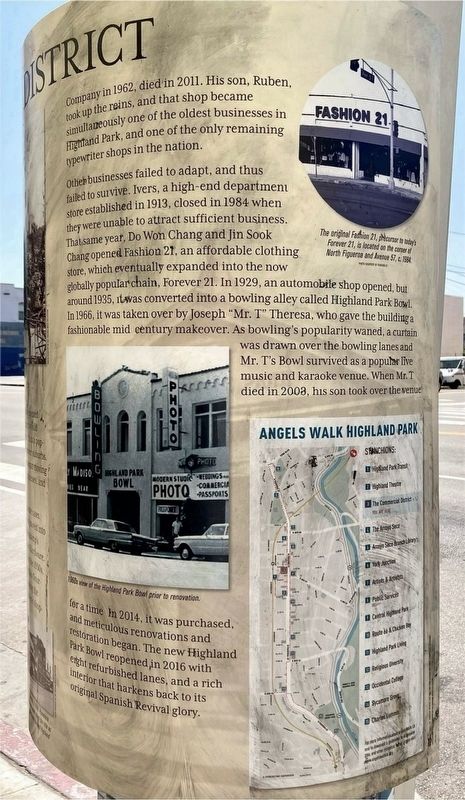
Some businesses established in that era proved remarkably resilient. Frank's Camera, founded by Frank Vacek in 1968, didn't close until 2014, the year Vacek passed away. Jesse Flores, who founded the U.S. Office Machines Company in 1962, died in 2011. His son, Ruben, took up the reins, and that shop became simultaneously one of the oldest businesses in Highland Park, and one of the only remaining typewriter shops in the nation.
Other businesses failed to adapt, and thus failed
Photographed by Craig Baker
2. The Commercial District Marker
Erected 2017 by City of Los Angeles.
Topics. This historical marker is listed in these topic lists: Industry & Commerce • Settlements & Settlers. A significant historical year for this entry is 1903.
Location. 34° 6.6′ N,
Photographed by Craig Baker, July 7, 2023
3. The Commercial District Marker

Regionally, this marker is in California’s Transverse Ranges. It is also on the American Pacific Coast. Globally, it is in North America, on the Ring of Fire, on the Pacific Rim, in the Western Hemisphere, in the Western World, and in the Anglosphere. Historically, it finds itself in what was once New Spain and also Mexico’s Alta California.
Other nearby markers. At least 8 other markers are within walking distance of this marker: Central Highland Park (within shouting distance of this marker); Highland Park Transit (about 400 feet away, measured in a direct line); Highland Park Ebell Club (about 400 feet away); Highland Theatre (about 600 feet away); Smith House (about 600 feet away); G.W.E. Griffith House (about 700 feet away); Public Services (about 700 feet away); Route 66 & Chicken Boy
Photographed by Craig Baker, July 7, 2023
4. The Commercial District Marker
Also see . . . Angels Walk L.A. Self-guided walking tours of historic neighborhoods in Los Angeles. The Commercial District marker is part of the Highland Park walk. (Submitted on July 20, 2023.)
July 7, 2023
5. Marker Detail
Aerial view of the 110 Freeway, Arroyo Seco Parkway, the Figueroa Street Tunnels, and Elysian Park, c. 1958.
Photographed by Craig Baker, October 29, 2023
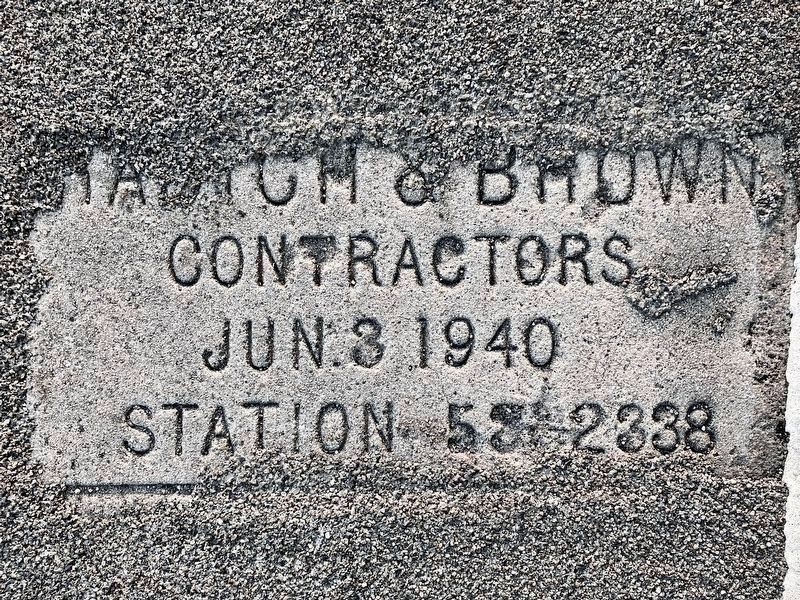
6. Concrete Contractor Stamp
Still visible today on the Arroyo Seco Parkway near 34.1112455, -118.1819520. (Requires freeway closure to view)
Credits. This page was last revised on July 21, 2025. It was originally submitted on July 19, 2023, by Craig Baker of Sylmar, California. This page has been viewed 603 times since then and 57 times this year. Photos: 1, 2, 3, 4, 5. submitted on July 19, 2023, by Craig Baker of Sylmar, California. 6. submitted on July 21, 2025, by Craig Baker of Sylmar, California.
