Colonna in Roma in Città metropolitana di Roma Capitale, Latium, Rome, Italy — Central Italy (Tyrrhenian Coast)
Hotel Pantheon
Photographed by James Hulse, June 13, 2023
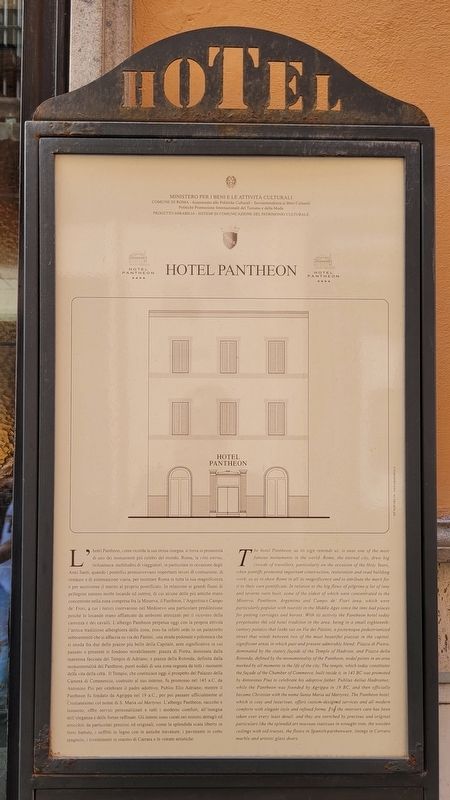
1. Hotel Pantheon Marker
Inscription. L'hotel Pantheon, come ricorda la sua stessa insegna, si trova in prossimità di uno dei monumenti più celebri del mondo. Roma, la città eterna, richiamava moltitudini di viaggiatori, in particolare in occasione degli Anni Santi, quando i pontefici promuovevano importanti lavori di costruzione, di restauro e di sistemazione viaria, per mostrare Roma in tutta la sua magnificenza e per ascriverne il merito al proprio pontificato. In relazione ai grandi flussi di pellegrini sorsero molte locande ed osterie, di cui alcune delle più antiche erano concentrate nella zona compresa fra la Minerva, il Pantheon, l'Argentina e Campo de' Fiori, a cui i turisti riservarono nel Medioevo una particolare predilezione poiché le locande erano affiancate da ambienti attrezzati per il ricovero della carrozza e dei cavalli. L'albergo Pantheon perpetua oggi con la propria attività l'antica tradizione alberghiera della zona, esso ha infatti sede in un palazzetto settecentesco che si affaccia su via dei Pàstini, una strada pedonale e pittoresca che si snoda fra due delle piazze più belle della Capitale, aree significative in cui passato e presente si fondono mirabilmente: piazza di Pietra, dominata dalla maestosa facciata del Tempio di Adriano, e piazza della Rotonda, definita dalla monumentalità del Pantheon, punti nodali di una zona segnata da tutti i momenti della vita della città. Il Tempio, che costituisce oggi il prospetto del Palazzo della Camera di Commercio, costruito al suo interno, fu promosso nel 145 a.C. da Antonino Pio per celebrare il padre adottivo, Publio Elio Adriano; mentre il Pantheon fu fondato da Agrippa nel 19 a.C., per poi passare ufficialmente al Cristianesimo col nome di S. Maria ad Martyres. L'albergo Pantheon, raccolto e lussuoso, offre servizi personalizzati e tutti i moderni comfort, all'insegna
Click or scan to see this page online
dell'eleganza e delle forme raffinate. Gli interni sono curati nei minimi dettagli ed arricchiti da particolari preziosi ed originali, come la splendida scala liberty in ferro battuto, i soffitti in legno con le antiche travature, i pavimenti in cotto spagnolo, i rivestimenti in marmo di Carrara e le vetrate artistiche.
English: The hotel Pantheon, as its sign reminds us, is near one of the most famous monuments in the world. Rome, the eternal city, drew big crowds of travellers, particularly on the occasion of the Holy Years, when pontiffs promoted important construction, restoration and road building work, so as to show Rome in all its magnificence and to attribute the merit for it to their own pontificate. In relation to the big flows of pilgrims a lot of inns and taverns were built, some of the oldest of which were concentrated in the Minerva, Pantheon, Argentina and Campo de' Fiori area, which were particularly popular with tourists in the Middle Ages since the inns had places for putting carriages and horses. With its activity the Pantheon hotel today perpetuates the old hotel tradition in the area, being in a small eighteenth-century
Photographed by James Hulse, June 13, 2023
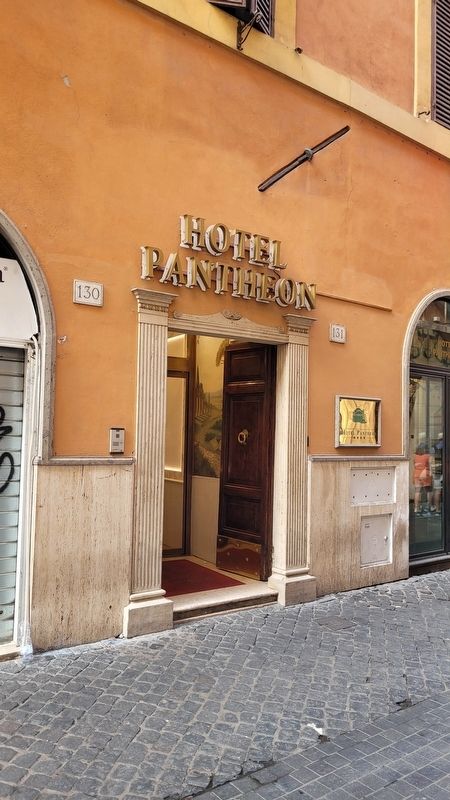
2. The entrance to the Hotel Pantheon
palazzo that looks out on Via dei Pàstini, a picturesque pedestrianized street that winds between two of the most beautiful piazzas in the capital, significant areas in which past and present admirably blend: Piazza di Pietra, dominated by the stately façade of the Temple of Hadrian, and Piazza della Rotonda, defined by the monumentality of the Pantheon, nodal points in an area marked by all moments in the life of the city. The temple, which today constitutes the façade of the Chamber of Commerce, built inside it, in 145 BC was promoted by Antoninus Pius to celebrate his adoptive father, Publius Aelius Hadrianus; while the Pantheon was founded by Agrippa in 19 BC, and then officially became Christian with the name Santa Maria ad Martyres. The Pantheon hotel, which is cosy and luxurious, offers custom-designed services and all modern comforts with elegant style and refined forms. For the interiors care has been taken over every least detail, and they are enriched by precious and original particulars like the splendid art nouveau staircase in wrought iron, the wooden ceilings with old trusses, the floors in Spanish earthenware, linings
Photographed by James Hulse, June 13, 2023
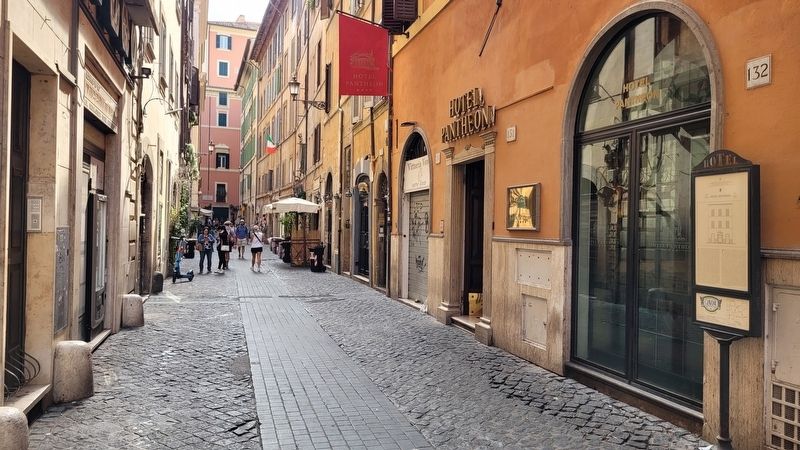
3. The view of the Hotel Pantheon and Marker from the street
in Carrara marble and artistic glass doors.
Erected by Ministero per i Beni e le Attività Culturali, Comune di Roma, Assessorato alle Politiche Culturale, Sovraintendenza ai Beni Culturali, Politiche Promozione Internazionale del Turismo e della Moda, Progetto Mirabilia and Sistemi di Comunicazione del Patrimonio Culturale.
Location. 41° 53.964′ N, 12° 28.647′ E. Marker is in Roma, Lazio (Latium, Rome), in Città metropolitana di Roma Capitale. It is in Colonna. It is at the intersection of Via dei Pastini and Piazza di Rotonda, on the left when traveling west on Via dei Pastini. The marker is located in front of the hotel. Touch for map. Marker is at or near this postal address: Via dei Pastini 131, Roma, Lazio 00186, Italy. Touch for directions.
Regionally, it is in Europe, the European Union, the Schengen Area, a coastal Mediterranean country, and the Western World. Historically, it finds itself in what was once the Roman Empire.
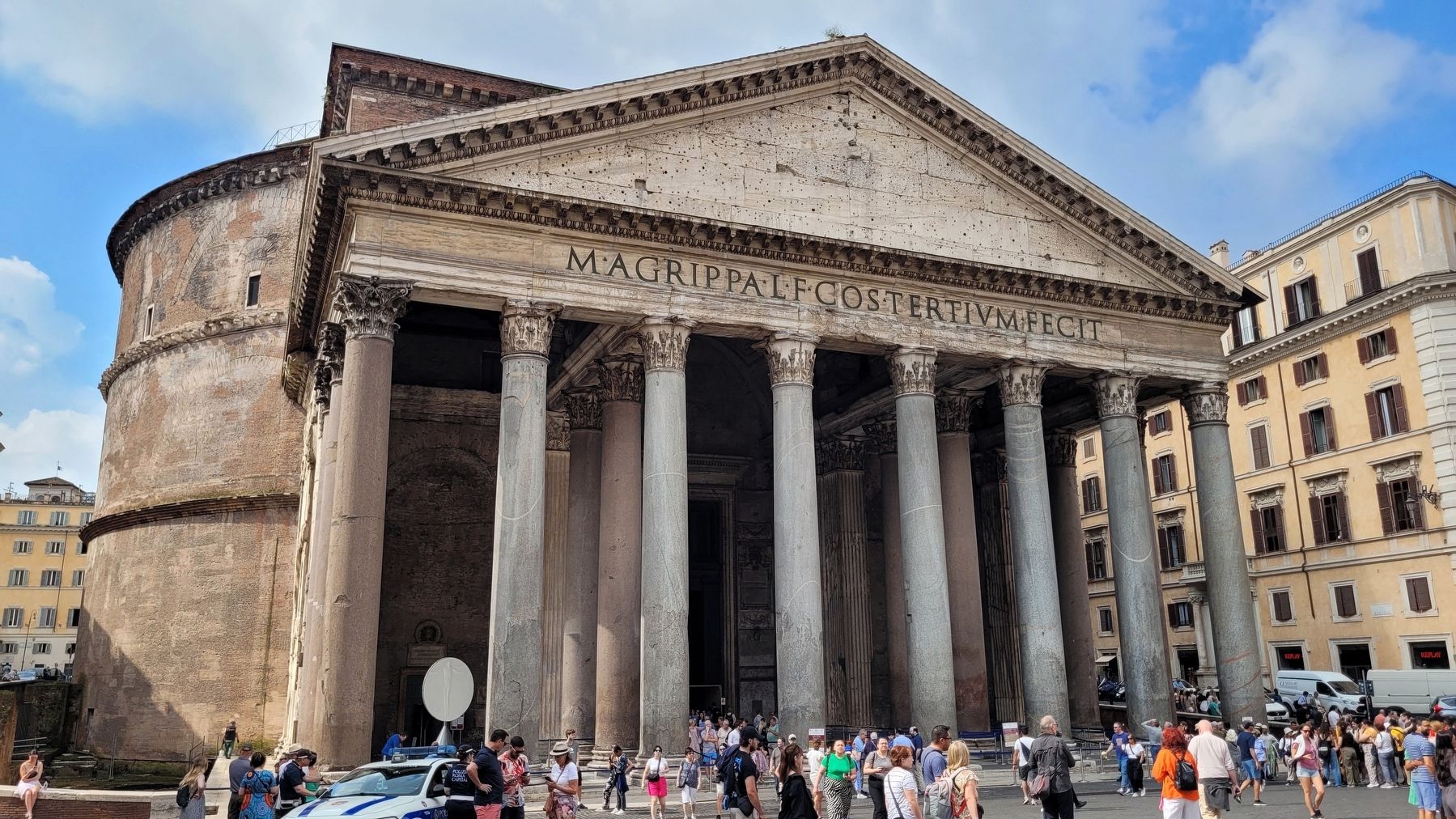
The Pantheon, temple of all the gods, is a former Roman temple and, since 609 AD, a Catholic church (Basilicam Santa Maria ad Martyres or Basilica of St. Mary and the Martyrs) in Rome, Italy, on the site of an earlier temple commissioned by Marcus Agrippa during the reign of Augustus (27 BC – 14 AD). It was rebuilt by the emperor Hadrian and probably dedicated c. 126 AD. Its date of construction is uncertain, because Hadrian chose not to inscribe the new temple but rather to retain the inscription of Agrippa's older temple, which had burned down.
(Submitted on July 24, 2023, by James Hulse of Medina, Texas.)
Credits. This page was last revised on July 25, 2023. It was originally submitted on July 24, 2023, by James Hulse of Medina, Texas. This page has been viewed 169 times since then and 31 times this year. Photos:1, 2, 3, 4. submitted on July 24, 2023, by James Hulse of Medina, Texas.