South Los Angeles in Los Angeles County, California — The American West (Pacific Coastal)
28th Street YMCA
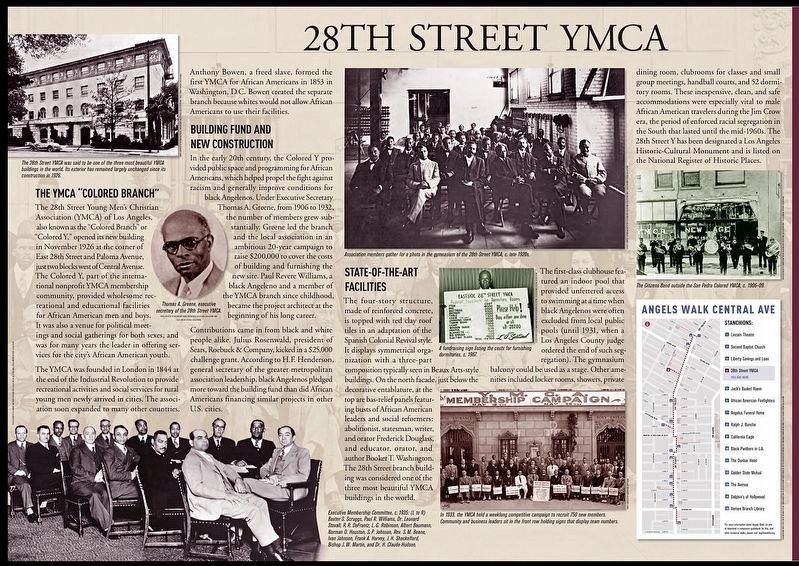
courtesy City of Los Angeles, circa 2020
1. 28th Street YMCA Marker
The YMCA "Colored Branch"
The 28th Street Young Men's Christian Association (YMCA) of Los Angeles, also known as the "Colored Branch or "Colored Y," opened its new building in November 1926 at the corner of East 28th Street and Paloma Avenue, just two blocks west of Central Avenue. The Colored Y, part of the international nonprofit YMCA membership community, provided wholesome recreational and educational facilities for African American men and boys. It was also a venue for political meetings and social gatherings for both sexes, and was for many years the leader in offering services for the city's African American youth.
The YMCA was founded in London in 1844 at the end of the Industrial Revolution to provide recreational activities and social services for rural young men newly arrived in cities. The association soon expanded to many other countries.
Anthony Bowen, a freed slave, formed the first YMCA for African Americans in 1853 in Washington, DC. Bowen created the separate branch because whites would not allow African Americans to use their facilities.
Building Fund and New Construction
this page online
In the early 20th century, the Colored Y provided public space and programming for African Americans, which helped propel the fight against racism and generally improve conditions for black Angelenos. Under Executive Secretary Thomas A. Greene, from 1906 to 1932, the number of members grew substantially. Greene led the branch and the local association in an ambitious 20-year campaign to raise $200,000 to cover the costs of building and furnishing the new site. Paul Revere Williams, a black Angeleno and a member of the YMCA branch since childhood, became the project architect at the beginning of his long career.
Contributions came in from black and white people alike. Julius Rosenwald, president of Seans, Roebuck & Company, kicked in a $25,000 challenge grant. According to H.F. Henderson, general secretary of the greater metropolitan association leadership, black Angelenos pledged more toward the building fand than did African Americans financing similar projects in other U.S. cities.
State-of-the-Art
The four-story structure, made of reinforced concrete, is topped with red clay roof tiles
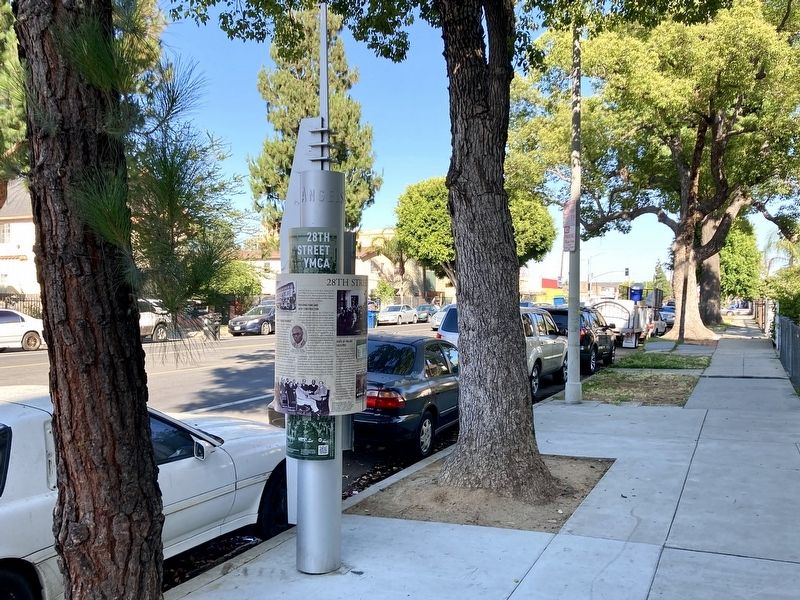
Photographed by Craig Baker
2. 28th Street YMCA Marker
The first-class clubhouse featured an indoor pool that provided unfettered access to swimming at a time when black Angelenos were often excluded from local public pools (until 1931, when a Los Angeles County judge ordered the end of such segregation). The gymnasium balcony could be used as a stage. Other amenities included locker rooms, showers, private dining room, clubrooms for classes and small group meetings, handball courts, and 52 dormitory rooms. These inexpensive, clean, and safe accommodations were especially vital to male African American travelers

Photographed by Craig Baker, July 4, 2023
3. 28th Street YMCA and Marker
The marker is at far left.
Erected 2020 by City of Los Angeles. (Marker Number 851.)
Topics and series. This historical marker is listed in these topic lists: Architecture • Charity & Public Work • Fraternal or Sororal Organizations. In addition, it is included in the Los Angeles Historic-Cultural Monument series list. A significant historical month for this entry is November 1926.
Location. 34° 1.035′ N, 118° 15.425′ W. Marker is in Los Angeles, California, in Los Angeles County. It is in South Los Angeles. It is on 28th Street west of Central Avenue, on the left when traveling west. Touch for map. Marker is at or near this postal address: 1006 E 28th St, Los Angeles CA 90011, United States of America. Touch for directions.

Regionally, this marker is in the Transverse Ranges. It is also on the American Pacific Coast. Globally, it is in North America, on the Ring of Fire, on the Pacific Rim, in the

Photographed by Craig Baker
4. Marker Detail
The 28th Street YMCA was said to be one of the three most beautiful YMCA buildings in the world. Its exterior has remained largely unchanged since its construction in 1926.
Other nearby markers. At least 8 other markers are within walking distance of this marker: Jack’s Basket Room (approx. 0.2 miles away); Jack’s Chicken Basket (approx. 0.2 miles away); Liberty Savings and Loan (approx. 0.2 miles away); Second Baptist Church (approx. ¼ mile away); Lincoln Theatre (approx. 0.3 miles away); Second Baptist Church of Los Angeles (approx. 0.3 miles away); Lincoln Theater (approx. 0.3 miles away); African American Firefighters (approx. 0.3 miles away). Touch for a list and map of all markers in Los Angeles.
Regarding 28th Street YMCA. In 2012, the historic YMCA reopened as 28th Street Apartments after a renovation project that converted the original building and a new addition into forty-nine studio apartments. The building now serves low-income adults and formerly homeless youths transitioning to independent living.
Also see . . . Angeles Walk L.A. Self-guided walking tours of historic neighborhoods in Los Angeles. The 28th Street

Photographed by Craig Baker
5. Street Sign
Y.M.C.A. - Cultural Heritage Board Monument No. 851
Credits. This page was last revised on May 21, 2026. It was originally submitted on July 24, 2023, by Craig Baker of Sylmar, California. This page has been viewed 741 times since then and 130 times this year. Photos: 1, 2, 3, 4, 5. submitted on July 24, 2023, by Craig Baker of Sylmar, California.
