Old Sacramento in Sacramento County, California — The American West (Pacific Coastal)
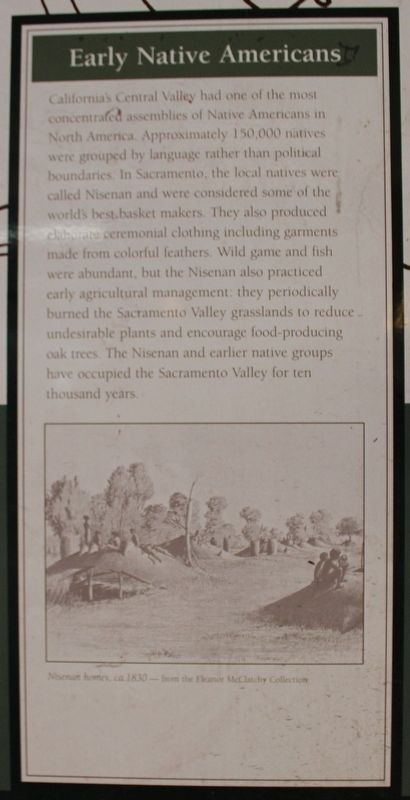
Early Native Americans
Photographed by Joseph Alvarado, May 24, 2023
1. Early Native Americans Marker
Topics. This historical marker is listed in this topic list: Indigenous Peoples and Communities.
Location. 38° 34.916′ N, 121° 30.251′ W. Marker is in Sacramento, California, in Sacramento County. It is in Old Sacramento. It can be reached from the intersection of K Street and Interstate 5, on the right when traveling east. The metal marker is mounted along the pedestrian walk where K Street extends under the freeway overpass towards downtown. Touch for map. Marker is in this post office area: Sacramento CA 95814, United States of America. Touch for directions.

Regionally, this marker is in the Sacramento Valley and specifically in the Central Valley. It is also on the American Pacific Coast. Globally, it is in North America, on the Ring of Fire, on the Pacific Rim, in the Western Hemisphere, in the Western World, and in the Anglosphere. Historically, it finds itself in what was once New Spain and also Mexico’s Alta California.
Other nearby markers. At least 8 other markers are within walking distance of this marker: Early Explorers
this page online
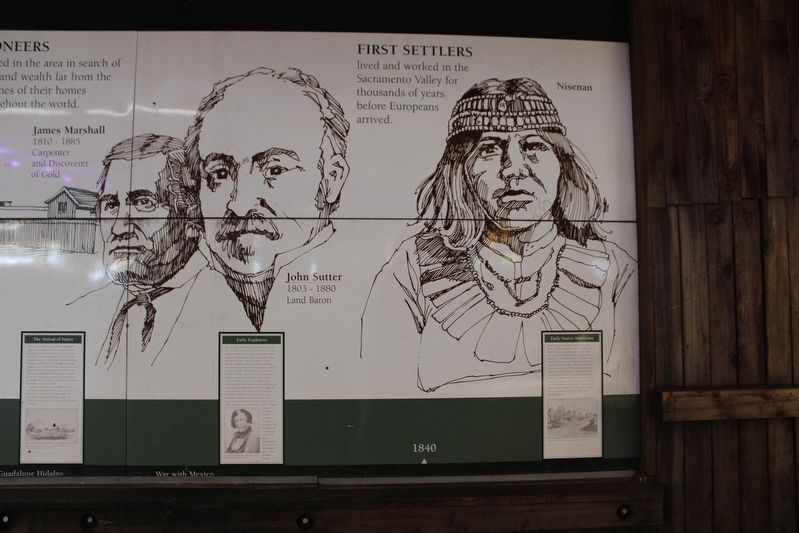
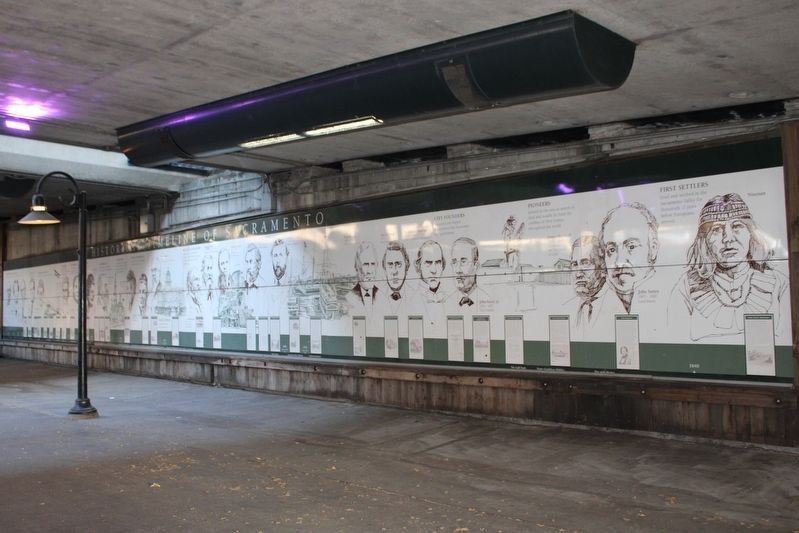
More about this marker. The marker is part of the Historical Timeline of Sacramento.
Inset Image:
Nisenan homes, ca. 1830 – from the Eleanor McClatchy Collection
Related marker. Click here for another marker that is related to this marker. Historical Timeline of Sacramento
Also see . . . Nisenan. Wikipedia
"The Nisenan were initially unaffected by European influence. In the early nineteenth century, their initial encounters with Spanish and U.S. expeditions were peaceful. In 1833, a severe malaria epidemic spread, which killed many of the Nisenan as well as other neighboring tribes."(Submitted on August 2, 2023, by Joseph Alvarado of Livermore, California.)
Photographed by Joseph Alvarado, May 24, 2023
2. Early Native Americans Marker
Photographed by Joseph Alvarado, May 24, 2023
3. Early Native Americans Marker Within the Timeline
Credits. This page was last revised on August 2, 2023. It was originally submitted on August 2, 2023, by Joseph Alvarado of Livermore, California. This page has been viewed 212 times since then and 15 times this year. Photos: 1, 2, 3. submitted on August 2, 2023, by Joseph Alvarado of Livermore, California.
