Pratt in Pratt County, Kansas — The American Midwest (Upper Plains)
Welcome to Historical World War II Pratt Army Airfield

Photographed by Cosmos Mariner, July 24, 2023
1. Welcome to Historical World War II Pratt Army Airfield Marker
The Pratt Army Air Field is an important site that shares the birthplace of the B-29 Program, a program that defeated Japan in three years nine months and ushered in atomic warfare. Site preparation grading started in October 1942; the first building on the airfield was the engineer's building. In January 1943, the 502nd Base Headquarters and Air Base Squadron were activated to function as the administrative and training squadron for the other organizations which would be assigned to the base. On February 1, 1943, the first detachment of twelve men arrived. On 6 March 1943 Lt. Col. J.F. Nelson assumed command of the field, and the installation began to function as a military post with the barest of essentials in housing, messing, and administrative equipment. On May 2, 1943, an open house was held for the public, and the field was officially dedicated.
The mission of the field was to train B-29 crews. Qualified pilots, flight engineers, radar operators, bombardiers, navigators, radio operators, and gunnery personnel formed 11-man crews and received instruction and hands-on training with B-29s. Maintenance was a big problem
this page online
The 40th Bomb Group arrived at Pratt Army Air Field in July 1943. The 29th and 497th Bomb Groups followed in April and May 1944. The 346th Bomb Group replaced the 29th and 497th in Jan 1945 and were replaced by the 93rd Bomb Group in July. Processing recorded a total of over 13,000 men and women during its three years in Pratt. Three hundred ninety-two B-29 crews completed training at PAAF. Two hundred thirty-two of these crews were sent to airfields in China, and on Guam, Saipan, and Tinian for raids on Japan.
The Air Field was closed on 31 December 1945. In its final edition the Pratt Army Air Field newsletter "Tailwind" said, "To sum up the operation and the effectiveness of PAAF requires no flowery words or elaboration on the actual facts. The records speak for themselves. Pratt trained the first B-29 Group to see active service overseas,
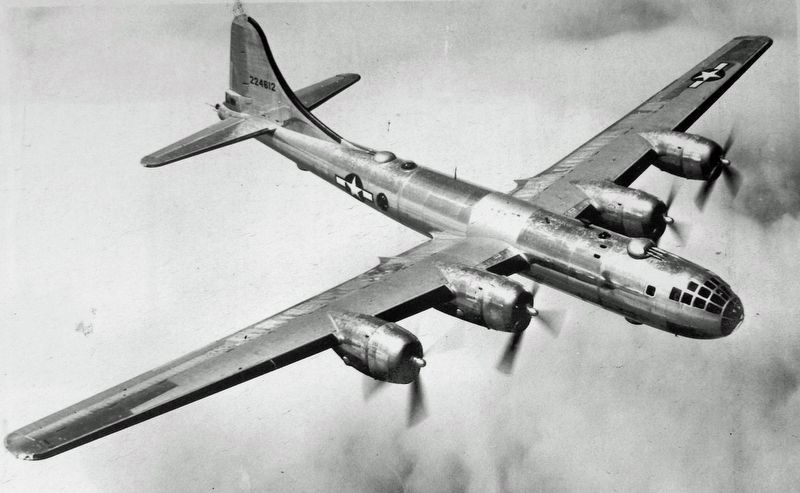
2. Marker detail: B-29 Illustration
Text by David Stitt, Virginia Hoover and Jim Bowman
Credit Reference: Giannangelo, Dorthea. Pratt Army Air Field: World War II 1943-1945 Publisher Unknown. 2002. Copy is on file at KSHS Cultural Resources Division
Funded in part by a grant from the Recreational Trails Program, administered by the Kansas Department of Wildlife, Parks and Tourism.
Sign frame by Pratt Well Service, Skaggs Ace Hardware and B29 Museum
Sign by Lowen Sign, Hutchinson, KS
Erected by Kansas

Photographed by Cosmos Mariner, July 24, 2023
3. Welcome to Historical World War II Pratt Army Airfield Marker
Topics. This historical marker is listed in these topic lists: Air & Space • Education • War, World II. A significant historical date for this entry is May 2, 1943.
Location. 37° 42.271′ N, 98° 44.382′ W. Marker is in Pratt, Kansas, in Pratt County. It can be reached from the intersection of U.S. 281 and Northeast 40th Street (Flint Road), on the left when traveling north. Marker is located in front of the B-29 All Veterans Memorial on the grounds of Pratt Regional Airport (the former Pratt Army Air Field). Touch for map. Marker is at or near this postal address: 40131 Barker Avenue, Pratt KS 67124, United States of America. Touch for directions.

Regionally, this marker is in Central Kansas. It is also in the American Midwest, in the Corn Belt, on the prairies, and on the Southern Plains. Globally, it is in North America, the Western Hemisphere, the Western World, and the Anglosphere. Historically, it finds itself in what was once the Louisiana Purchase.
Other nearby markers. At least 8 other markers are within walking distance of this marker: McDonnell Douglas F-4C (within shouting distance of this marker); Bell AH-1F Cobra Helicopter (within shouting distance of this marker); Northrop AT-38B "Talon" (within shouting distance of this marker); B-29 All Veterans Memorial (within shouting distance of this marker); Pratt Army Air Field (within shouting distance of this marker); 45th Bombardment Squadron (VH) Honored Dead (within shouting distance of this marker); 29th Bomb Group (within shouting distance of this marker); 58th Bomb Wing (within shouting distance of this marker). Touch for a list and map of all markers in Pratt.
Related markers. Click here for a list of markers that are related to this marker. Pratt Army Air Field Historical Walk
Also see . . . Pratt Army Air Field (Wikipedia). Excerpt:
Pratt Army Air Field is significantly historic as it was the first United States Army Air Forces B-29 Superfortress station, receiving the prototype YB-29 bomber in the summer of 1943. Eventually, Pratt AAF would have three 8,000-foot-long main runways and five hangars. The War Assets Administration eventually turned the air base over to local government officials. The airfield was converted to civil use and is now known as Pratt Regional Airport.(Submitted on August 5, 2023, by Cosmos Mariner of Cape Canaveral, Florida.)
Credits. This page was last revised on August 8, 2023. It was originally submitted on August 3, 2023, by Cosmos Mariner of Cape Canaveral, Florida. This page has been viewed 970 times since then and 118 times this year. Photos: 1, 2, 3. submitted on August 5, 2023, by Cosmos Mariner of Cape Canaveral, Florida.
