Litchfield in Northwest Hills Region, Connecticut — The American Northeast (New England)
The Orchard
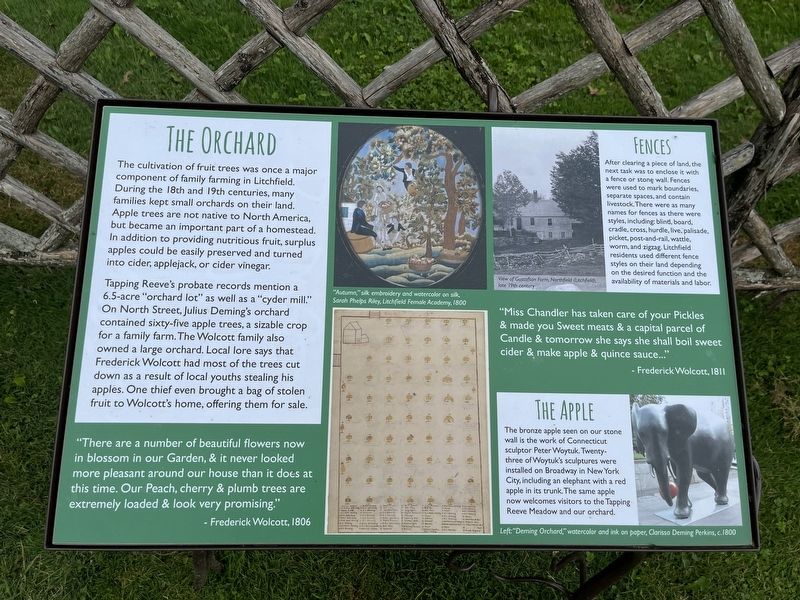
The cultivation of fruit trees was once a major component of family farming in Litchfield. During the 18th and 19th centuries, many families kept small orchards on their land. Apple trees are not native to North America, but became an important part of a homestead. In addition to providing nutritious fruit, surplus apples could be easily preserved and turned into cider, applejack, or cider vinegar.
Tapping Reeve's probate records mention a 6.5-acre "orchard lot" as well as a "cyder mill." On North Street, Julius Deming's orchard contained sixty-five apple trees, a sizable crop for a family farm. The Wolcott family also owned a large orchard. Local lore says that Frederick Wolcott had most of the trees cut down as a result of local youths stealing his apples. One thief even brought a bag of stolen fruit to Wolcott's home, offering them for sale.
"There are a number of beautiful flowers now in blossom in our Garden, & it never looked more pleasant around our house than it does at this time. Our Peach, cherry & plumb trees are extremely loaded & look very promising."
- Frederick Wolcott, 1806
Fences
After clearing
this page online
"Miss Chandler has taken care of your Pickles & made you Sweet meats & a capital parcel of Candle & tomorrow she says she shall boil sweet cider & make apple & quince sauce…"
- Frederick Wolcott, 1811
The Apple
The bronze apple seen on our stone wall is the work of Connecticut sculptor Peter Woytuk. Twenty-three of Woytuk's sculptures were installed on Broadway in New York City, including an elephant with a red apple in its trunk. The same apple now welcomes visitors to the Tapping Reeve Meadow and our orchard.
Erected by Litchfield Historical Society.
Topics. This historical marker is listed in these topic lists: Agriculture • Architecture •
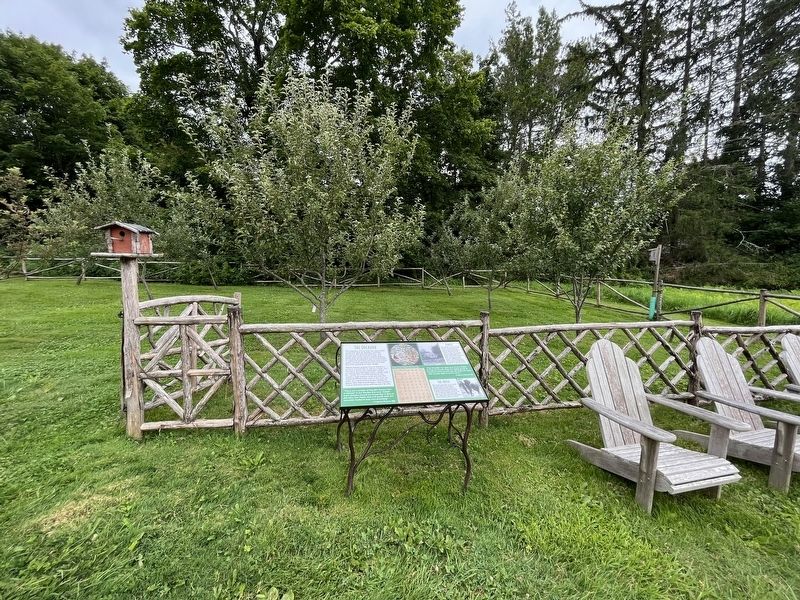
Location. 41° 44.621′ N, 73° 11.358′ W. Marker is in Litchfield in Northwest Hills Region, Connecticut. It can be reached from South Street (Connecticut Route 63) north of Wolcott Street, on the right when traveling south. Touch for map. Marker is in this post office area: Litchfield CT 06759, United States of America. Touch for directions.

Regionally, this marker is in the Berkshire Foothills and in the Litchfield Hills. It is also in the American Northeast and in New England. Globally, it is in North America, the Western Hemisphere, the Western World, and the Anglosphere. Historically, it finds itself in what was once Litchfield County and also one of the original Thirteen Colonies.
Other nearby markers. At least 8 other markers are within walking distance of this marker: Welcome to the Tapping Reeve Meadow (a few steps from this marker); The Garden (a few steps from this marker); Stone Walls • Chestnut Grove • Wet Meadow (within shouting distance of this marker); Oliver Wolcott Jr. Home (approx. 0.2 miles away); Litchfield World War I Monument (approx. ¼ mile away); Site of Recruiting Tent (approx. ¼ mile away); War on Terrorism Memorial (approx. ¼ mile away); Litchfield Vietnam War Monument (approx. ¼ mile away). Touch for a list and map of all markers in Litchfield.
Another marker is no longer nearby. Earliest American Law School (was about 400 feet away, measured in a direct line but has been permanently removed).
Credits. This page was last revised on May 19, 2026. It was originally submitted on August 9, 2023, by Devry Becker Jones of Washington, District of Columbia. This page has been viewed 308 times since then and 28 times this year. Photos: 1, 2. submitted on August 9, 2023, by Devry Becker Jones of Washington, District of Columbia.
