Litchfield in Northwest Hills Region, Connecticut — The American Northeast (New England)
The Garden
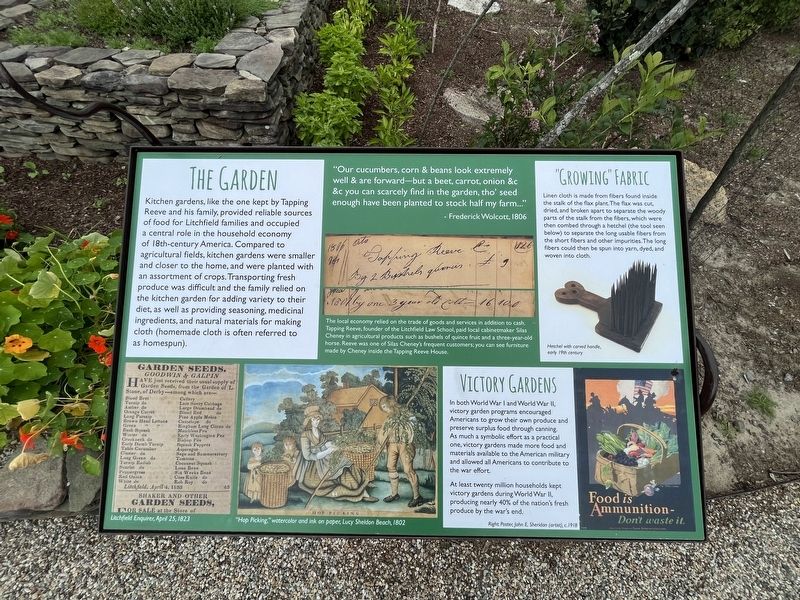
Kitchen gardens, like the one kept by Tapping Reeve and his family, provided reliable sources of food for Litchfield families and occupied a central role in the household economy of 18th-century America. Compared to agricultural fields, kitchen gardens were smaller and closer to home, and were planted with an assortment of crops. Transporting fresh produce was difficult and the family relied on the kitchen garden for adding variety to their diet, as well as providing seasoning, medicinal ingredients, and natural materials for making cloth (homemade cloth is often referred to as homespun).
"Our cucumbers, corn & beans look extremely well & are forward—but a beet, carrot, onion &c &c you can scarcely find in the garden, tho' seed enough have been planted to stock half my farm…"
- Frederick Wolcott, 1806
"Growing" Fabric
Linen cloth is made from fibers found inside the stalk of the flax plant. The flax was cut, dried, and broken apart to separate the woody parts of the stalk from the fibers, which were then combed through a hetchel (the tool seen below) to separate the long usable fibers from the short fibers and
this page online
Victory Gardens
In both World War I and World War II, victory garden programs encouraged Americans to grow their own produce and preserve surplus food through canning. As much as a symbolic effort as a practical one, victory gardens made more food and materials available to the American military and allowed all Americans to contribute to the war effort.
At least twenty million households kept victory gardens during World War II, producing nearly 40% of the nation's fresh produce by war's end.
[Caption:]
The local economy relied on the trade of goods and services in addition to cash. Tapping Reeve, founder of Litchfield Law School, paid local cabinetmaker Silas Cheney in agricultural products such as bushels of quince fruit and a three-year-old horse. Reeve was one of Silas Cheney's frequent customers; you can see furniture made by Cheney inside the Tapping Reeve Home.
Erected by Litchfield Historical Society.
Topics. This historical marker is listed in these topic lists: Agriculture • Industry & Commerce • War, World I
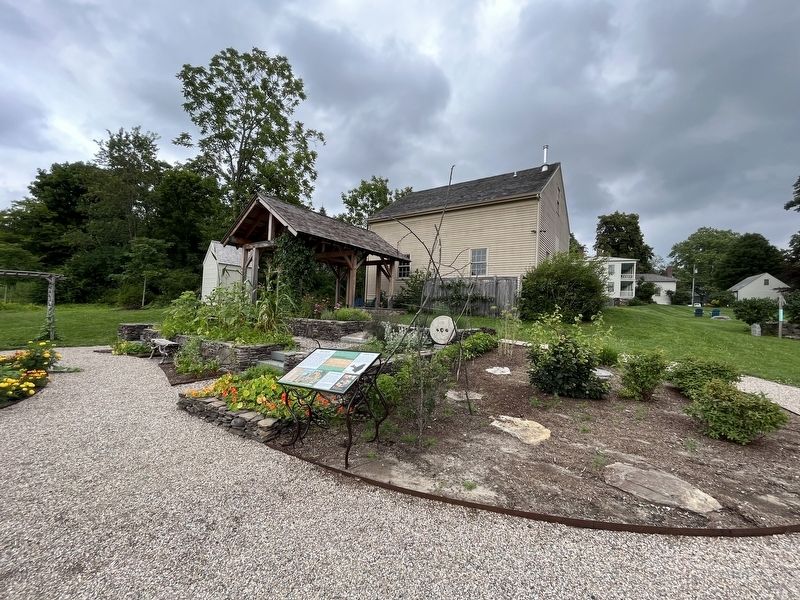
Location. 41° 44.632′ N, 73° 11.361′ W. Marker is in Litchfield in Northwest Hills Region, Connecticut. It can be reached from South Street (Connecticut Route 63) north of Wolcott Street, on the right when traveling south. Touch for map. Marker is in this post office area: Litchfield CT 06759, United States of America. Touch for directions.

Regionally, this marker is in the Berkshire Foothills and in the Litchfield Hills. It is also in the American Northeast and in New England. Globally, it is in North America, the Western Hemisphere, the Western World, and the Anglosphere. Historically, it finds itself in what was once Litchfield County and also one of the original Thirteen Colonies.
Other nearby markers. At least 8 other markers are within walking distance of this marker: The Orchard (a few steps from this marker); Stone Walls • Chestnut Grove • Wet Meadow (a few steps from this marker); Welcome to the Tapping Reeve Meadow (within shouting distance of this marker); Oliver Wolcott Jr. Home (approx. 0.2 miles away); Litchfield World War I Monument (approx. 0.2 miles away); Site of Recruiting Tent (approx. 0.2 miles away); War on Terrorism Memorial (approx. ¼ mile away); Litchfield Vietnam War Monument (approx. ¼ mile away). Touch for a list and map of all markers in Litchfield.
Another marker is no longer nearby. Earliest American Law School (was about 300 feet away, measured in a direct line but has been permanently removed).
Additional keywords. barter economy
Credits. This page was last revised on May 19, 2026. It was originally submitted on August 9, 2023, by Devry Becker Jones of Washington, District of Columbia. This page has been viewed 158 times since then and 19 times this year. Photos: 1, 2. submitted on August 9, 2023, by Devry Becker Jones of Washington, District of Columbia.
