Near Long Grove in Scott County, Iowa — The American Midwest (Upper Plains)
St. Ann's Church
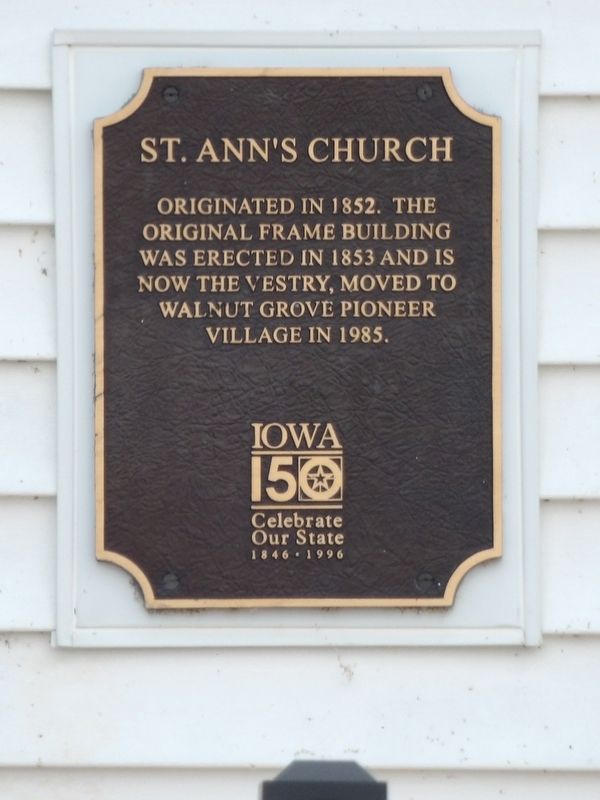
Photographed by Duane and Tracy Marsteller, July 8, 2023
1. St. Ann's Church Marker
Topics. This historical marker is listed in these topic lists: Architecture • Religion & Religious Structures. A significant historical year for this entry is 1852.
Location. 41° 43.645′ N, 90° 31.939′ W. Marker is near Long Grove, Iowa, in Scott County. It is on 290th Street ¼ mile east of Veterans Way, on the right when traveling east. Marker is in Dan Nagle Walnut Grove Pioneer Village. Touch for map. Marker is at or near this postal address: 18817 290th St, Long Grove IA 52756, United States of America. Touch for directions.

Regionally, this marker is in the Quad Cities and in Eastern Iowa. It is also in the American Midwest, in the Corn Belt, and in the Great River Road Region. Globally, it is in North America, the Western Hemisphere, the Western World, and the Anglosphere. Historically, it finds itself in what was once the territory of the Mississippian Culture and also the Louisiana Purchase.
Other nearby markers. At least 8 other markers are within 13 miles
this page online
Other markers no longer nearby. Historic Davenport / Interstate 80 Bridge (was approx. 9.4 miles away but has been confirmed missing); a different marker also named Historic Davenport / Interstate 80 Bridge (was approx. 9.4 miles away but has been permanently removed).
Also see . . . The History of St. Anns Parish. A small wooden frame structure served as the original church from 1853 until 1870. This building seated about 50 people, and the parish outgrew it quickly. In 1870, a larger church was built and the original structure was used as a vestry. The wooden frame church seated just 250 people, but served the congregation well
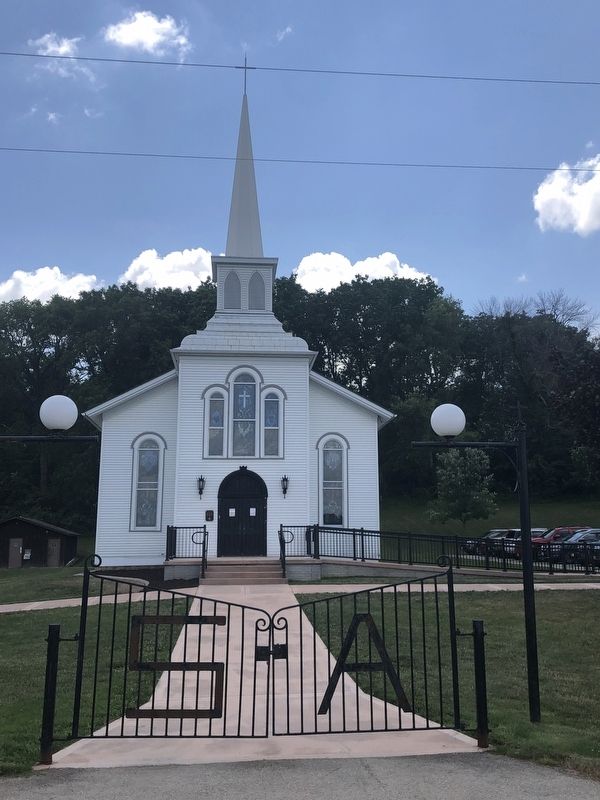
Photographed by Duane and Tracy Marsteller, July 8, 2023
2. St. Ann's Church Marker
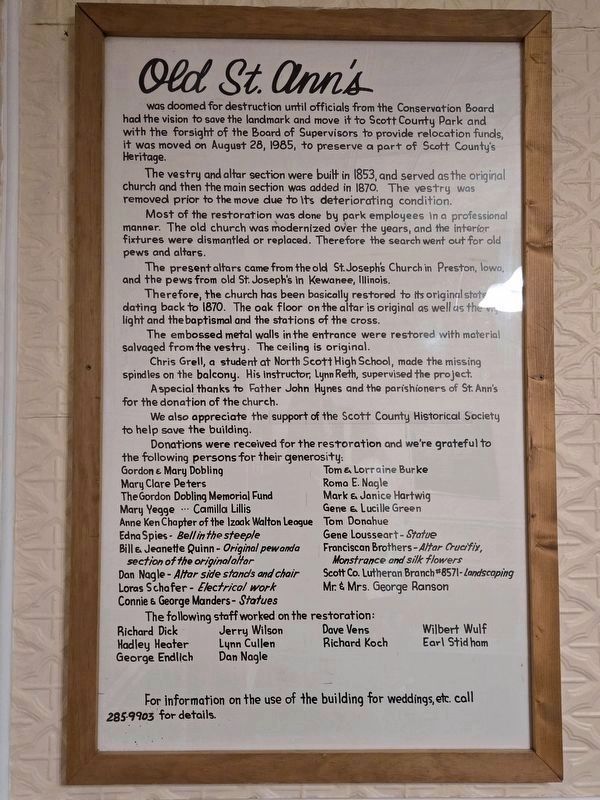
Photographed by Mark Parker, June 25, 2024
3. History of Old St. Ann's
Old St. Ann's was doomed for destruction until officials from the Conservation Board had the vision to save the landmark and move it to Scott County Park and with the forsight of the Board of Supervisors to provide relocation funds, it was moved on August 28, 1985, to preserve a part of Scott County's Heritage.
The vestry and altar section were built in 1853, and served as the original church and then the main section Was added in 1870. The vestry Was removed prior to the move due to Its deteriorating condition.
Most of the restoration was done by park employees in a professional manner. The old church was modernized over the years and the interior fixtures were dismantled or replaced. Therefore the search went out for old pews and altars.
The present altars came from the old St. Joseph's Church in Preston, lowa, and the pews from old St. Joseph's in Kewanee, Illinois.
Therefore, the church has been basically restored to its original state dating back to 1870. The oak floor on the altar is original as well as the org. light and the baptismal and the stations of the cross.
The embossed metal walls in the entrance were restored with material salvaged from the vestry. The ceiling is original.
Chris Grell, a student at North Scott High School, made the missing spindles on the balcony. His instructor, Lynn Reth, supervised the project.
The vestry and altar section were built in 1853, and served as the original church and then the main section Was added in 1870. The vestry Was removed prior to the move due to Its deteriorating condition.
Most of the restoration was done by park employees in a professional manner. The old church was modernized over the years and the interior fixtures were dismantled or replaced. Therefore the search went out for old pews and altars.
The present altars came from the old St. Joseph's Church in Preston, lowa, and the pews from old St. Joseph's in Kewanee, Illinois.
Therefore, the church has been basically restored to its original state dating back to 1870. The oak floor on the altar is original as well as the org. light and the baptismal and the stations of the cross.
The embossed metal walls in the entrance were restored with material salvaged from the vestry. The ceiling is original.
Chris Grell, a student at North Scott High School, made the missing spindles on the balcony. His instructor, Lynn Reth, supervised the project.

Photographed by Mark Parker, June 25, 2024
4. St. Ann's Church altar and nave
Used in the restoration of St. Ann's, the altar was originally at St. Joseph's Church in Preston, Iowa. The pews are originally from St. Joseph's in Kewanee, Illinois
Credits. This page was last revised on October 20, 2025. It was originally submitted on August 9, 2023, by Duane and Tracy Marsteller of Murfreesboro, Tennessee. This page has been viewed 230 times since then and 21 times this year. Photos: 1, 2. submitted on August 9, 2023, by Duane and Tracy Marsteller of Murfreesboro, Tennessee. 3, 4. submitted on July 13, 2024, by Mark Parker of Hickory, North Carolina.
