North Bridgeport in Greater Bridgeport Region, Connecticut — The American Northeast (New England)
Black-Tailed Prairie Dog
Cynomys ludovicianus
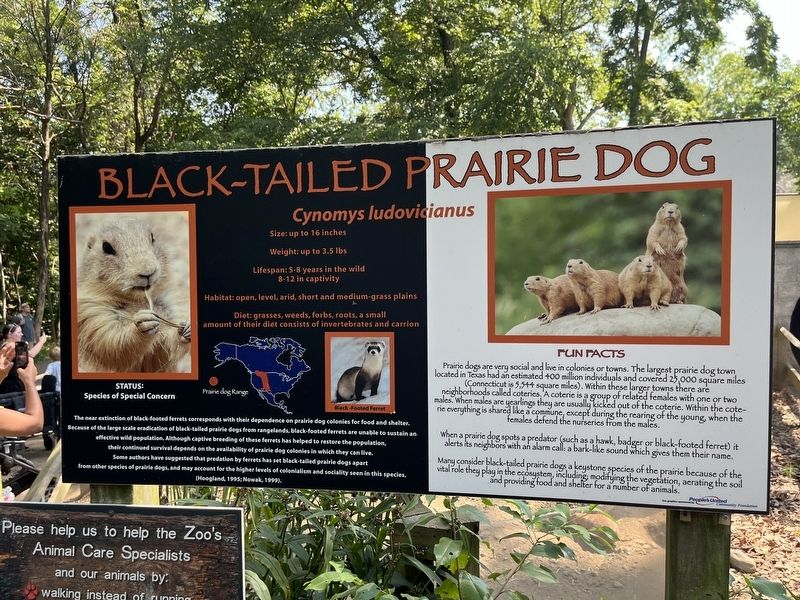
Size: up to 16 inches
Weight: up to 3.5 lbs
Lifespan: 5-8 years in the wild[;] 8-12 years in captivity
Habitat: open, level, arid, short and medium-grass plains
Diet: grasses, weeds, forbs, roots, a small amount of their diet consists of invertebrates and carrion
Status: Species of Special Concern
The near extinction of black-footed ferrets corresponds with their dependence on prairie dog colonies for food and shelter. Because of the large scale eradication of black-tailed prairie dogs from rangelands, black-footed ferrets are unable to sustain an effective wild population. Although captive breeding of these ferrets has helped to restore the population, their continued survival depends on the availability of prairie dog colonies in which they can live. Some authors have suggested that predation by ferrets has set black-tailed prairie dogs apart from other species of prairie dogs, and may account for the higher levels of colonialism and sociality seen in this species. (Hoogland, 1995; Nowak, 1999).
Fun Facts
Prairie dogs are very social and live in colonies or towns. The largest prairie dog town located in
this page online
When a prairie dog spots a predator (such as a hawk, badger or black-footed ferret) it alerts its neighbors with an alarm call: a bark-like sound which gives them their name.
Many consider black-tailed prairie dogs a keystone species of the prairie because of the vital role they play in the ecosystem, including; modifying the vegetation, aerating the soil and providing food and shelter for a number of animals.
Erected by Connecticut's Beardsley Zoo.
Topics. This historical marker is listed in these topic lists: Animals • Environment.
Location. 41° 12.76′ N, 73° 10.915′ W. Marker is in Bridgeport in Greater Bridgeport
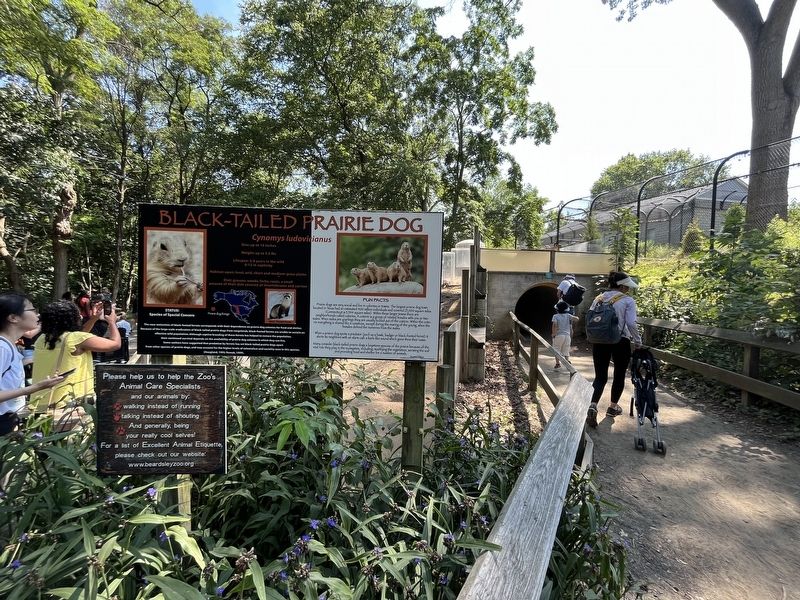

Regionally, this marker is on the Connecticut Shoreline. It is also in the American Northeast, in New England, and on the Eastern Seaboard. Globally, it is in the North Atlantic Region, North America, the Western Hemisphere, the Western World, and the Anglosphere. Historically, it finds itself in what was once Fairfield County and also one of the original Thirteen Colonies.
Other nearby markers. At least 8 other markers are within walking distance of this marker: Barred Owl (a few steps from this marker); Bears - The Sun, the Moon, and the Stars (within shouting distance of this marker); Rare Bears (within shouting distance of this marker); Domestic Cattle (within shouting distance of this marker); American Bison (about 300 feet away, measured in a direct line); Dexter Cattle (about 300 feet away); Guinea Hogs (about 300 feet away); White-Tailed Deer (about 300 feet away). Touch for a list and map of all markers in Bridgeport.
Credits. This page was last revised on May 19, 2026. It was originally submitted on August 16, 2023, by Devry Becker Jones of Washington, District of Columbia. This page has been viewed 198 times since then and 24 times this year. Photos: 1, 2. submitted on August 16, 2023, by Devry Becker Jones of Washington, District of Columbia.
