DeKalb in DeKalb County, Illinois — The American Midwest (Great Lakes)
Barbed Wire Manufacturing
1873 – 1938

Photographed by Duane and Tracy Marsteller, July 9, 2023
1. Barbed Wire Manufacturing Marker
This house, built in 1861, was the home of Joseph Glidden, who in 1873 invented barbed wire fencing. With Phineas W. Vaughn he perfected a machine to manufacture it. DeKalb was the home of Isaac L. Ellwood and Jacob Haish, also manufacturers of barbed wire. Haish developed the S-barb. DeKalb became the manufacturing center for barbed wire, significant in the development of the west.
Erected 1955 by Illinois State Historical Society.
Topics and series. This historical marker is listed in this topic list: Industry & Commerce. In addition, it is included in the Illinois State Historical Society series list. A significant historical year for this entry is 1873.
Location. 41° 55.898′ N, 88° 46.231′ W. Marker is in DeKalb, Illinois, in DeKalb County. It can be reached from West Lincoln Highway (Illinois Route 38) east of West Locust Street, on the left when traveling east. Marker is in front of the Joseph F. Glidden Homestead and Historical Center. The museum is behind an old gas station presently occupied by a florist. Touch for map. Marker is at or near this postal address: 921 W Lincoln Hwy, Dekalb IL 60115, United States
this page online

Regionally, this marker is in Northern Illinois. It is also in the American Midwest and in the Corn Belt. Globally, it is in North America, the Western Hemisphere, the Western World, and the Anglosphere. Historically, it finds itself in what was once the territory of the Mississippian Culture and also the Northwest Territory.
Other nearby markers. At least 8 other markers are within walking distance of this marker: Dr. Martin Luther King, Jr. (approx. 0.3 miles away); Northern Illinois University 75th Anniversary Time Capsule (approx. 0.4 miles away); Northern Illinois State College Veterans Memorial (approx. 0.4 miles away); NIU Veterans Memorial (approx. 0.4 miles away); “Unified and Diversified” Time Capsule (approx. 0.4 miles away); Northern Illinois University (approx. half a mile away); William George Eckhardt (approx. 0.6 miles away); Annie’s Woods (approx. 0.7 miles away). Touch for a list and map of all markers in DeKalb.
Also see . . .
1. Joseph F. Glidden Homestead and Historical Center. Home page for the museum, the centerpiece of which is Glidden's restored ca.

Photographed by Duane and Tracy Marsteller, July 9, 2023
2. Barbed Wire Manufacturing Marker
It is in front of Glidden's homestead, which is now a historical house museum.
2. I.L. Ellwood & Barbed Wire. Keenly aware of the needs of farmers for a cheap durable fencing material through his hardware business, Ellwood began to tinker with ways to improve fencing. In 1874 he abandoned his own idea and purchased a one-half interest in DeKalb farmer Joseph Glidden’s barbed wire patent for $265. (Ellwood House Museum) (Submitted on August 16, 2023, by Duane and Tracy Marsteller of Murfreesboro, Tennessee.)
3. The thorny history of barbed wire. The U.S. Patent Office processed more than 200 different patents for various types of “spiked fencing” between 1867 and 1874. The contraptions varied widely, from lines alternating spikes and wooden boards, to sheets of wood studded with spikes. But Lucien Smith is credited with making the first barbed wire prototypes, which he called “thorny wire.” (Eleanor Cummins, Popular Science, published July 12, 2021) (Submitted on August 16, 2023, by Duane and Tracy Marsteller of Murfreesboro, Tennessee.)
4. Jacob Haish's Family History. Jacob

from Biographical Dictionary and Portrait Gallery of the Representative Men of the … (Public Domain), 1896
3. Joseph Farwell Glidden (1813-1906)
Despite an expensive patent battle, his design made him one of America's wealthiest men. He donated land for the Northern Illinois State Normal School in DeKalb in 1898. The school later became Northern Illinois University.
Additional commentary.
1. Marker Erection Date & Original Record Location
According to the Illinois State Historical Society's 1989 marker textbook, the marker was erected in 1954. This obviously does not match with the date of 1955 on the marker itself, but I thought that this might be interesting to note.
Also, the original location was written down as "US Alt. 30, west of DeKalb", but changed to "IL 38, 500 feet East of Glidden Rd., North side."
— Submitted August 16, 2026.
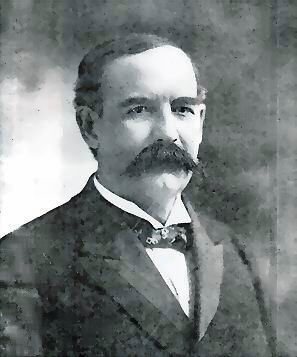
from Antique Barbed Wire Society via Wikimedia Commons (PD-US)
4. Isaac L. Ellwood (1833-1910)
A hardware store owner, he patented his own barbed wire design in 1874 but bought a half interest in Glidden's patent because it was superior to his own.
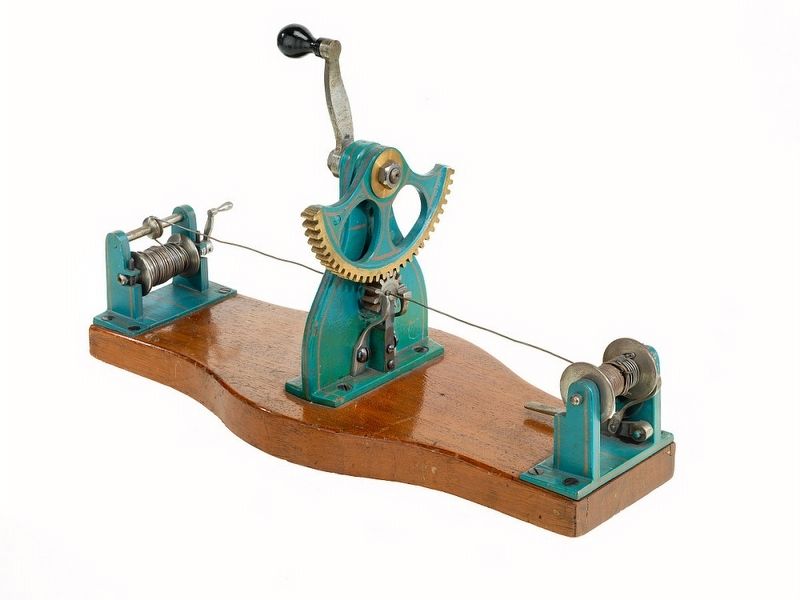
via National Museum of American History (Fair use)
5. Glidden Fence Making Patent Model
On December 8, 1874 Joseph Glidden and Phineas Vaughn patented this machine for making wire fences. This apparatus attached barbs to double stranded wire cables that were used to corral cattle. The machine boasts a mahogany base and metal end pieces that are painted green with gold edging.
Credits. This page was last revised on August 20, 2026. It was originally submitted on August 16, 2023, by Duane and Tracy Marsteller of Murfreesboro, Tennessee. This page has been viewed 758 times since then and 166 times this year. Last updated on August 13, 2026, by Matthew Stevens of Washington, Illinois. Photos: 1, 2, 3, 4, 5. submitted on August 16, 2023, by Duane and Tracy Marsteller of Murfreesboro, Tennessee. • Devry Becker Jones was the editor who published this page.
