North Bridgeport in Greater Bridgeport Region, Connecticut — The American Northeast (New England)
Bald Eagle
Restored Legacy
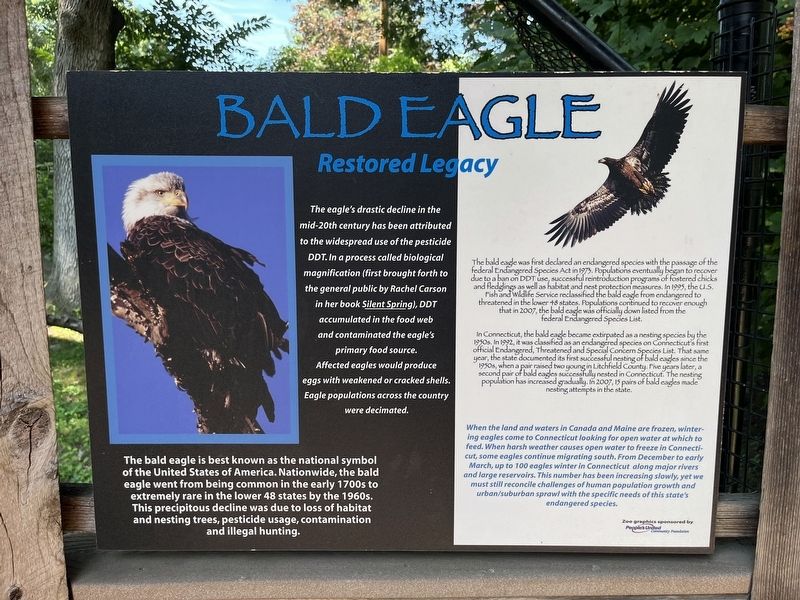
The eagle's drastic decline in the mid-20th century has been attributed to the widespread use of the pesticide DDT. In a process called biological magnification (brought brought forth to the general public by Rachel Carson in her book Silent Spring), DDT accumulated in the food web and contaminated the eagle's primary food source. Affected eagles would produce eggs with weakened or cracked shells. Eagle populations across the country were decimated.
The bald eagle is best known as the national symbol of the United States of America. Nationwide, the bald eagle went from being common in the early 1700s to extremely rare in the lower 48 states by the 1960s. This precipitous decline was due to loss of habitat and nesting trees, pesticide usage, contamination and illegal hunting.
The bald eagle was first declared an endangered species with the passage of the federal Endangered Species Act of 1973. Populations eventually began to recover due to a ban on DDT use, successful reintroduction programs of fostered chicks and fledglings as well as habitat and nest protection measures. In 1995, the U.S. Fish and Wildlife Service
this page online
In Connecticut, the bald eagle became extirpated as a nesting species by the 1950s. In 1992, it was classified as an endangered species on Connecticut's first official Endangered, Threatened and Special Concern Species List. That same year, the state documented its first successful nesting of bald eagles since the 1950s, when a pair raised two young in Litchfield County. Five years later, a second pair of bald eagles successfully nested in Connecticut. The nesting population has increased gradually. In 2007, 15 pairs of bald eagles made nesting attempts in the state.
When the land and waters in Canada and Maine are frozen, wintering eagles come to Connecticut looking for open water at which to feed. When harsh weather causes open water to freeze in Connecticut, some eagles continue migrating south. From December to early March, up to 100 eagles winter in Connecticut along major rivers and large reservoirs. This number has been increasing slowly, yet we must still reconcile challenges of human population growth and urban/suburban sprawl with the specific needs of this state's endangered species.
Erected by Connecticut's
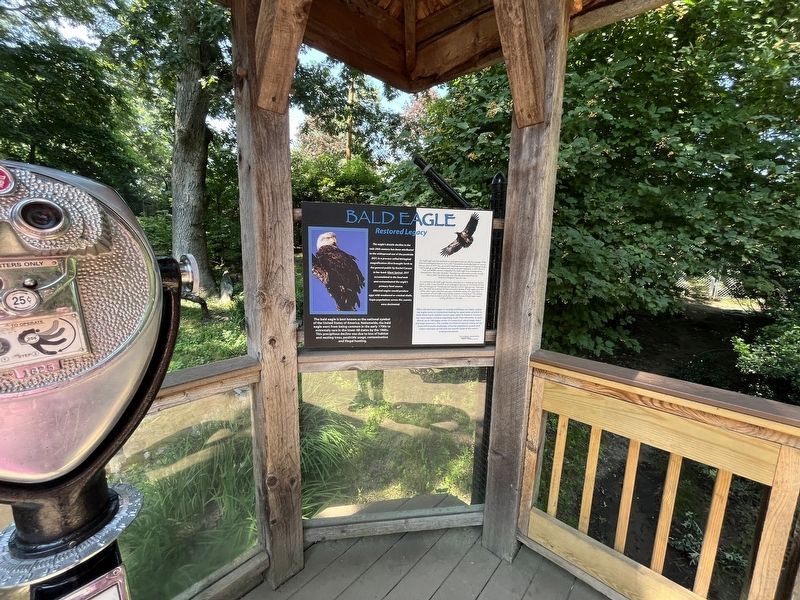
Topics. This historical marker is listed in these topic lists: Animals • Environment • Industry & Commerce. A significant historical year for this entry is 1973.
Location. 41° 12.684′ N, 73° 10.837′ W. Marker is in Bridgeport in Greater Bridgeport Region, Connecticut. It is in North Bridgeport. It can be reached from Noble Avenue north of Crown Street, on the left when traveling north. Touch for map. Marker is at or near this postal address: 1875 Noble Ave, Bridgeport CT 06610, United States of America. Touch for directions.

Regionally, this marker is on the Connecticut Shoreline. It is also in the American Northeast, in New England, and on the Eastern Seaboard. Globally, it is in the North Atlantic Region, North America, the Western Hemisphere, the Western World, and the Anglosphere. Historically, it finds itself in what was once Fairfield County and also one of the original Thirteen Colonies.
Other nearby markers. At least 8 other markers are within walking distance of this marker: A different marker also named Bald Eagle (here, next to this marker); American Alligator (a few steps from this marker); Connecticut's Beardsley Zoo's Big Cow (within shouting distance of this marker); Barred Owl (within shouting distance of this marker); Amur Tiger Conservation (within shouting distance of this marker); Why We Don't Have White Tigers (within shouting distance of this marker); Amur Leopard (within shouting distance of this marker); Amur Leopard Range (within shouting distance of this marker). Touch for a list and map of all markers in Bridgeport.
Additional keywords. 🦅
Credits. This page was last revised on May 19, 2026. It was originally submitted on August 16, 2023, by Devry Becker Jones of Washington, District of Columbia. This page has been viewed 212 times since then and 17 times this year. Photos: 1, 2. submitted on August 16, 2023, by Devry Becker Jones of Washington, District of Columbia.
