Darien Downtown in Western Region, Connecticut — The American Northeast (New England)
Museum of Darien
Darien Heritage Trail
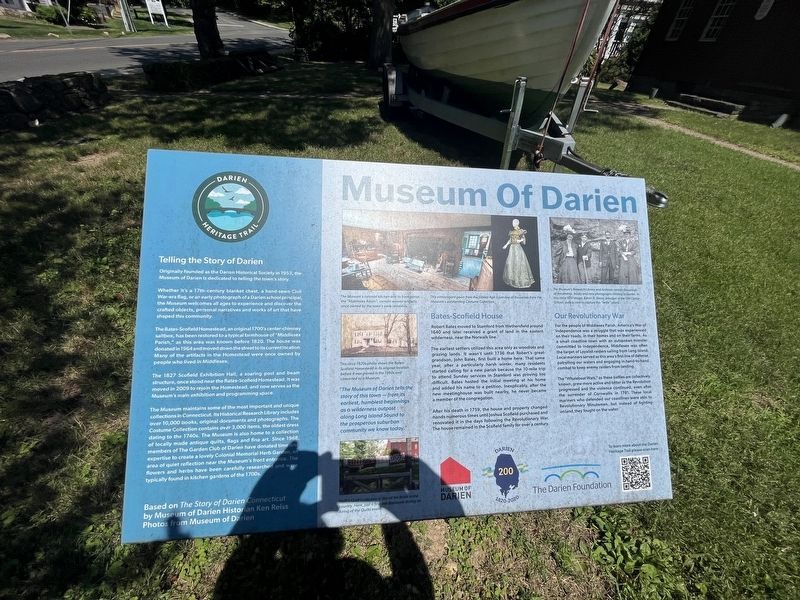
Telling the Story of Darien
Originally founded as the Darien Historical Society in 1953, the Museum of Darien is dedicated to telling the town's story.
Whether it's a 17th-century blanket chest, a hand-sewn Civil War-era flag, or an early photograph of a Darien school principal, the Museum welcomes all ages to experience and discover the crafted objects, personal narratives and works of art that have shaped this community.
The Bates-Scofield Homestead, an original 1700's center-chimney saltbox, has been restored to a typical farmhouse of "Middlesex Parish," as this area was known before 1820. the house was donated in 1964 and moved down the street to its current location. Many of the artifacts in the Homestead were once known by people who lived in Middlesex.
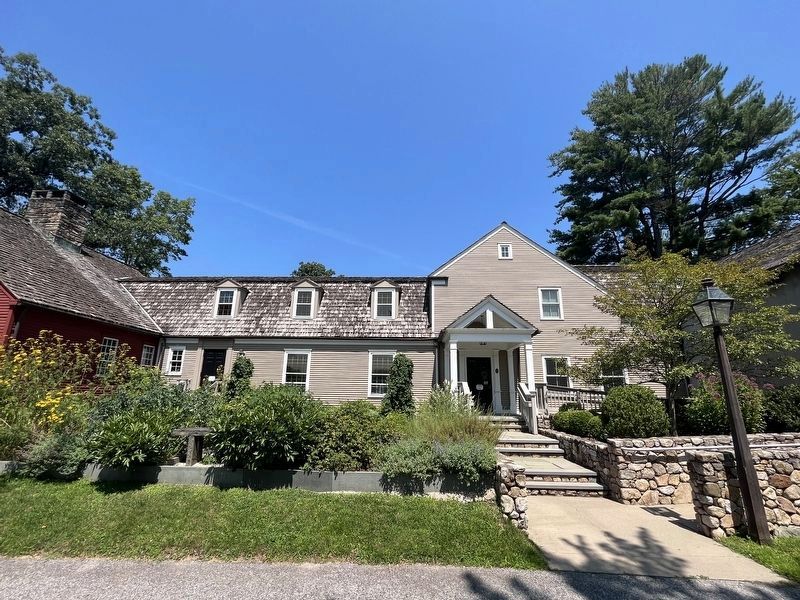
The 1827 Scofield Exhibition Hall, a soaring post and beam structure, once stood near the Bates-Scofield Homestead. It was moved in 2009 to rejoin the Homestead, and now serves as the Museum's main exhibition and programming space.
The Museum maintains some of the most important and unique collections in Connecticut. Its Historical Research Library includes
this page online
Based on The Story of Darien Connecticut by Museum of Darien Historian Ken Reiss
Photos from Museum of Darien
"The Museum of Darien tells the story of this town — from its earliest, humblest beginnings as a wilderness outpost along Long Island Sound to the prosperous suburban community we know today."
Bates-Scofield House
Robert Bates moved to Stamford from Wethersfield around 1640 and later received a grant of land in the eastern wilderness, near Norwalk line.
The earliest settlers utilized this area only as woodlots and grazing lands. It wasn't until 1736 that Robert's great-grandson, John
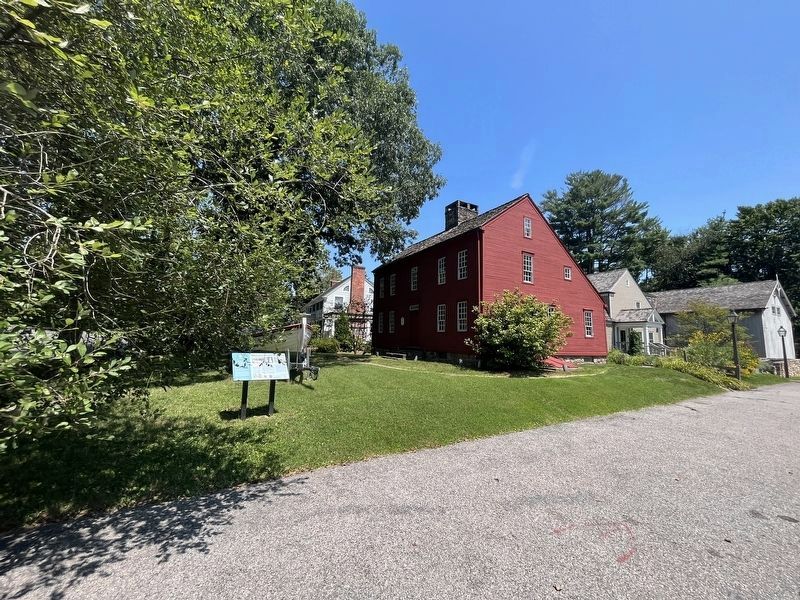
After his death in 1759, the house and property changed hands numerous times until Joshua Scofield purchased and renovated it in the days following the Revolutionary War. The house remained in the Scofield family for over a century.
Our Revolutionary War
For the people of Middlesex Parish, America's War of Independence was a struggle that was experienced on their roads, in their homes and on their farms. As a small coastline town with an outspoken minister committed to independence, Middlesex was often the target of Loyalist raiders sailing from Long Island. Local mariners served as this area's first line of defense, patrolling our waters and engaging in hand-to-hand combat to keep enemy raiders from landing.
The "Whaleboat Wars,"
[Captions:]
The Museum's colonial kitchen and its front parlor, the "Middlesex Room", contain several artifacts once owned by the town's early residents.
This extravagant gown from the Gilded Age is just one of thousands from the Museum's outstanding Costume Collection.
The Museum's Research Library and Archives contain thousands of documents, books and rare photographs relating to Darien. In this circa 1910 image, Edwin B. Stone, principal of the Old Center School, pulls a card to capture this "selfie" photo.
This circa 1920s photo shows the Bates-Scofield Homestead in its original location, before it was moved in the 1960s and converted to a Museum.
MoD's Quilt Collection is one of the finest in the country. Here, just a few are displayed during an Airing of the Quilts event.
Erected 2022 by Museum
Photographed by Devry Becker Jones (CC0), August 6, 2023
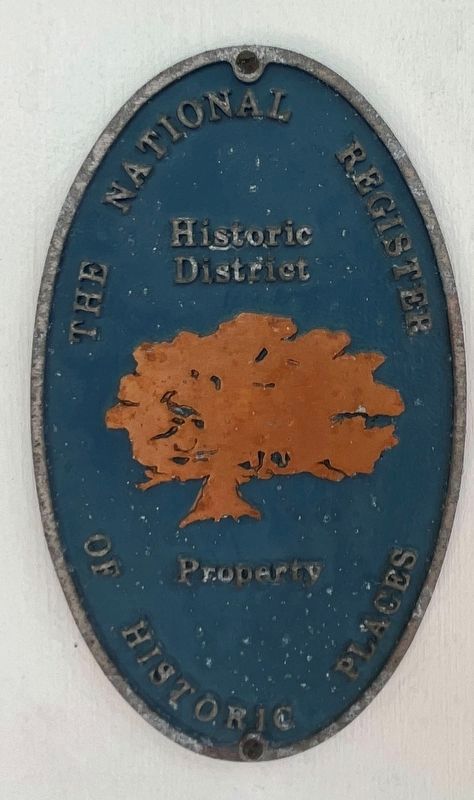
4. The National Register of Historic Places plaque on the Scofield Exhibition Hall
Topics. This historical marker is listed in these topic lists: Architecture • Colonial Era • Education • Religion & Religious Structures • Settlements & Settlers • War, US Revolutionary. A significant historical year for this entry is 1953.
Location. 41° 4.804′ N, 73° 27.887′ W. Marker is in Darien in Western Region, Connecticut. It is in Darien Downtown. It is on Old Kings Highway North south of Pine Brook Lane, on the right when traveling north. Touch for map. Marker is at or near this postal address: 45 Old Kings Hwy N, Darien CT 06820, United States of America. Touch for directions.

Regionally, this marker is on the Connecticut Shoreline and in Greater Bridgeport. It is also in the American Northeast, in New England, and on the Eastern Seaboard. Globally, it is in the North Atlantic Region, North America, the Western Hemisphere, the Western World, and the Anglosphere. Historically, it finds itself in what was once Fairfield County and also one of the original Thirteen Colonies.
Other nearby markers. At least 8 other markers are within 2 miles of this marker, measured as the crow flies: The First Congregational Church (about 500 feet away, measured in a direct line); Middlesex Graveyard (about 500 feet away); Rev. Dr. Moses Mather (about 500 feet away); Munson Hoyt (approx. 0.2 miles away); Spring Grove Cemetery Veterans Memorial (approx. 1.1 miles away); Oscar E. Peck (approx. 1.1 miles away); Rowayton Veterans Memorial (approx. 1.4 miles away); Darien Civil War and World War I Memorial (approx. 1.4 miles away). Touch for a list and map of all markers in Darien.
Credits. This page was last revised on May 19, 2026. It was originally submitted on August 17, 2023, by Devry Becker Jones of Washington, District of Columbia. This page has been viewed 500 times since then and 59 times this year. Photos: 1, 2, 3, 4. submitted on August 17, 2023, by Devry Becker Jones of Washington, District of Columbia.
