Köln, North Rhine-Westphalia, Germany — Central Europe
Historisches Rathaus
⎯⎯⎯
Historical Town Hall

February 24, 2023
1. Historisches Rathaus / Historical Town Hall Marker

Historisches Rathaus
Mitte des 12. Jh. Erwähnung eines „Hauses der Bürger“ im Wohnquartier der Kölner Juden. Hundert Jahre später der Begriff „Rat“ als Verfassungsorgan überliefert. 1320/1330 Neubau des gotischen Rathauses mit sog. „Hansasall“. An dessen innerer Südwand Figuren der „Neun Guten Helden“. 1396 Sieg der Gaffeln, der polit. Organisationen der Kölner Handwerker und Kaufleute, über die Patrizier. Der neue Rat errichtet 1407-14 als Zeichen seiner Macht den 61 m hohen Ratsturm mit umfangreichem Figurenschmuck. In dessen 1. Obergeschoss neuer Sitzungssaal („Senatssaal“). 1541 „Löwenhof“ als offener Renaissance-Arkadenhof. 1548-54 Erwerb des „Leinenkaufhauses“ am Alter Markt mit Renaissance-Fassade. 1569-73 Renaissance-Laube an der Westseite des Hansasaaltraktes von Wilhelm Vernukken, heutige Gestalt etwa 1618. Im 19. Jh. durchgreifende Restaurierung des Baukomplexes und Errichtung neuer Fassaden im Geist des Historismus unter Julius Raschdorff. 1943-45 schwerste Zerstörungen. 1950 Gründung der „Bauhütte Rathausturm e.V.“ und bis 1954 erste Aufbauphase des Ratsturms auf Initiative und aus Spenden des Kölner
this page online
-
In the mid-12th century, mention of a "House of the Citizens" in the residential quarter of Cologne's Jews. 100 years later, the term "Rat" (council) passed down as constitutional organ. 1320-1330, new building of the Gothic Town Hall with so-called "Hansasaal". On its inner southern wall, figures of the "Nine Good Heroes". 1393, victory of the Gaffeln, the political organisation of the craftsmen and traders of Cologne, over the patricians.

February 24, 2023
2. Historisches Rathaus / Historical Town Hall Marker
1541, "Löwenhof" ("Lion's Court") as open Renaissance arcade court. 1548-54, acquired the "Leinenkaufhaus" (linen store) on the Alter Markt with Renaissance facade. 1569-73, Renaissance arcade on the "Hansasaal" west side section by Wilhelm Vernukken; current form, around 1618.
19th century, radical restoration of the building and construction of the new facades in the spirit of historicism under Julius Raschdorff. 1943-45, severe destruction. 1950, founding of the "Bauhütte Rathausturm e.V." and, until 1954, first rebuilding phase of the council tower on the initiative and with donations of the craftsmen of Cologne; also, 1958, carillon and "Platzjabbek" (bust with tongue sticking out). 1975, completion of the tower based on historic model. 1986-1995, design and fitting of the new decorative figures (a total of 124 of which 5 old, 119 new figures, donated from all circles of Cologne's citizens). By 1972, reconstruction of the "Hansasaal" and "Löwenhof" in historic
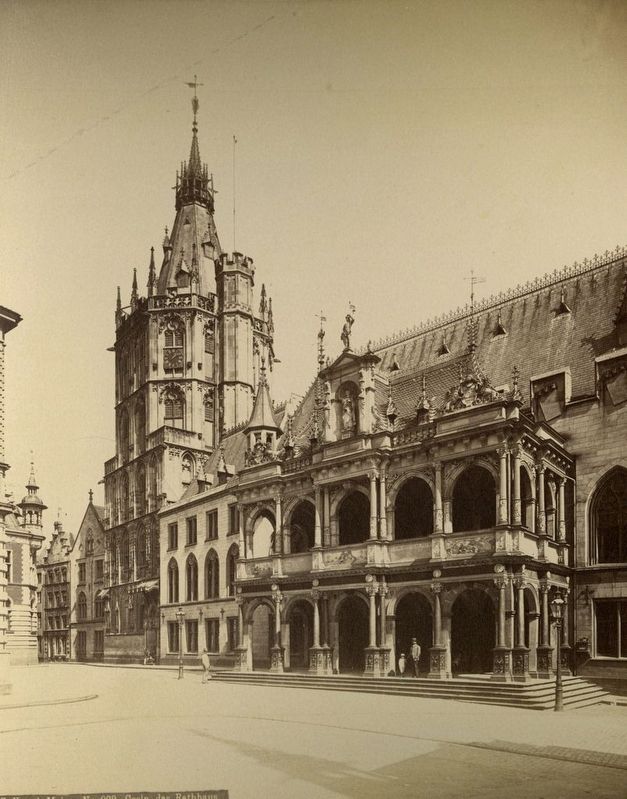
Carl Hertel (courtesy of the Washington University (Saint Louis, Mo.) Art & Architecture Library), circa 1895
3. Köln Rathhaus / Cologne City Hall
Erected by Lions-Club Köln-Colonia.
Topics. This historical marker is listed in these topic lists: Architecture • Government & Politics.
Location. 50° 56.304′ N, 6° 57.579′ E. Marker is in Köln, Nordrhein-Westfalen (North Rhine-Westphalia). It can be reached from Alter Markt. Touch for map. Marker is at or near this postal address: Alter Markt 31, Köln HE 50667, Germany. Touch for directions.

Regionally, this marker is in the German Rhineland. Globally, it is in Europe, the European Union, Atlantic Europe, Central Europe, the Schengen Area, Western Europe, and the Western World. Historically, it finds itself in what was once the Roman Empire, the Holy Roman Empire, the Hanseatic League, and the former West Germany.
Other nearby markers. At least 8 other markers are within walking distance of this marker: Pfarrkirche St. Laurenz / Parish Church of St. Laurenz (about 120 meters away, measured in a direct line); Teilstück des Römischen Abwasserkanals / Section of Roman Sewage System (about 120 meters away); Johann Maria Farina and Eau de Cologne (about 120 meters away); Artothek (about 180 meters away); Strassen (about 210 meters away); Köln (about 210 meters away); Rom (about 210 meters away); Die Heinzelmännchen Fountain (about 240 meters away). Touch for a list and map of all markers in Köln.
Credits. This page was last revised on August 19, 2023. It was originally submitted on August 18, 2023. This page has been viewed 250 times since then and 16 times this year. Photos: 1, 2. submitted on August 18, 2023. 3. submitted on August 19, 2023. • Andrew Ruppenstein was the editor who published this page.
