Fallsburg in Sullivan County, New York — The American Northeast (Mid-Atlantic)
Borscht Belt - Fallsburg
| — | Borscht Belt Historical Marker Project | — |
Photographed by Jerry Klinger
1. Borscht Belt - Fallsburg Marker
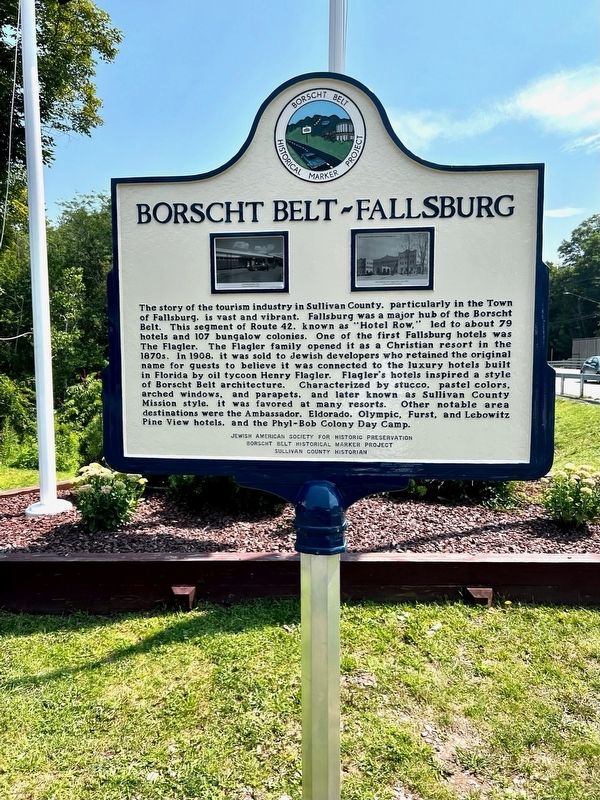
Borscht Belt - Fallsburg
The story of the tourism industry in Sullivan County, particularly in the Town of Fallsburg, is vast and vibrant. Fallsburg was a major hub of the Borscht Belt. This segment of Route 42, known as "Hotel Row," led to about 79 hotels and 107 bungalow colonies. One of the first Fallsburg hotels was the Flagler. The Flagler family opened it as a Christian restort in the 1870s. In 1908, it was sold to Jewish developers who retained the original name for guests to believe it was connected to the luxury hotels built in Florida by oil tycoon Henry Flager. Flagler's hotels inspired a style of Borscht Belt architecture. Characterized by stucco, pastel colors, arched windows, and parapets, and later known as Sullivan County Mission style, it was favored at many resorts. Other notable area destinations were the Ambassador, Eldorado, Olympic, Furst, and Lebowitz Pine View hotels, and the Phyl-Bob Colony Day Camp.
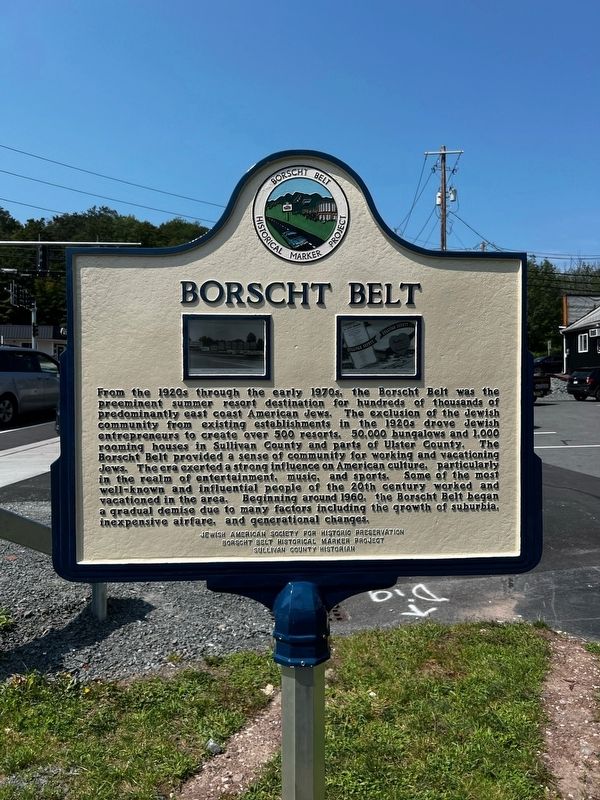
Borscht Belt
From the 1920s through the early 1970s, the Borscht Belt was the preeminent summer resort destination for hundreds of thousands of predominantly east coast American Jews. The
this page online
Erected by Jewish American Society for Historic Preservation, the Borscht Belt Historical Marker Project, Sullivan County Historian.
Topics and series. This historical marker is listed in these topic lists: Architecture • Entertainment • Industry & Commerce • Notable Places • Parks & Recreational Areas. In addition, it is included in the Borscht Belt Historical Marker Project, and the Jewish American Society for Historic Preservation.
Photographed by Jerry Klinger
2. Borscht Belt - Fallsburg Marker side 2
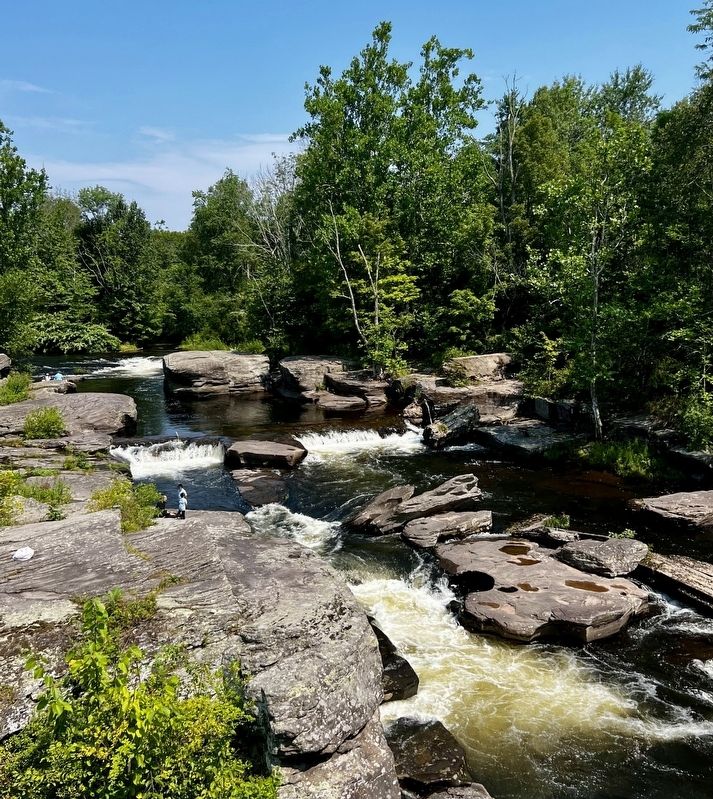
Location. 41° 43.829′ N, 74° 36.268′ W. Marker is in Fallsburg, New York, in Sullivan County. It is on Old Falls Road near Route 42, on the right when traveling north. Located in front of the flags next to the Fallsburg, Falls scenic overlook. Touch for map. Marker is at or near this postal address: 5 Old Falls Road, Fallsburg NY 12733, United States of America. Touch for directions.

Regionally, this marker is in Upstate New York and in the Hudson Valley. It is also in the American Northeast, in the Mid-Atlantic, in Appalachia, and specifically in Northern Appalachia. Globally, it is in North America, the Western Hemisphere, the Western World, and the Anglosphere. Historically, it finds itself in what was once New Netherland and also one of the original Thirteen Colonies.
Other nearby markers. At least 8 other markers are within 4 miles of this marker, measured as the crow flies: Borscht Belt - Woodbourne (approx. 2 miles away); Borscht Belt - South Fallsburg (approx. 2 miles away); In Memory (approx. 2.1 miles away); Mayors of the Village of Woodridge (approx.
Photographed by Jerry Klinger
3. Borscht Belt - Fallsburg Marker
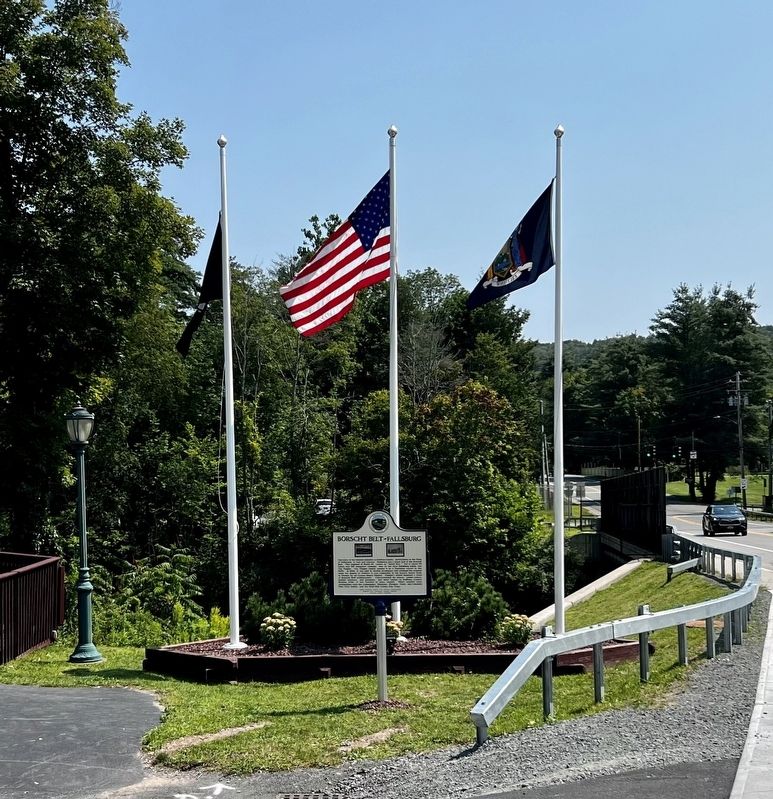
Marker sited in front of flag poles overlooking the scenic view.
More about this marker. The marker is the fourth in the Borsch Belt Historical Marker Project series
Regarding Borscht Belt - Fallsburg. Fallsburg was a major hub of the Borscht Belt. This segment of Route 42, known as "Hotel Row," led to about 79 hotels and 107 bungalow colonies.
Also see . . .
1. Fallsburg, New York. (Submitted on August 21, 2023, by Jerry Klinger of Boynton Beach, Florida.)
2. New Catskill Historical Trail Rekindles Glory Days Of The Borscht Belt.
The Catskill region was a popular getaway for a half-century from the 1920s through the 1970s. During its heyday, an estimated 500 hotels and resorts, 50,000 bungalows, and countless rooming houses welcomed guests, predominantly Eastern European Jews...(Submitted on August 21, 2023, by Jerry Klinger of Boynton Beach, Florida.)
During the first half of the 20th century, rampant antisemitism in the hospitality industry limited access of Jewish people to many vacation spots.
The Catskills was a placewhere working, middle and upper-middle-class Jews could escape the heat of steamy tenements (before air conditioning) and enjoy nature and the fresh air.Photographed by Jerry Klinger4. Fallsburg - Falls
Not only did they find acceptance here but also a true sense of community with people who shared a common culture. Yiddish was often spoken and 95 percent of the hotel kitchens were kosher.
3. White Lake NY Hotels in the Early 20th Century.
Narrated by Cy Plotkin whose parents bought the original Woodlawn Villa in 1920. A brief history of hotels around White Lake and Kauneonga Lake, Sullivan County, New York. Created by Sullivan County Historical Society.(Submitted on August 18, 2024, by Jerry Klinger of Boynton Beach, Florida.)
4. Woodstock.
The Woodstock Music and Art Fair, commonly referred to as Woodstock, was a music festival held from August 15 to 18, 1969, on Max Yasgur's dairy farm in Bethel, New York,40 miles (65 km) southwest of the town of Woodstock. Billed as "an Aquarian Exposition: 3 Days of Peace & Music" and alternatively referred to as the Woodstock Rock Festival, it attracted more than 460,000 attendees. Thirty-two acts performed outdoors despite overcast and sporadic rain. It was one of the largest music festivals in history and became synonymous with the counterculture of the 1960s.[(Submitted on August 18, 2024, by Jerry Klinger of Boynton Beach, Florida.)
5. The Borscht Belt Was a Haven for Generations of Jewish Americans.
Beyond safe haven, the Borscht Belt hoteliers put on a range of music and entertainment; their most notable contribution to American culture, however, was comedy. Influential entertainers Milton Berle, Henny Youngman, Red Buttons, Joan Rivers and Jackie Mason were among the many who got their start going from hotel to hotel. Even in the later days of the resorts’ prowess, stand-up comics like Jerry Seinfeld and writers like Alan Zweibel, who started out writing jokes for Catskills comedians on paper bags at a deli in Queens before working at “Saturday Night Live,” made the circuit.(Submitted on August 18, 2024, by Jerry Klinger of Boynton Beach, Florida.)
“This became a really important proving ground for them,” says Jacobs, adding that comedians were able to do multiple shows a night. Their jokes could be salty and racy and were often self-deprecating, giving audiences a chance to laugh at themselves and at the doom and gloom that always seemed to be just around the corner. Crowds could be tough, so that helped comics improve their sets; if they were doing well, the audience’s reaction showed it.
6. Fallsburg Historic Marker Dedication, October 15, 2023 (YouTube, 34:47). Borscht Belt Historic Marker Project - Fallsburg dedication, Old Falls/Route 42. (Submitted on September 24, 2024.)
Credits. This page was last revised on September 24, 2024. It was originally submitted on August 21, 2023, by Jerry Klinger of Boynton Beach, Florida. This page has been viewed 1,244 times since then and 104 times this year. Photos: 1, 2, 3, 4. submitted on August 21, 2023, by Jerry Klinger of Boynton Beach, Florida. • Andrew Ruppenstein was the editor who published this page.
