Zanesville in Muskingum County, Ohio — The American Midwest (Great Lakes)
Zanesville and Muskingum County Artwall
Photographed by William Fischer, Jr., October 25, 2009
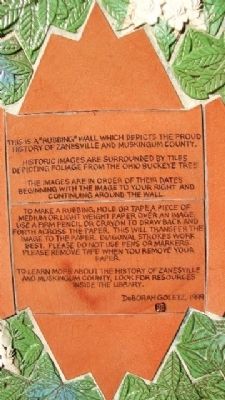
1. Zanesville & Muskingum Co. Artwall Marker
history of Zanesville and Muskingum County.
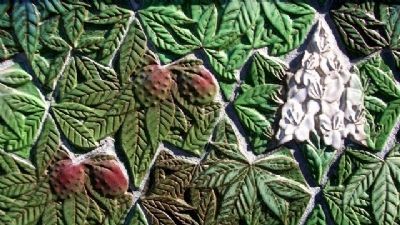
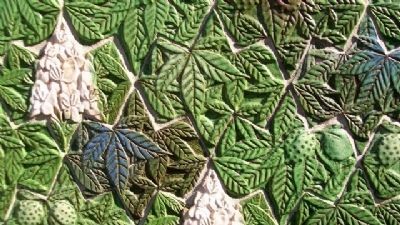
Historic images are surrounded by tiles
depicting foliage from the Ohio Buckeye tree.
The images are in order of their dates
beginning with the image to your right and
continuing around the wall.
To make a rubbing, hold or tape a piece of
medium or light weight paper over an image.
Use a firm pencil or crayon to draw back and
forth across the paper. This will transfer the
image to the paper. Diagonal strokes work
best. Please do not use pens or markers.
Please remove tape when you remove your paper.
To learn more about the history of Zanesville
and Muskingum County, look for resources
inside the library.
DeBorah Goletz, 1999 [who made the tiles]
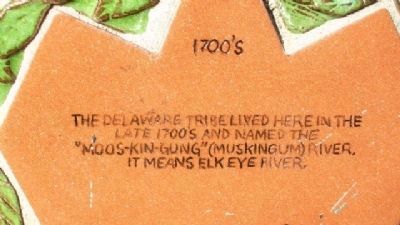
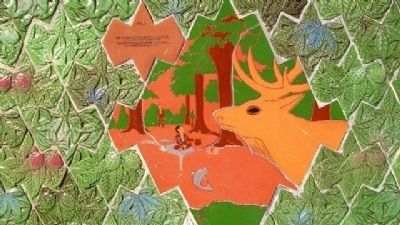
[A.] 1700's
The Delaware tribe lived here in the
late 1700's and named the
“Moos-kin-gung” (Muskingum) River.
It means Elk Eye River.
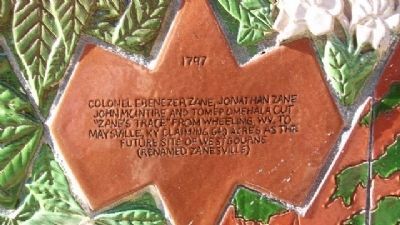
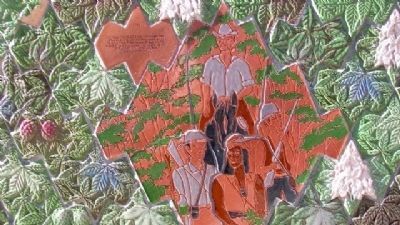
[B.] 1797
Colonel Ebenezer Zane, Jonathan Zane
John McIntire and Tomepomehala cut
“Zane's Trace” from Wheeling, WV, to
Maysville, KY claiming 640 acres as the
future site of Westbourne
(renamed Zanesville)
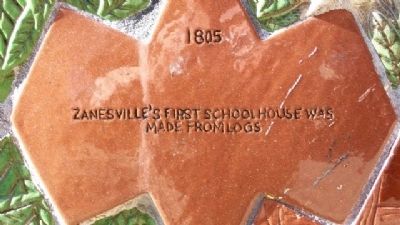
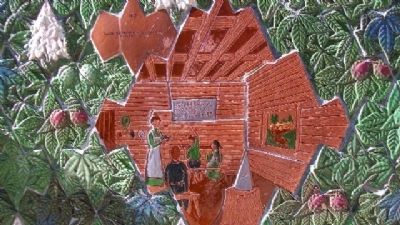
[C.] 1805
Zanesville's first school house was
made from logs
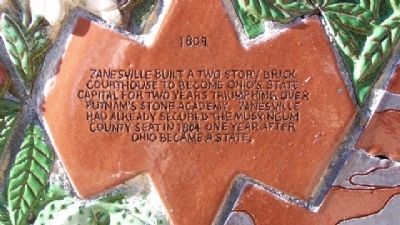
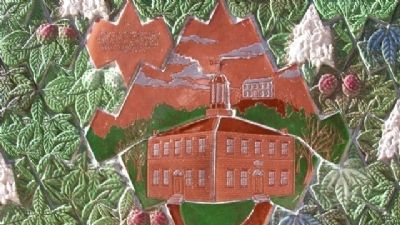
[D.] 1809
Zanesville built a two story brick
courthouse to become Ohio's state
capital for two years triumphing over
Putnam's Stone Academy. Zanesville
had already secured the Muskingum
County seat in 1804 one year after
Ohio became a state.
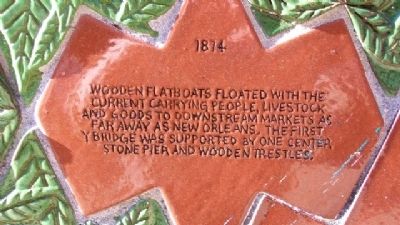
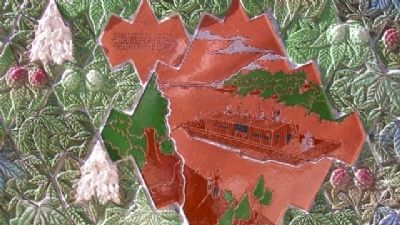
[E.] 1814
Wooden flatboats floated with the
current carrying people, livestock
and goods to downstream markets as
far away as New Orleans. The first
Y Bridge was supported by one center
stone pier and wooden trestles.
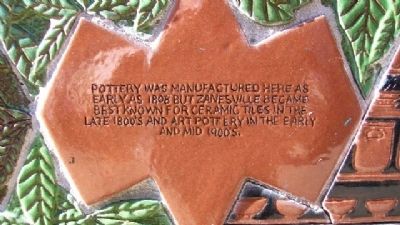
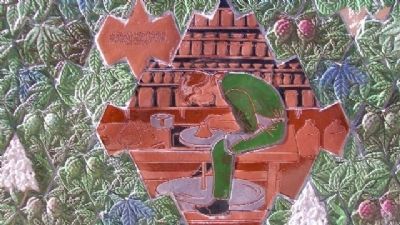
[F.] Pottery was manufactured here as
early as 1808 but Zanesville became
best known for ceramic tiles in the
late 1800's and art pottery in the early
and mid 1900's.
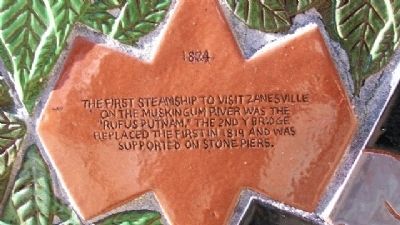
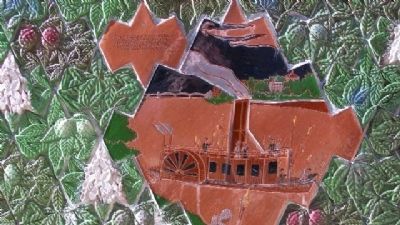
[G.] 1824
The
this page online
on the Muskingum River was the
“Rufus Putnam.” The 2nd Y Bridge
replaced the first in 1819 and was
supported on stone piers.
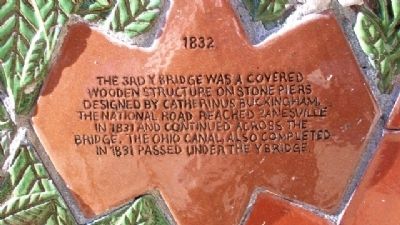
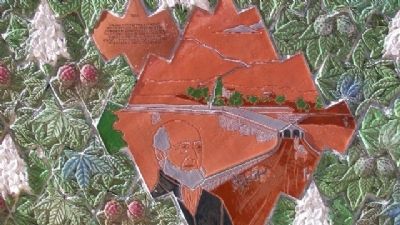
[H.] 1832
The 3rd Y Bridge was a covered
wooden structure on stone piers
designed by Catherinus Buckingham.
The National Road reached Zanesville
in 1831 and continued across the
bridge. The Ohio Canal, also completed
in 1831 passed under the Y Bridge.
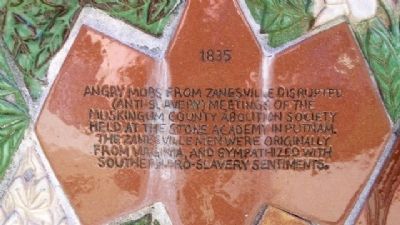
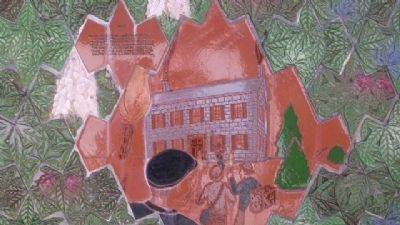
[I.] 1835
Angry mobs from Zanesville disrupted
(Anti-Slavery) meetings of the
Muskingum County Abolition Society
held at the Stone Academy in Putnam.
The Zanesville men were originally
from Virginia, and sympathized with
Southern Pro-Slavery sentiments.
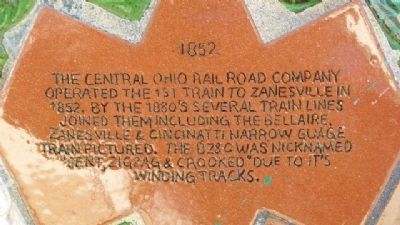
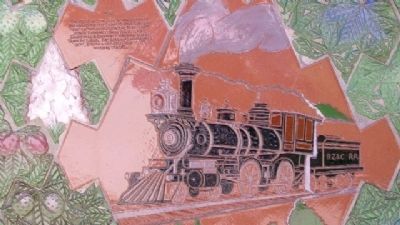
[J.] 1852
The Central Ohio Railroad Company
operated the 1st train to Zanesville in
1852. By the 1880's several train lines
joined them including the Bellaire,
Zanesville & Cincinatti [sic] narrow guage [sic]
train pictured. The BZ&C was nicknamed
“Bent, Zigzag & Crooked” due to it's
winding tracks.
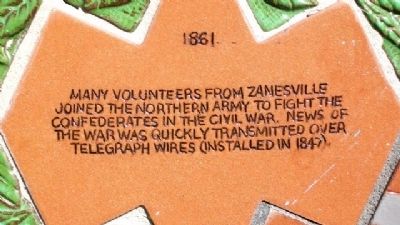
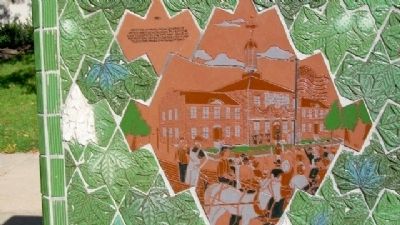
[K.] 1861
Many volunteers from Zanesville
joined the Northern army to fight the
Confederates in the Civil War. News of
the war was quickly transmitted
Photographed by William Fischer, Jr., October 25, 2009
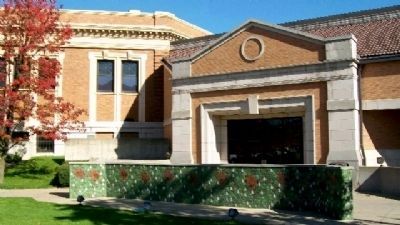
2. Zanesville & Muskingum County Artwall
telegraph wires (installed in 1847).
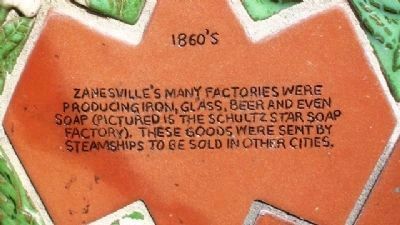
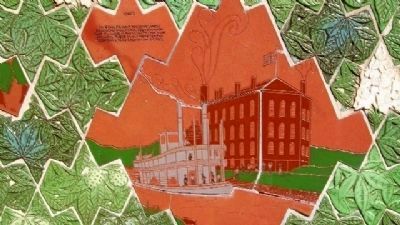
[L.] 1860's
Zanesville's many factories were
producing iron, glass, beer and even
soap (pictured is the Schultz Star Soap
Factory). These goods were sent by
steamships to be sold in other cities.
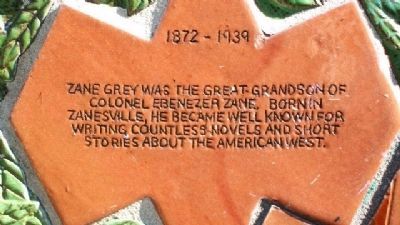
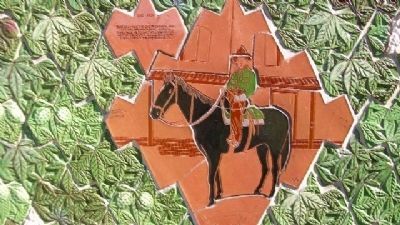
[M.] 1872-1939
Zane Grey was the great-grandson of
Colonel Ebenezer Zane. Born in
Zanesville, he became well known for
writing countless novels and short
stories about the American West.
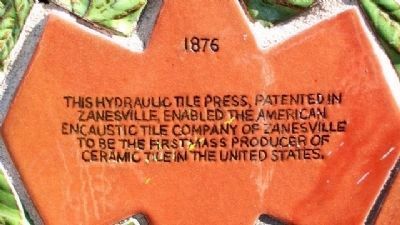
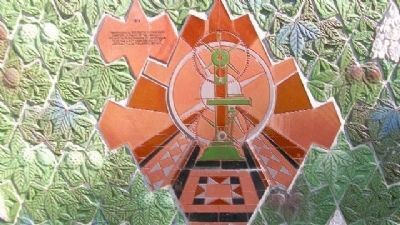
[N.] 1876
This hydraulic tile press, patented in
Zanesville, enabled the American
Encaustic Tile Company of Zanesville
to be the first mass producer of
ceramic tile in the United States.
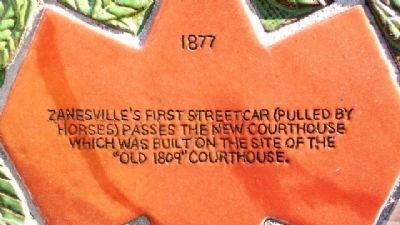
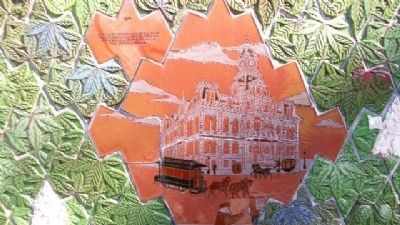
[O.] 1877
Zanesville's first streetcar (pulled by
horses) passes the new courthouse
which was built on the site of the
“Old 1809” courthouse.
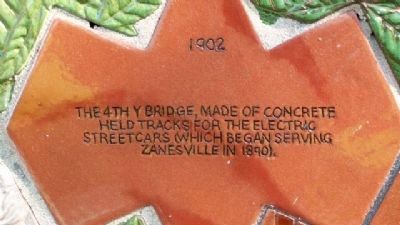
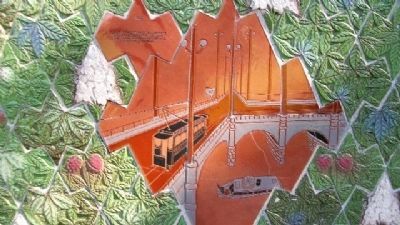
[P.] 1902
The 4th Y Bridge, made of concrete
held tracks for the electric
streetcars (which began serving
Zanesville in 1890).
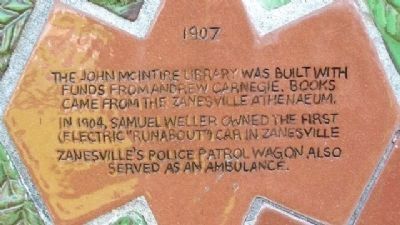
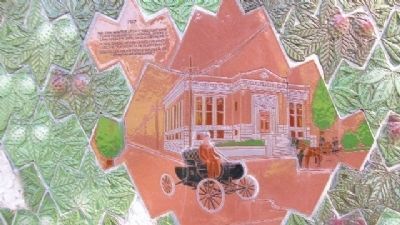
[Q.] 1907
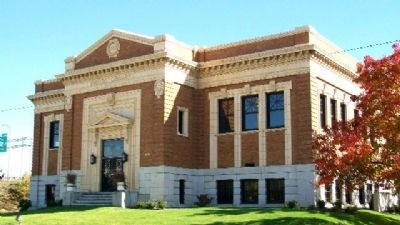
The John McIntire Library was built with
funds from Andrew Carnegie. Books
came from the Zanesville Athenaeum.
In 1904, Samuel Weller owned the first
(electric “Runabout”) car in Zanesville.
Zanesville's police patrol wagon
Photographed by William Fischer, Jr., August 25, 2009
3. Original Carnegie Library Building
served as an ambulance.
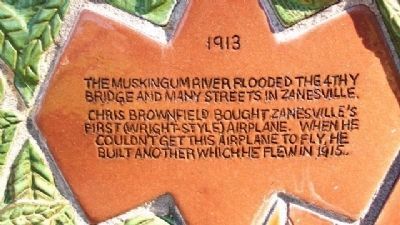
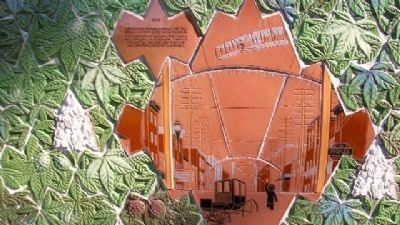
[R.] 1913
The Muskingum River flooded the 4th Y
Bridge and many streets in Zanesville.
Chris Brownfield bought Zanesville's
first (Wright-style) airplane. When he
couldn't get this airplane to fly, he
built another which he flew in 1915.
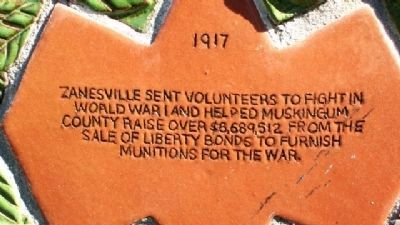
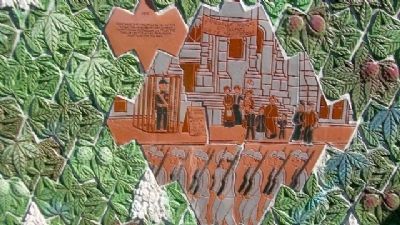
[S.] 1917
Zanesville sent volunteers to fight in
World War I and helped Muskingum
County raise over $6,689,512 from the
sale of Liberty Bonds to furnish
munitions for the war.
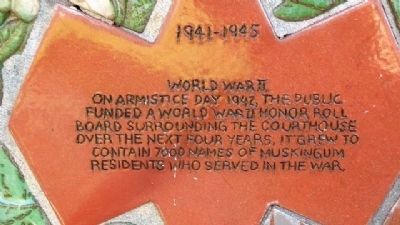
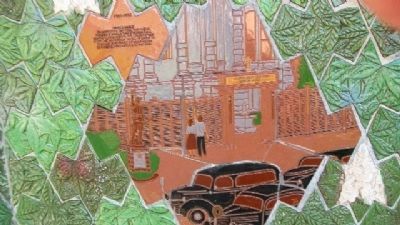
[T.] 1941-1945
World War II
On Armistice Day 1942, the public
funded a World War II Honor Roll
Board surrounding the courthouse.
Over the next four years, it grew to
contain 7000 names of Muskingum
residents who served in the war.
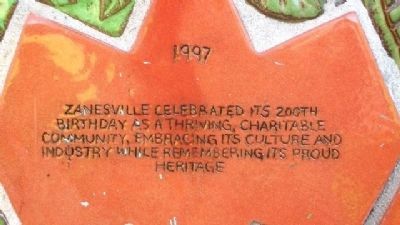
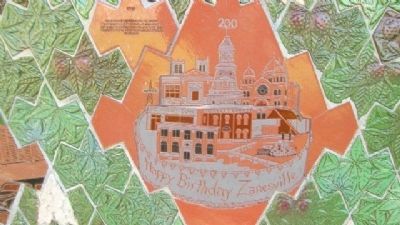
[U.] 1997
Zanesville celebrated its 200th
birthday as a thriving, charitable
community, embracing its culture and
industry while remembering its proud
heritage.
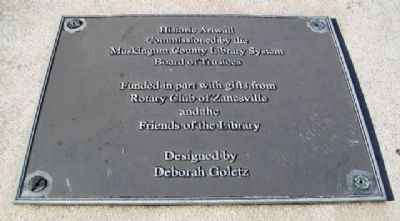
Erected 1999 by Muskingum County Library System, Rotary Club of Zanesville, and Friends of the Library.
Topics and series. This historical marker is listed in this topic list: Arts, Letters, Music. In addition, it is included in the Rotary International series list. A significant historical year for this entry is 1999.
Location. 39° 56.636′ N,
Photographed by William Fischer, Jr., October 25, 2009
4. Zanesville & Muskingum Co. Artwall Marker

Regionally, this marker is in the American Midwest, in Appalachia, and specifically in Northern Appalachia. Globally, it is in North America, the Western Hemisphere, the Western World, and the Anglosphere. Historically, it finds itself in what was once the Haudenosaunee (Iroquois) Confederacy, the territory of the Mississippian Culture, and the Northwest Territory.
Other nearby markers. At least 8 other markers are within walking distance of this marker: Karl Kappes (within shouting distance of this marker); 100th Anniversary of the Flood of 1913 (approx. 0.2 miles away); Historical Flood Mark (approx. 0.2 miles away); Architect Cass Gilbert
Photographed by William Fischer, Jr., October 25, 2009
5. A. 1700's Artwall Marker
Another marker is no longer nearby. Lodge of Amity No. 5 Free and Accepted Masons (was approx. 0.2 miles away but has been permanently removed).
Regarding Zanesville and Muskingum County Artwall. "Zanesville & Cincinatti [sic]" found; presumably , the source should have had "Zanesville & Cincinnati".
Photographed by William Fischer, Jr., October 25, 2009
6. A. 1700's Artwall Marker
Photographed by William Fischer, Jr., October 25, 2009
7. B. 1797 Artwall Marker
Photographed by William Fischer, Jr., October 25, 2009
8. B. 1797 Artwall Marker
Photographed by William Fischer, Jr., August 25, 2009
9. C. 1805 Artwall Marker
Photographed by William Fischer, Jr., August 25, 2009
10. C. 1805 Artwall Marker
Photographed by William Fischer, Jr., August 25, 2009
11. D. 1809 Artwall Marker
Photographed by William Fischer, Jr., August 25, 2009
12. D. 1809 Artwall Marker
Photographed by William Fischer, Jr., August 25, 2009
13. E. 1814 Artwall Marker
Photographed by William Fischer, Jr., August 25, 2009
14. E. 1814 Artwall Marker
Photographed by William Fischer, Jr., August 25, 2009
15. F. Pottery Artwall Marker
Photographed by William Fischer, Jr., August 25, 2009
16. F. Pottery Artwall Marker
Photographed by William Fischer, Jr., August 25, 2009
17. G. 1824 Artwall Marker
Photographed by William Fischer, Jr., August 25, 2009
18. G. 1824 Artwall Marker
Photographed by William Fischer, Jr., August 25, 2009
19. H. 1832 Artwall Marker
Photographed by William Fischer, Jr., August 25, 2009
20. H. 1832 Artwall Marker
Photographed by William Fischer, Jr., August 25, 2009
21. I. 1835 Artwall Marker
Photographed by William Fischer, Jr., August 25, 2009
22. I. 1835 Artwall Marker
Photographed by William Fischer, Jr., August 25, 2009
23. J. 1852 Artwall Marker
Photographed by William Fischer, Jr., August 25, 2009
24. J. 1852 Artwall Marker
Photographed by William Fischer, Jr., August 25, 2009
25. K. 1861 Artwall Marker
Photographed by William Fischer, Jr., August 25, 2009
26. K. 1861 Artwall Marker
Photographed by William Fischer, Jr., October 25, 2009
27. L. 1860's Artwall Marker
Photographed by William Fischer, Jr., October 25, 2009
28. L. 1860's Artwall Marker
Photographed by William Fischer, Jr., October 25, 2009
29. M. 1872-1939 Artwall Marker
Photographed by William Fischer, Jr., October 25, 2009
30. M. 1872-1939 Artwall Marker
Photographed by William Fischer, Jr., October 25, 2009
31. N. 1876 Artwall Marker
Photographed by William Fischer, Jr., October 25, 2009
32. N. 1876 Artwall Marker
Photographed by William Fischer, Jr., October 25, 2009
33. O. 1877 Artwall Marker
Photographed by William Fischer, Jr., October 25, 2009
34. O. 1877 Artwall Marker
Photographed by William Fischer, Jr., October 25, 2009
35. P. 1902 Artwall Marker
Photographed by William Fischer, Jr., October 25, 2009
36. P. 1902 Artwall Marker
Photographed by William Fischer, Jr., October 25, 2009
37. Q. 1907 Artwall Marker
Photographed by William Fischer, Jr., October 25, 2009
38. Q. 1907 Artwall Marker
Photographed by William Fischer, Jr., October 25, 2009
39. R. 1913 Artwall Marker
Photographed by William Fischer, Jr., October 25, 2009
40. R. 1913 Artwall Marker
Photographed by William Fischer, Jr., October 25, 2009
41. S. 1917 Artwall Marker
Photographed by William Fischer, Jr., October 25, 2009
42. S. 1917 Artwall Marker
Photographed by William Fischer, Jr., October 25, 2009
43. T. 1941-1945 Artwall Marker
Photographed by William Fischer, Jr., October 25, 2009
44. T. 1941-1945 Artwall Marker
Photographed by William Fischer, Jr., October 25, 2009
45. U. 1997 Artwall Marker
Photographed by William Fischer, Jr., October 25, 2009
46. U. 1997 Artwall Marker
Photographed by William Fischer, Jr., October 25, 2009
47. Buckeye Tiles on Artwall
Photographed by William Fischer, Jr., October 25, 2009
48. Buckeye Tiles on Artwall
Credits. This page was last revised on August 27, 2023. It was originally submitted on March 21, 2010, by William Fischer, Jr. of Reynoldsburg, Ohio. This page has been viewed 1,852 times since then and 38 times this year. Last updated on August 22, 2023, by Carl Gordon Moore Jr. of North East, Maryland. Photos: 1, 2, 3, 4, 5, 6, 7, 8, 9, 10, 11, 12, 13, 14, 15, 16, 17, 18, 19, 20, 21, 22, 23, 24, 25, 26, 27, 28, 29, 30, 31, 32, 33, 34, 35, 36, 37, 38, 39, 40, 41, 42, 43, 44, 45, 46, 47, 48. submitted on March 22, 2010, by William Fischer, Jr. of Reynoldsburg, Ohio. • J. Makali Bruton was the editor who published this page.
