Lexington, Virginia — The American South (Mid-Atlantic)
John Robinson
1754 - 1826
Photographed by Tom Bosse, July 30, 2023
1. John Robinson Marker
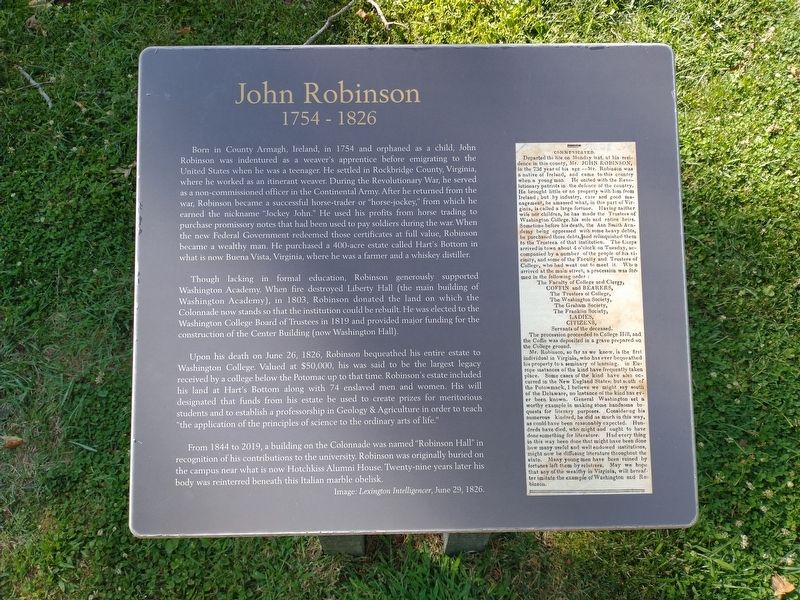
Born in County Armagh, Ireland, in 1754 and orphaned as a child, John Robinson was indentured as a weaver's apprentice before emigrating to the United States when he was a teenager. He settled in Rockbridge County, Virginia, where he worked as an itinerant weaver. During the Revolutionary War, he served as a non-commissioned officer in the Continental Army. After he returned from the war, Robinson became a successful horse-trader or "horse-jockey," from which he earned the nickname "Jockey John." He used his profits from horse trading to purchase promissory notes that had been used to pay soldiers during the war. When the new Federal Government redeemed those certificates at full value, Robinson became a wealthy man. He purchased a 400-acre estate called Hart's Bottom in what is now Buena Vista, Virginia, where he was a farmer and a whiskey distiller.
Though lacking in formal education, Robinson generously supported Washington Academy. When fire destroyed Liberty Hall (the main building of Washington Academy), in 1803, Robinson donated the land on which the Colonnade now stands so that the institution could be rebuilt.
this page online
Upon his death on June 26, 1826, Robinson bequeathed his entire estate to Washington College. Valued at $50,000, his was said to be the largest legacy received by a college below the Potomac up to that time. Robinson's estate included his land at Hart's Bottom along with 74 enslaved men and women. His will designated that funds from his estate be used to create prizes for meritorious students and to establish a professorship in Geology & Agriculture in order to teach "the application of the principles of science to the ordinary arts of life."
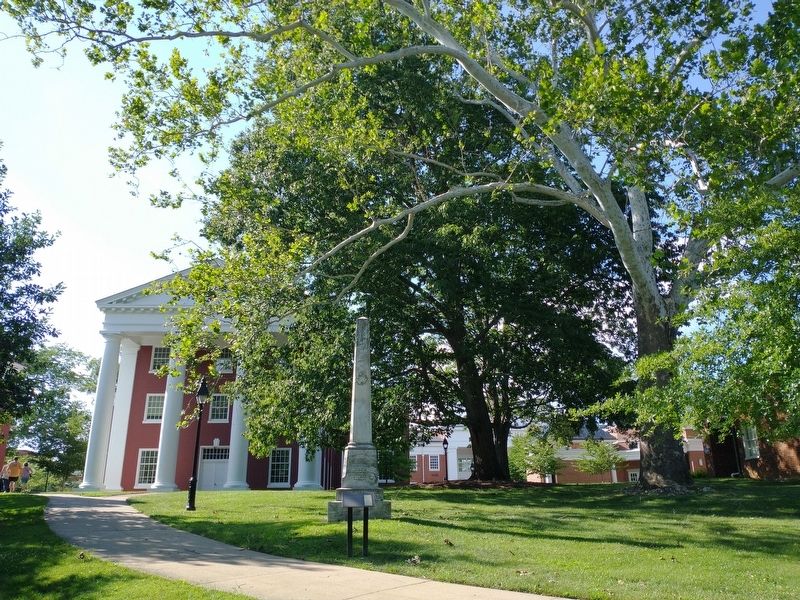
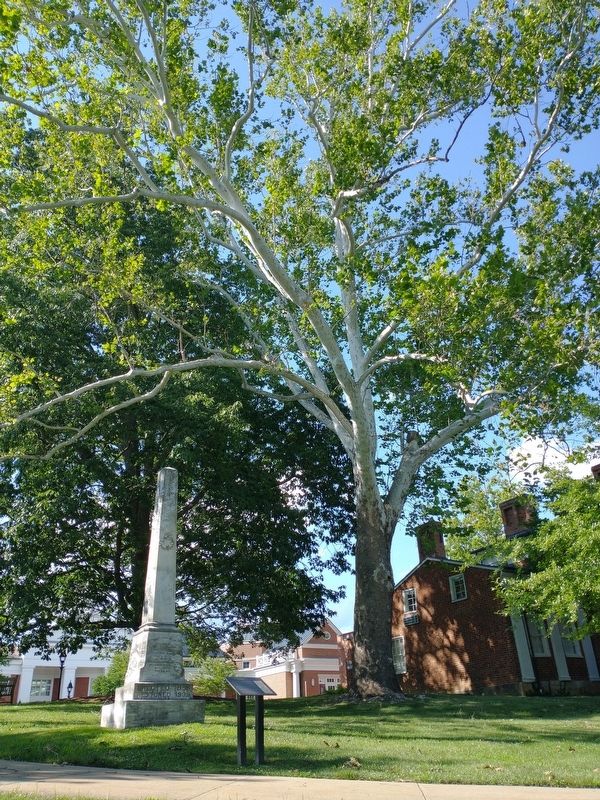
From 1844 to 2019, a building on the Colonnade was named "Robinson Hall in recognition of his contributions to the university. Robinson was originally buried on the campus near what is now Hotchkiss Alumni House. Twenty-nine years later his body was reinterred beneath this Italian marble obelisk.
Image: Lexington Intelligencer, June 29, 1826.
Topics. This historical marker is listed in these topic lists: Education •
Photographed by Tom Bosse, July 30, 2023
2. John Robinson Marker
Location. 37° 47.293′ N, 79° 26.494′ W. Marker is in Lexington, Virginia. It can be reached from Letcher Avenue north of North Jefferson Street (Business U.S. 11), on the left when traveling north. Marker is located on the grounds of Washington and Lee University. Touch for map. Marker is in this post office area: Lexington VA 24450, United States of America. Touch for directions.

Regionally, this marker is in the Shenandoah Valley. It is also in the American South and specifically in the Upper South. Globally, it is in North America, the Western Hemisphere, the Western World, and the Anglosphere. Historically, it finds itself in what was once the territory of the Mississippian Culture, one of the original Thirteen Colonies, one of the Confederate States of America, and the Antebellum South.
Other nearby markers. At least 8 other markers are within walking distance of this marker: A different marker also named John Robinson (here, next to this marker); Oklahoma Survivor Tree (within shouting distance of
Photographed by Tom Bosse, July 30, 2023
3. John Robinson Marker
Credits. This page was last revised on July 25, 2025. It was originally submitted on August 26, 2023, by Tom Bosse of Jefferson City, Tennessee. This page has been viewed 938 times since then and 111 times this year. Photos: 1, 2, 3. submitted on August 26, 2023, by Tom Bosse of Jefferson City, Tennessee. • Bernard Fisher was the editor who published this page.
