
Galveston in Galveston County, Texas — The American South (West South Central)
Galveston Historical Foundation
Photographed by Jim Evans, May 23, 2012
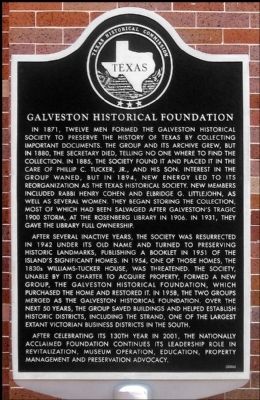
1. Galveston Historical Foundation Marker
After several inactive years, the Society was resurrected in 1942 under its old name and turned to preserving historic landmarks, publishing a booklet in 1951 of the island's significant homes. In 1954, one of those homes, the 1830s Williams-Tucker House, was threatened. The Society, unable by its charter to acquire property, formed a new group, the Galveston Historical Foundation, which purchased the home and restored it. In 1958, the two groups merged as the Galveston Historical Foundation. Over the next 50 years, the group saved buildings and helped establish historic districts, including The Strand, one of the largest extant Victorian business districts in the South.
After celebrating its 130th year in 2001, the nationally acclaimed foundation continues its leadership role in revitalization, museum operation, education, property management and preservation advocacy.
Erected 2006 by Texas Historical Commission. (Marker Number 13717.)
Topics. This historical marker is listed in this topic list: Notable Buildings. A significant historical year for this entry is 1871.
Location. 29° 18.48′ N, 94° 47.504′ W.
this page online

Regionally, this marker is in the Houston Metropolitan Area. It is also in the American South and on the Gulf Coast. Globally, it is in North America, a Gulf of Mexico state, the Western Hemisphere, the Western World, and the Anglosphere. Historically, it finds itself in what was once New Spain, the Republic of Texas, and one of the Confederate States of America.
Other nearby markers. At least 8 other markers are within walking distance of this marker: The Hendley Building (a few steps from this marker); Hendley Row (a few steps from this marker); Hendley's Row (within shouting distance of this marker); Mallory-Produce Building (about 300 feet away, measured in a direct line); Kuhn's Wharf (about 400 feet away); The First National Bank of Galveston (about 500 feet away); American National Insurance Company
Photographed by Jim Evans, May 23, 2012
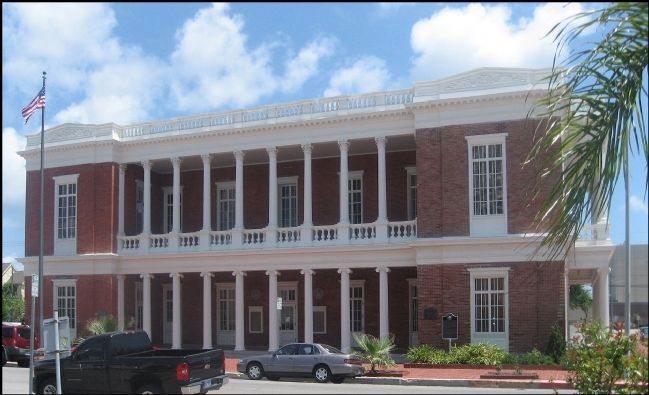
2. Galveston Custom House
Other markers no longer nearby. The Heidenheimer Bros. Marine Building (was about 400 feet away but has been confirmed missing); Trueheart-Adriance Building (was about 500 feet away but has been confirmed missing).
Regarding Galveston Historical Foundation. The Galveston Custom House is also known as the "Old Customhouse," a Greek Revival-style two-story red brick structure at Twentieth and Post Office streets, was constructed between 1858 and 1861. Some believe it was the first Galveston building designed by an architect.
The building was completed on the eve of the Civil War. It was used only briefly before the outbreak of the war, when it was turned over to the Confederacy. During the conflict it probably took shelling during the battle of Galveston in 1863 and was the site of a "bread riot" initiated by wives of absent Confederate soldiers who stormed the building demanding flour. On June 2, 1865, Union forces took symbolic possession of the site by raising a flag, and the war officially ended there three
Photographed by Jeff Leichsenring, August 27, 2023
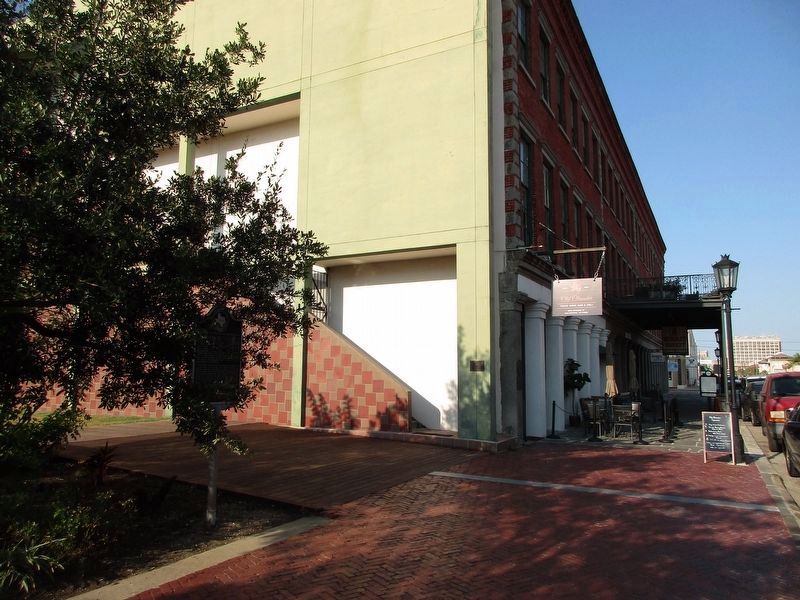
3. Galveston Historical Foundation Marker's new location next to Hendley's Row building
Related markers. Click here for a list of markers that are related to this marker. U.S. Custom House, Galveston, Texas (1861)
Also see . . .
1. United States Customs House and Court House (Galveston, Texas, 1861). Wikipedia (Submitted on May 24, 2012, by Jim Evans of Houston, Texas.)
2. Galveston Custom House. The Handbook of Texas Online, Texas State Historical Association (Submitted on May 24, 2012, by Jim Evans of Houston, Texas.)
Photographed by Jim Evans, May 23, 2012
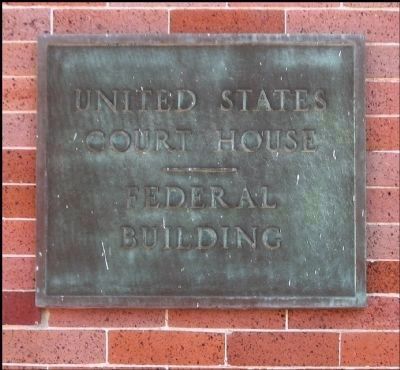
4. A plaque indicating its use as a Federal Court House
Credits. This page was last revised on August 30, 2023. It was originally submitted on May 24, 2012, by Jim Evans of Houston, Texas. This page has been viewed 1,414 times since then and 50 times this year. Last updated on August 29, 2023, by Jeff Leichsenring of Garland, Texas. Photos: 1, 2. submitted on May 24, 2012, by Jim Evans of Houston, Texas. 3. submitted on August 29, 2023, by Jeff Leichsenring of Garland, Texas. 4. submitted on May 24, 2012, by Jim Evans of Houston, Texas. • James Hulse was the editor who published this page.
