University in Minneapolis in Hennepin County, Minnesota — The American Midwest (Upper Plains)
Distance Learning
Photographed by McGhiever, July 4, 2023
1. Distance Learning Marker
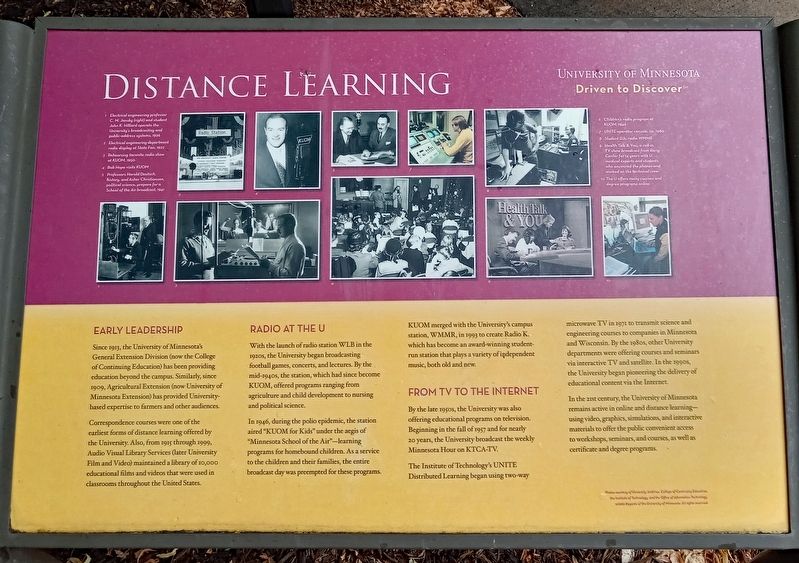
1 Electrical engineering professor C.M. Janskey (right) and student John K. Hilliard operated the University's broadcasting and public-address systems, 1926
2 Electrical engineering department radio display at State Fair, 1922
3 Rehearsing taconite radio show at KUOM, 1950
4 Bob Hope visits KUOM
5 Professors Harold Deutsch, history, and Asher Christiansen, political science, prepare for a School of the Air broadcast, 1941
6 Children's radio program at KUOM, 1946
7 UNITE operator console, ca. 1980
8 Student DJs, radio WMMR
9 Health Talk & You, a call-in TV show broadcast from Rarig Center for 14 years with U medical experts and students who answered the phones and worked on the technical crew
10 The U offers many courses and degree programs online
Early Leadership
Since 1913, the University of Minnesota's General Extension Division (now the College of Continuing Education) has been providing education beyond the campus. Similarly, since 1909, Agricultural Extension (now University of Minnesota Extension) has provided University-based expertise to farmers and other audiences.
Correspondence courses were
this page online
Radio at the U
With the launch of radio station WLB in the 1920s, the University began broadcasting football games, concerts, and lectures. By the mid-1940s, the station, which had since become KUOM, offered programs ranging from agriculture and child development to nursing and political science.
In 1946, during the polio epidemic, the station aired "KUOM for Kids" under the aegis of "Minnesota School of the Air"—learning programs for homebound children. As a service to the children and their families, the entire broadcast day was preempted for these programs.
KUOM merged with the University's campus station, WMMR, in 1993 to create Radio K, which has become an award-winning student-run station that plays a variety of independent music, both old and new.
From TV to the Internet
By the late 1950s, the University was also offering educational

Photographed by McGhiever, July 4, 2023
2. Distance Learning Marker near the West Bank Community Garden and Wilson Library
The Institute of Technology's UNITE Distributed Learning began using two-way microwave TV in 1971 to transmit science and engineering courses to companies in Minnesota and Wisconsin. By the 1980s, other University departments were offering courses and seminars via interactive TV and satellite. In the 1990s, the University began pioneering the delivery of educational content via the Internet.
In the 21st century, the University of Minnesota remains active in online and distance learning—using video, graphics, simulations, and interactive materials to offer the public convenient access to workshops, seminars, and courses, as well as certificate and degree programs.
Erected 2009 by Regents of the University of Minnesota.
Topics. This historical marker is listed in these topic lists: Communications • Education. A significant historical year for this entry is 1913.
Location. 44° 58.215′ N, 93° 14.592′ W. Marker is in Minneapolis, Minnesota, in Hennepin County. It is in University. It is on S. 4th Street west of 21st Avenue S., on the right when traveling west. The marker is on the University of Minnesota's West Bank campus, between the Rarig Center and the Carlson School of Management. Touch for map. Marker is at or near this postal address: 330 21st Avenue S, Minneapolis MN 55454, United States of America. Touch for directions.

Regionally, this marker is in the Twin Cities Metropolitan Area. It is also in the American Midwest, in the Corn Belt, and in the Great River Road Region. Globally, it is in North America, the Western Hemisphere, the Western World, and the Anglosphere. Historically, it finds itself in what was once Rupert’s Land, the territory of the Mississippian Culture, and the Louisiana Purchase.
Other nearby markers. At least 8 other markers are within walking distance of this marker: A Global University (about 300 feet away, measured in a direct line); A Legacy of Public Service (about 400 feet away); Mulford Q. Sibley Grove (about 700 feet away); The West Bank (about 700 feet away); Historic Activism (approx. 0.2 miles away); You Are Here… Bohemian Flats (approx. 0.3 miles away); Old Portage Trail (approx. 0.3 miles away); Murphy Square (approx. 0.4 miles away). Touch for a list and map of all markers in Minneapolis.
Credits. This page was last revised on September 4, 2023. It was originally submitted on September 1, 2023, by McGhiever of Minneapolis, Minnesota. This page has been viewed 164 times since then and 17 times this year. Last updated on September 3, 2023, by McGhiever of Minneapolis, Minnesota. Photos: 1, 2. submitted on September 1, 2023, by McGhiever of Minneapolis, Minnesota. • J. Makali Bruton was the editor who published this page.
