Seguin in Guadalupe County, Texas — The American South (West South Central)
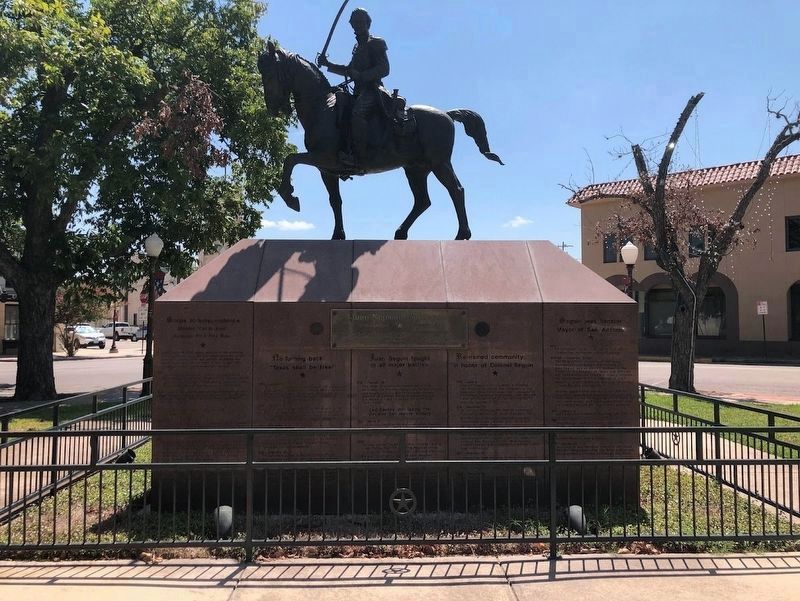
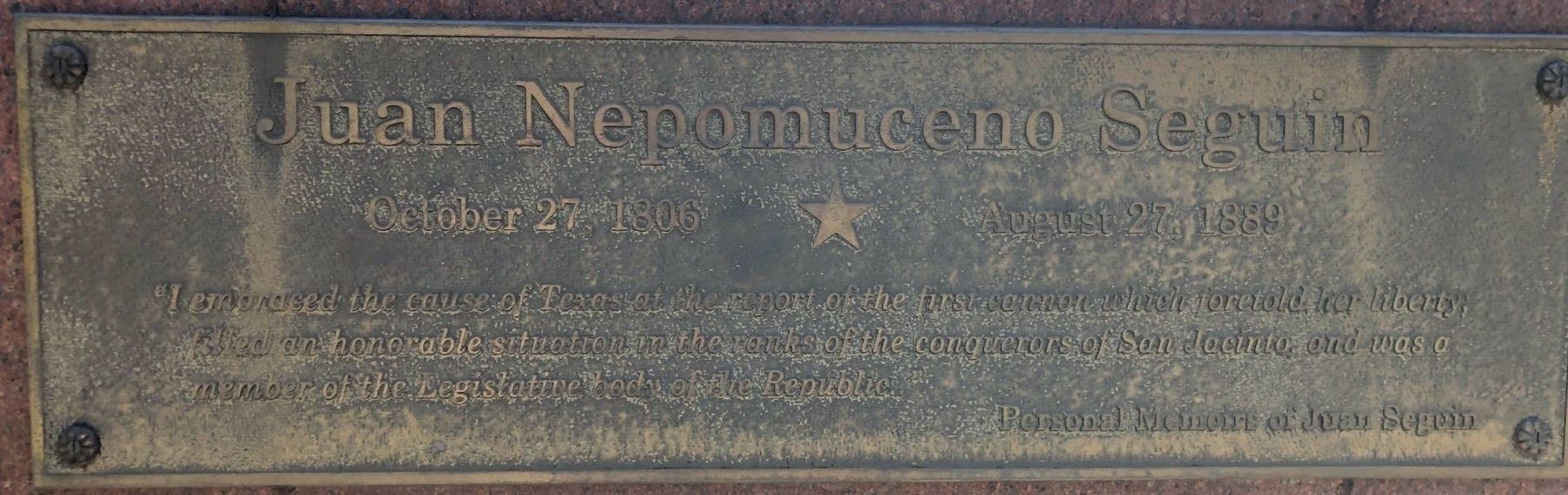
Juan Nepomuceno Seguin
October 27, 1806 - August 27, 1889
Photographed by Sean Flynn, September 5, 2023
1. Juan Nepomuceno Seguin Statue
Personal Memoirs of Juan Seguin
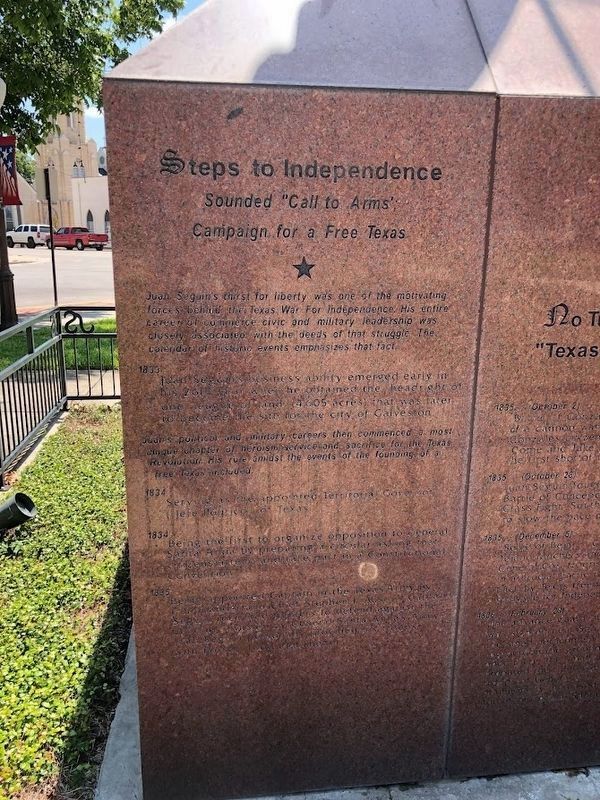
Panel 1
Sounded "Call to Arms";
Campaign for a Free Texas
☆
1833
Juan Seguin's business ability emerged early in his 26th year when he obtained the "headright of one league of land" (4,605 acres) that was later to become the site for the city of Galveston.
Juan's political and military careers then commenced a most unique chapter of heroism, service and sacrifice for the Texas Revolution. His role amidst the events of the founding of a free Texas included:
1834
Serving as the appointed territorial Governor ("Jefe Politico") of Texas.
1834
Being
this page online
1835
Being appointed Captain in the Texas Army by Commander and Chief Stephen F. Austin; Captain Seguin recruited fighters to defend against the pending invasion by General Santa Anna's Army. Juan Seguin personally provided his troops with horses, food and shelter.
Panel 2
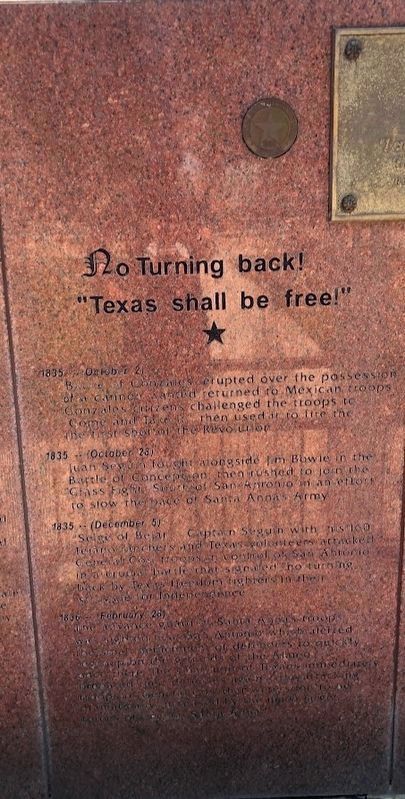
"Texas shall be free!"
☆
1835 -- October 2
Battle of Gonzales erupted over the possession of a cannon wanted returned to Mexican troops. Gonzales citizens challenged the troops to "Come and Take It," then used it to fire the first shot of the Revolution.
1835 -- October 28
Juan Seguin fought along side Jim Bowie in the Battle of Concepcion, then rushed to join the "Grass Fight". South of San Antonio in an effort to slow the pace of Santa Anna's Army.
1835 -- December 5
"Siege of Bejar" - Captain Seguin with his 160 Tejano ranchers and Texas volunteers attacked General Cos' troops in control of San Antonio in a crucial battle that signaled "no turning back" by Texas freedom
Photographed by Sean Flynn, September 5, 2023
2. Juan Nepomuceno Seguin - Top Center Brass Plaque
1836 -- February 28
The advance guard of Santa Anna's troops was sighted near San Antonio which alerted the small detachment of defenders to quickly regroup on the grounds of the Alamo. Once there, the small unit of Texans immediately prepared their defenses against the attacking troops of General Cos that were soon to be dramatically increased by the much larger forces of General Santa Anna.
Panel 3
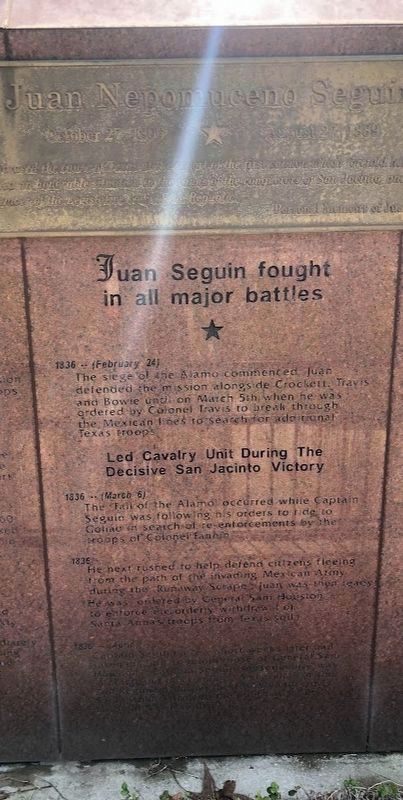
in all major battles
☆
The siege of the Alamo commenced; Juan defended the mission alongside Crockett, Travis and Bowie until on March 5th when he was ordered by Colonel Travis to break through the Mexican lines to search for additional Texas troops.
Decisive San Jacinto Victor
The "Fall of the Alamo" occurred while Captain Seguin was following his orders to ride to Goliad in search of re-enforcements by the troops of Colonel Fannin.
1836
He next rushed to help defend citizens fleeing from the path of the invading Mexican Army during the "Runaway Scrape." Juan was then ready. (He was ordered
Photographed by Sean Flynn, September 5, 2023
3. Juan Nepomuceno Seguin - Panel 1
1836 -- April
Captain Seguin a few short weeks later had taken his unit to rejoin those of General Sam Houston. Captain Seguin subsequently was in command of Company "A" (cavalry) of the 2nd Regiment during the Texas victory over the army of Santa Anna in the brief but fierce Battle of San Jacinto.
Panel 4
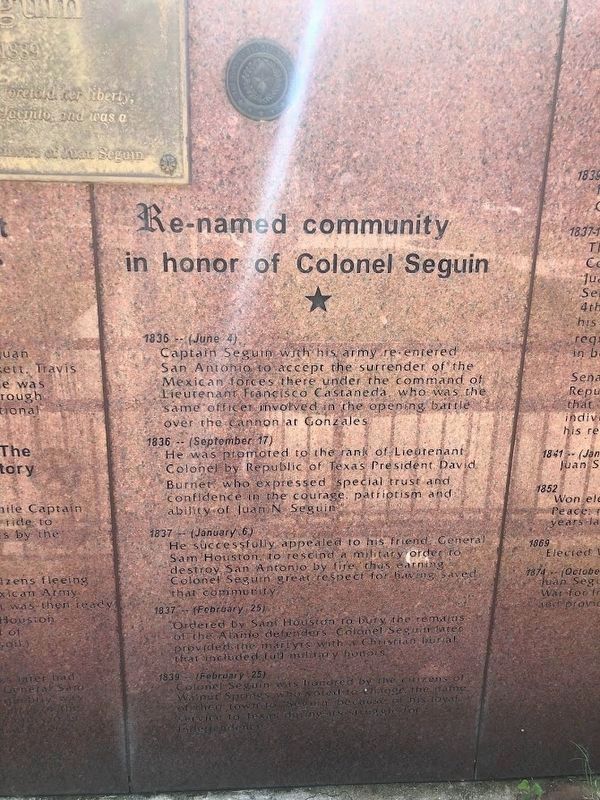
in honor of Colonel Seguin
☆
Captain Seguin with his army re-entered San Antonio to accept the surrender of the Mexican forces there under the command of Lieutenant Francisco Castaneda, who was the same officer involved in the opening battle over the cannon at Gonzales.
1836 -- (September 17)
He was promoted to the rank of Lieutenant Colonel by Republic of Texas President David Burnet, who expressed "special trust and confidence in the courage, patriotism and ability of Juan N. Seguin."
1837 -- (January 6)
He successfully appealed to his friend General Sam Houston, to rescind a military order to destroy San Antonio by fire, thus earning Colonel Seguin great respect for having saved
Photographed by Sean Flynn, September 5, 2023
4. Juan Nepomuceno Seguin - Panel 2
1837 -- (February 25)
Ordered by Sam Houston to bury the remains of the Alamo defenders. Colonel Seguin later provided the martyrs with a Christian burial that included full military honors.
1839 -- (February 25)
Colonel Seguin was honored by the citizens of Walnut Springs, who voted to change the name of their town to "Seguin" because of his loyal service to Texas during its struggle for independence.
Panel 5
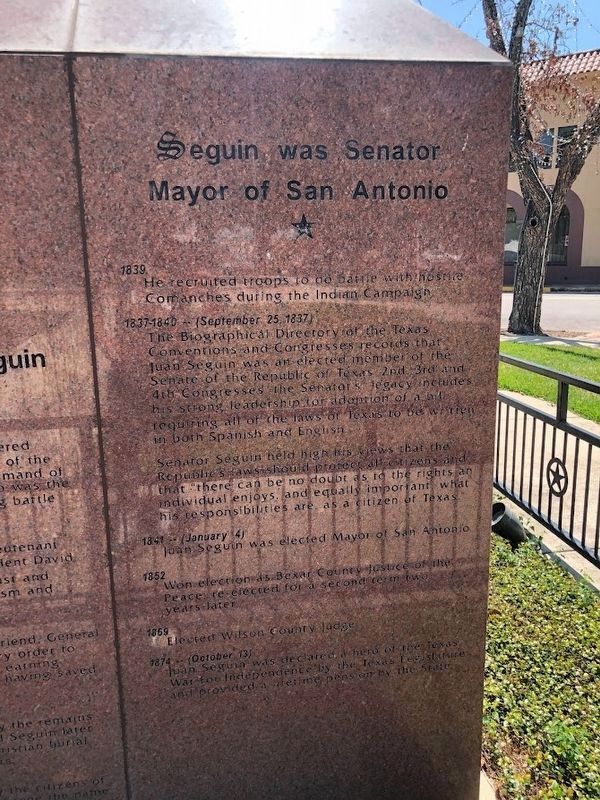
Mayor of San Antonio
☆
He recruited troops to do battle with hostile Comanches during the Indian Campaign.
1837-1840 -- (September 25, 1837)
The Biographical Directory of the Texas Conventions and Congresses records that Juan Seguin was an elected member of the Senate of the Republic of Texas' 2nd, 3rd and 4th Congresses; the Senator's legacy includes his strong leadership for adoption of a bill requiring all of the laws of Texas to be written in both Spanish and English.
Senator Seguin held high his views that the Republic's laws should protect all citizens and that, "there can be no doubt as to the rights an individual enjoys, and equally important, what his responsibilities are, as a citizen of Texas."
1841 -- (January 4)
Juan Seguin was elected Mayor of San Antonio.
1852
Won election as Bexar County Justice of the Peace; re-elected for a second term two years later.
1859
Elected Wilson County Judge.
1874 -- (October 13)
Juan Seguin was declared a hero of the Texas War for Independence by the Texas Legislature and provided a lifetime pension by the State.
Panel 6
☆
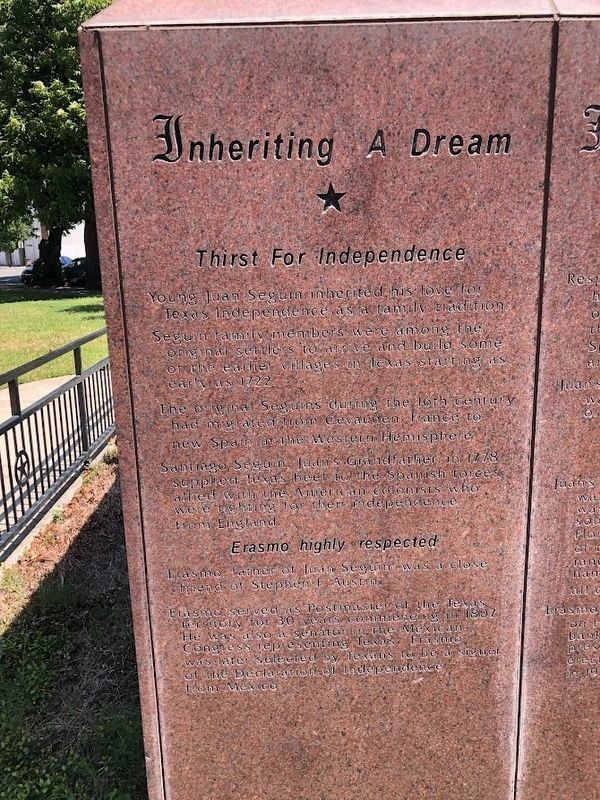
Thirst for Independence
Young Juan Seguin inherited his love for Texas Independence as a family tradition.
Seguin family members were among the original settlers to arrive and build some of the earlier villages in Texas starting as early
Photographed by Sean Flynn, September 5, 2023
5. Juan Nepomuceno Seguin - Panel 3
The original Seguins during the 16th century had migrated from Gevauden, France to New Spain in the Western Hemisphere.
Santiago Seguin, Juan's Grandfather, in 1778 supplied Texas beef to the Spanish forces allied with the American colonists who were fighting for their independence from England.
Erasmo served as Postmaster of the Texas territory for 30 years commencing in 1807. He was also a senator in the Mexican Congress representing Texas. Erasmo was later selected by Texans to be a signer of the Declaration of Independence from Mexico.
Panel 7
☆
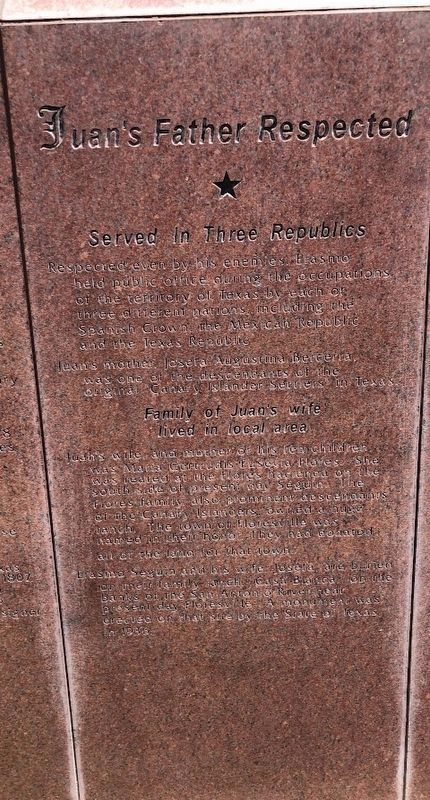
Served In Three Republics
Respected even by his enemies, Erasmo held public office during the occupations of the territory of Texas by each of three different nations, including the Spanish Crown, the Mexican Republic and the Texas Republic.
Juan's mother, Josefa Augustina Bercerra, was one of the descendents of the original "Canary Islander Settlers" in Texas.
lived in local area
Juan's wife, and mother of his ten children, was Maria Gertrudis Eusevia Flores. She was reared at the Flores hacienda on the south side of present day Seguin. The Flores family, also prominent descendants of the Canary Islanders, owned a huge ranch. The town of Floresvile was named in their honor. They had donated all of the land for that town.
Erasmo Seguin and his wife, Josefa, are buried on their family ranch, "Casa Blanca," on the banks of the San Antonio River near present day Floresville. A monument was erected on that site by the State of Texas in 1936.
Panel 8
☆
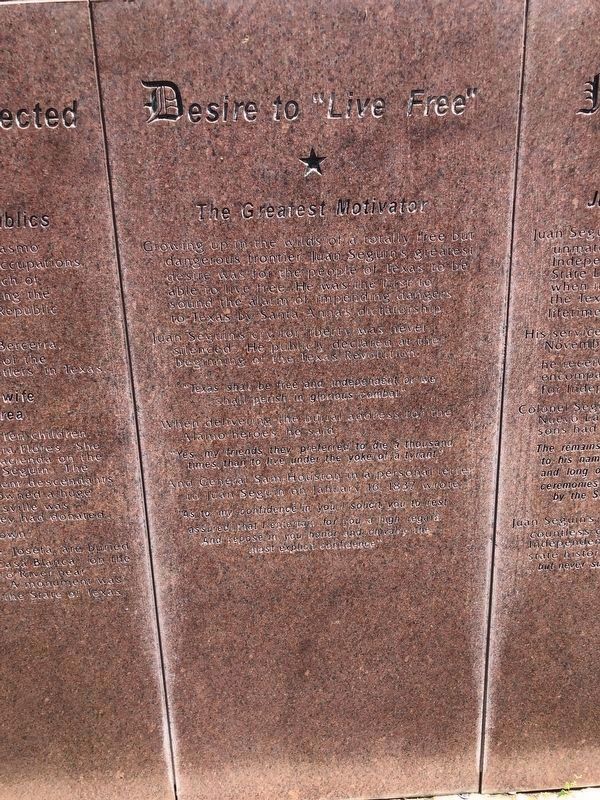
The Greatest Motivator
Growing up in the wilds of a totally free but dangerous frontier, Juan Seguin's greatest
Photographed by Sean Flynn, September 5, 2023
6. Juan Nepomuceno Seguin - Panel 4
Juan Seguin's cry for liberty was never silenced. He publicly declared at the beginning of the Texas Revolution.
shall perish in glorious combat."
When delivering the burial address for the Alamo heroes, he said:
time, than to live under the yoke of a tyrant."
And General Sam Houston, in a personal letter to Juan Seguin on January 16, 1837, wrote:
assured that I entertain for you a high regard.
And repose in your hands and chivalry the
most explicit confidence."
Panel 9
☆
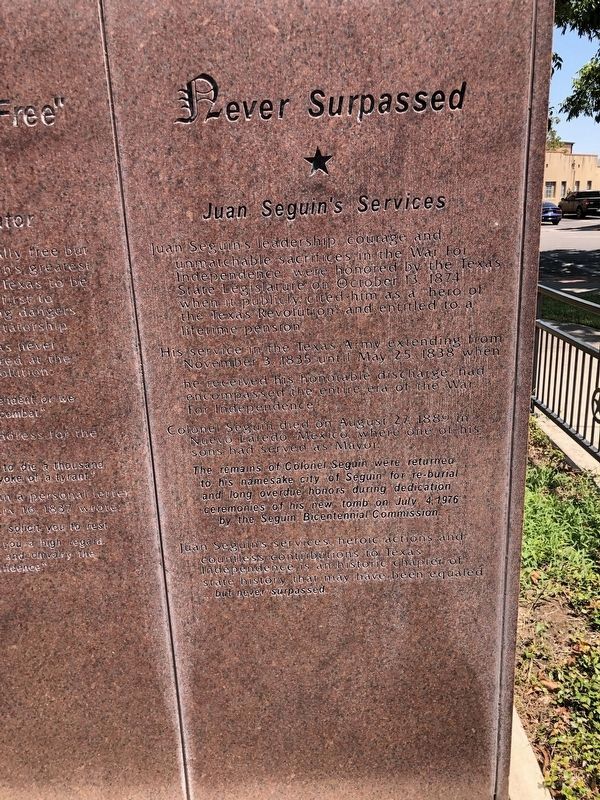
Juan Seguin's Services
Juan Seguin's leadership, courage and unmatchable sacrifices in the War For Independence were honored by the Texas State Legislature on October 13, 1874, when it publicly cited him as a "hero of the Texas Revolution", and entitled to a lifetime pension.
His service in the Texas Army extending from November
Photographed by Sean Flynn, September 5, 2023
7. Juan Nepomuceno Seguin - Panel 5
Colonel Seguin died on August 27, 1889 in Nuevo Laredo, Mexico, where one of his sons had served as Mayor.
The remains of Colonel Seguin were returned to his namesake city of Seguin for re-burial and long overdue honors during dedication ceremonies of his new tomb on July 4, 1976, by the Seguin Bicentennial Commission.
Juan Seguin's services, heroic actions and countless contributions to Texas Independence is an historic chapter of state history that may have been equaled ... but never surpassed.
Erected 2000 by City of Seguin.
Topics. This memorial is listed in these topic lists: Hispanic Americans • Patriots & Patriotism • Settlements & Settlers • War, Texas Independence. A significant historical year for this entry is 1833.
Location. 29° 34.059′ N, 97° 57.84′ W. Memorial is in Seguin, Texas, in Guadalupe County. It is at the intersection of South River Street and East Nolte Street, on the right when traveling south on South River Street. The statue of Juan Seguin is located in
Photographed by Sean Flynn, September 5, 2023
8. Juan Nepomuceno Seguin - Panel 6

Regionally, this memorial is in the Hill Country and in the San Antonio Metropolitan Area. It is also in the American South. Globally, it is in North America, a Gulf of Mexico state, the Western Hemisphere, the Western World, and the Anglosphere. Historically, it finds itself in what was once New Spain, the Republic of Texas, and one of the Confederate States of America.
Other nearby markers. At least 8 other markers are within walking distance of this marker: German Pioneers (a few steps from this marker); Colonel John Ireland (within shouting distance of this marker); The Alfred H. Koebig Central Park Fountain (within shouting distance of this marker); Stephen F. Austin Oak Tree (within shouting distance of this marker); Guadalupe County, C.S.A. (within shouting distance of this marker); Zuehl Family Fence (within shouting distance of this marker); St. Andrew's Episcopal Church (about 300 feet away, measured in a direct line); "White Way" Lighting (about 400 feet
Photographed by Sean Flynn, September 5, 2023
9. Juan Nepomuceno Seguin - Panel 7
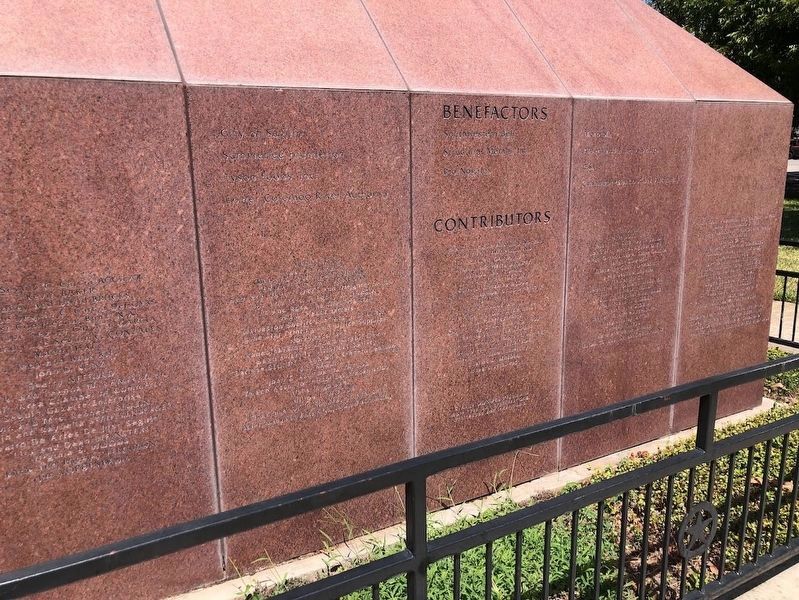
More about this memorial. The marker includes a list of 11 benefactors plus a few dozen contributors to the erection of this monument. Juan Seguin's gravesite in the city of Seguin, referenced on the panels of the statue, is about three-quarters of a mile to the southwest of the statue.
Also see . . . The Equestrian Statue of Juan Seguin. Brief story about the unveiling of Juan Seguin's statue on October 28, 2000.
Texas Escapes: "The detailed bronze was still hot enough for Seguin Town Historian Charley Eckhardt to (respectfully) light a cigar from it."(Submitted on September 11, 2023, by Sean P. Flynn of Oak Park, Illinois.)
Additional keywords. Juan Seguin Texas Alamo
Photographed by Sean Flynn, September 5, 2023
10. Juan Nepomuceno Seguin - Panel 8
Photographed by Sean Flynn, September 5, 2023
11. Juan Nepomuceno Seguin - Panel 9
Photographed by Sean Flynn, September 5, 2023
12. Juan Nepomuceno Seguin - Benefactors and Contributors panels
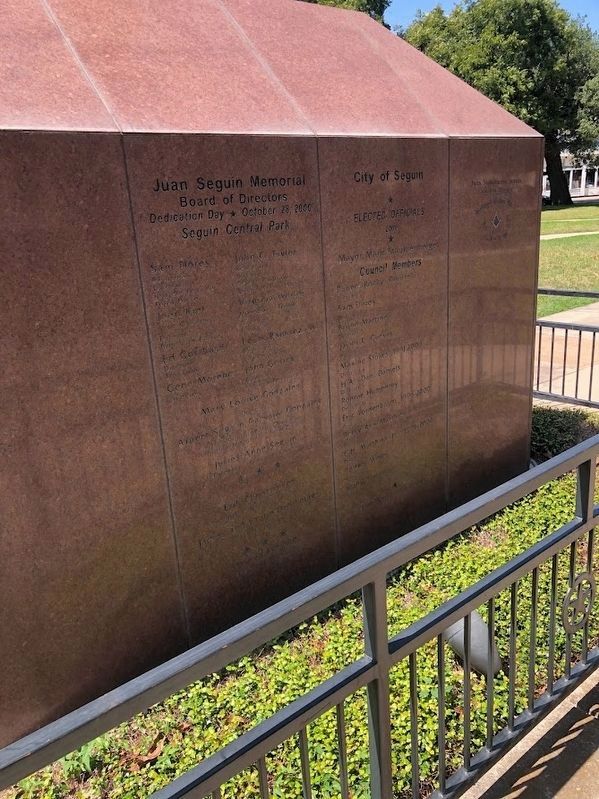
Photographed by Sean Flynn
13. Juan Nepomuceno Seguin - panels for board of directors, city officials and Masonic symbol
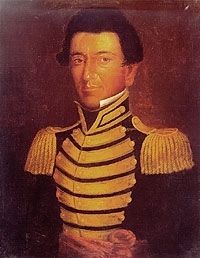
Courtesy of the Texas State Library and Archives Commission
14. Juan Seguin (1806-1890)
Credits. This page was last revised on September 25, 2025. It was originally submitted on September 8, 2023, by Sean P. Flynn of Oak Park, Illinois. This page has been viewed 944 times since then and 131 times this year. Photos: 1. submitted on September 8, 2023, by Sean P. Flynn of Oak Park, Illinois. 2. submitted on September 11, 2023, by Sean P. Flynn of Oak Park, Illinois. 3. submitted on September 15, 2023, by Sean P. Flynn of Oak Park, Illinois. 4, 5, 6, 7. submitted on September 11, 2023, by Sean P. Flynn of Oak Park, Illinois. 8, 9, 10, 11, 12. submitted on September 15, 2023, by Sean P. Flynn of Oak Park, Illinois. 13. submitted on September 16, 2023, by Sean P. Flynn of Oak Park, Illinois. 14. submitted on September 25, 2025, by Sean P. Flynn of Oak Park, Illinois. • James Hulse was the editor who published this page.
