Middle East in Baltimore, Maryland — The American Northeast (Mid-Atlantic)
Painted Screens: An East Baltimore Tradition
Welcome to Eager Park
| — | Eager Park | — |
Photographed by Devry Becker Jones (CC0), September 8, 2023
1. Painted Screens: An East Baltimore Tradition Marker
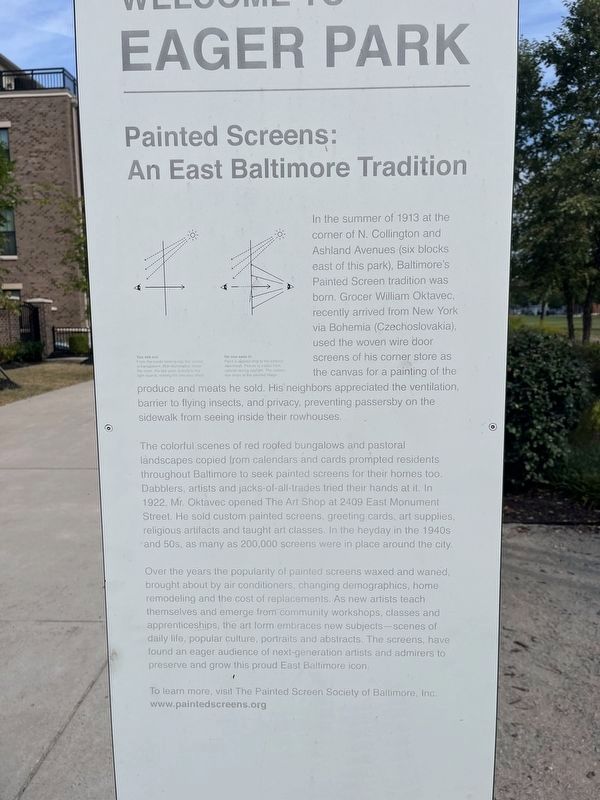
In the summer of 1913 at the corner of N. Collington and Ashland Avenues (six blocks east of this park), Baltimore's Painted Screen tradition was born. Grocer William Oktavec, recently arrived from New York via Bohemia (Czechoslovakia), used the woven wire door screens of his corner store as the canvas for a painting of the produce and meats he sold. His neighbors appreciated the ventilation barrier to flying insects, and privacy, preventing passersby on the sidewalk from seeing inside their rowhouses.
The colorful scenes of red roofed bungalows and pastoral landscapes copied from calendars and cards prompted residents throughout Baltimore to seek painted screens for their homes too. Dabblers, artists and jacks-of-all-trades tried their hands at it. In 1922, Mr. Oktavec opened The Art Shop at 2409 East Monument Street. He sold custom painted screens, greeting cards, art supplies, religious artifacts and taught art classes. In the heyday in the 1940s and 50s, as many as 200,000 screens were in place around the city.
Over the years the popularity of painted screens waxed and waned, brought about by air conditioners,
this page online
To learn more, visit The Painted Screen Society of Baltimore, Inc. www.paintedscreens.org
Topics. This historical marker is listed in these topic lists: Arts, Letters, Music • Immigration • Industry & Commerce. A significant historical year for this entry is 1913.
Location. 39° 18.126′ N, 76° 35.506′ W. Marker is in Baltimore, Maryland. It is in Middle East. It is at the intersection of North Durham Street and East Eager Street, on the right when traveling north on North Durham Street. Touch for map. Marker is at or near this postal address: 1002 N Durham St, Baltimore MD 21213, United States of America. Touch for directions.

Regionally, this marker is in Central Maryland. It is also in the American Mid-Atlantic, in the Chesapeake
![Painted Screens: An East Baltimore Tradition Marker [reverse] image. Click for full size.](Photos7/748/Photo748540.jpg?1214202383300AM "Painted Screens: An East Baltimore Tradition Marker [reverse]. Click for full size.")
Photographed by Devry Becker Jones (CC0), September 8, 2023
2. Painted Screens: An East Baltimore Tradition Marker [reverse]
Other nearby markers. At least 8 other markers are within walking distance of this marker: Clarence H. "Du" Burns Amphitheater (about 400 feet away, measured in a direct line); The Cycle of East Baltimore Communities, 1870s - 1970s (about 700 feet away); Broadway School (approx. 0.2 miles away); “The General’s Highway” (approx. 0.3 miles away); First Baptist Church (approx. half a mile away); Old Dunbar High School (approx. half a mile away); St. Francis Xavier Church (approx. half a mile away); St. Francis Xavier Catholic Church (approx. half a mile away). Touch for a list and map of all markers in Baltimore.
Also see . . . CBS Sunday Morning News Report on the Baltimore's painted screens. The video is dated October 19, 2014. (Submitted on September 8, 2023, by Devry Becker Jones of Washington, District of Columbia.)
Additional commentary.
1.
Photographed by Devry Becker Jones (CC0), September 8, 2023
3. Painted Screens: An East Baltimore Tradition Marker
The marker notes that Bohemia is part of modern Czechoslovakia. While the marker is presumably new, that country was disbanded in 1993, becoming the Czech Republic (or Czechia) and Slovakia. Bohemia is historically part of modern Czechia.
— Submitted September 8, 2023, by Devry Becker Jones of Washington, District of Columbia.
Credits. This page was last revised on December 14, 2023. It was originally submitted on September 8, 2023, by Devry Becker Jones of Washington, District of Columbia. This page has been viewed 295 times since then and 27 times this year. Photos: 1, 2, 3. submitted on September 8, 2023, by Devry Becker Jones of Washington, District of Columbia.
