Casco Viejo in Pamplona in Navarre, Spain — Southwestern Europe (Iberian Peninsula)
Castle of Pamplona

Photographed by J. Makali Bruton, August 2, 2023
1. Castle of Pamplona Marker

Nafarroako Luis Lak eraikitakoa, gaur Gaztelu Plaza dagoen orubean altxatu zen lehenengo gaztelua izan zen. 1308 eta 130 urteen artean eraiki zen, Erronkariko Martin eta Cruzateko Belenguer irakasleen zuzendariztapean, eta plaren iparraldean kokatua zegoen, La Perla Hotelaren ondean. Planta karratua, eta dorre borobilak, eredu frantziarrak jarraituz.
Bere murruak, gaurko Estafeta karrikarekin paraleloak ziren. Kale honetako etze asko, gaztelu honen pareta sendoen gainean altxatu ziren. Gaztelu eraikitzeko, Nabarreriako Burgoaren harriak erabili ziren, garai horietan ondakinak birhurtua zegoena, 1276. Urtean, Burgoen Gerran, deuseztatua izan zen eta.
Hiru ate zituen. Ate nagusia, gaurko plazari begira irekitzen zen, gazteluaren arma-patio gisa erabiltzen zena. Beste ate bat, Zorriburbu auzoari begira zegoen, San Nicolaseko 1411urtean adibedez, egurrezko palkoak altzatzen siren. Bertatik, errege-erreginek, Gaztelu Plazan ospatzen ziren jaialdi eta lehiak ikus ditzaten.
1512ko konkistaren ondoren, gaztelua suntsitu zuten, eta bere harriekin gotorleku berria eraiki zuten, Fernando Katolikoak aginduta,
this page online
Castillo de Pamplona
El castillo construido en Pamplona por el rey Luis I de Navarra fue el primero que se levantó en el solar de la actual Plaza del Castillo. Se edificó entre 1308 y 1310, bajo la dirección de los maestros Belenguer de Cruzat y Martín de Roncal, y se encontraba en el cuadrante septentrional de la plaza, el más cercano al hotel La Perla. Tenía planta cuadrangular, con torres angulares circulares, y debía seguir modelos franceses.
Sus muros corrian paralelos a la actual calle de la Estafeta, y muchas de las casas de esta calle se levantaron apoyándose en las recias paredes de piedra del castillo. En su construcción, además, se emplearon piedras del burgo de la Navarrería, que había sido arrasado en 1276, durante la Guerra de los Burgos, y que por entonces se encontraba en ruinas.
Sabemos que tenía tres puertas. La principal se abría hacia la explanada de la actual plaza, que servia como patio de armas del castillo. Otra se abría hacia el barrio de Zorriburbu, que se encontraba cerca de las escaleras de San Nicolás, y una tercera
Photographed by J. Makali Bruton, August 2, 2023
2. Castle of Pamplona Marker
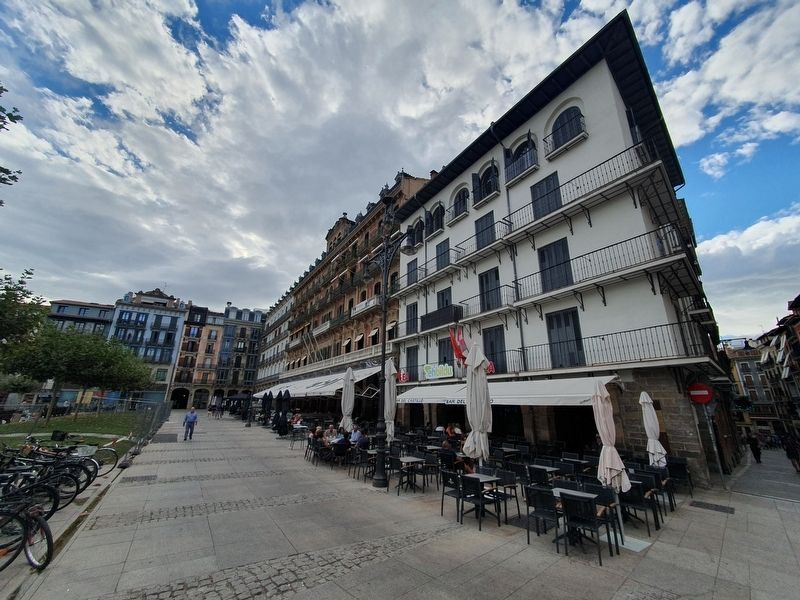
The marker is on the near corner of the building seen here.
Tras la conquista de 1512 el viejo castillo fue derribado, empleándose sus piedras en la construcción de la nueva fortaleza que, por orden de Fernando el Católico, se levantó en el frente contrario de la plaza, donde hoy se encuentra Palacio de Navarra 1519.
Castle of Pamplona
The castle, built in Pamplona under King Louis I of Navarre, was the first castle built on the site of the current Plaza del Castillo (Castle Square). It was built between 1308 and 1310, under the guidance of masters Belenguer de Cruzat and Martin de Roncal, and was situated in the northern quadrant of the square, northwest to the La Perla hotel. The castle was square-shaped, with circular towers with angled corners and made following French designs.
Its walls ran parallel to the current calle de la Estafeta, and many of the houses built on this street were supported by the sturdy stone walls of the castle. Furthermore, stones from the borough of Navarreria were used in its construction. The borough had been razed in 1276 during the War of the Boroughs and remained in ruins since then.
The castle is known to have had three doors. The main door opened onto the esplanade of the current square, which was used as the castle's weapons courtyard. Another door opened towards the Zorriburbu district, which was near the Saint Nicholas staircase, and the third door opened onto the site of the modern-day staircase of Calle de la Estafeta. From time to time, for example in 1411, wooden boxes were erected in the castle, from which the monarchs could watch tournaments, bullfights and celebrations which took place in Plaza del Castillo at that time.
After the 1512 conquest, the old castle was demolished and its stones were used in building the new fortress which, by order of Ferdinand the Catholic, was built on the opposite side of the square, on the site of the modern-day Palace of Navarre.
Château de Pampelune
Le château costruit à Pampelune par le roi Louis 1 de Navarre fut le premier qui a été bâti sur le terrain de l'actuelle Place du Château. Il a été construit entre 1308 et 1310, sous la direction des enseignants Belenguer de Cruzat et Martin de Roncal Il était dans le quadrant nord de la place, le plus proche de l'hôtel La Perla. Il avait trois tours d'angle circulaires, et il devait continuer à modèles français.
Ses murs étaient parallèles à la actuelle rue de Estafeta, et la plupart des maisons de cette rue ont été bâties sur les murs du château de pierres solides. Dans la construction, en plus, des pierres du bourg de la Navarreria (détruit en 1276) avaient été utilisées.
On sait qu'il avait trois portes. La principale ouverte dans la cour de la place actuelle, qui servait comme salle d'armes du château. Un autre était ouverte dans le quartier Zorriburu, qui était près des escaliers de San Nicolas. Une troisième troisème porte était, plus ou moins, dans les escaliers de la rue Estafeta Parfois, par exemple en 1411, ils ont construit des loges en bois, à partir desquelles le roi pouvait voir les tournois et festivités qui étaient organisées sur la place du château.
Après la conquête de 1512, le vieux château a été démoli Ses pierres utilisées dans la construction de la nouvelle forteresse sur les ordres de Fernando el Catolico, se levèrent sur la face opposée de la place, où se trouve aujourd'hui le Palais de Navarrerent sur la face opposée de la place, où se trouve aujourd'hui le Palais de la Navarre.
Topics. This historical marker is listed in this topic list: Forts and Castles. A significant historical year for this entry is 1308.
Location. 42° 49.052′ N, 1° 38.571′ W. Marker is in Pamplona, Navarra (Navarre). It is in Casco Viejo. It is at the intersection of Plaza del Castillo and Calle de la Chapitela, on the right when traveling west on Plaza del Castillo. Touch for map. Marker is at or near this postal address: Pl del Castillo 49, Pamplona, Navarra 31001, Spain. Touch for directions.

Regionally, it is in the North Atlantic Region, on the Atlantic Arc, in Europe, in the European Union, in Atlantic Europe, on the Iberian Peninsula, in the Schengen Area, in a coastal Mediterranean country, and in the Western World. Historically, it finds itself in what was once the Roman Empire.
Other nearby markers. At least 8 other markers are within walking distance of this marker: Manuel Iribarren Paternáin (within shouting distance of this marker); Café Kutz (within shouting distance of this marker); Calle Estafeta (about 90 meters away, measured in a direct line); Club Atlético Osasuna Headquarters (about 120 meters away); Garcilaso de la Vega as a Knight of Santiago (about 120 meters away); Casildo and Lino Ojeta Irigoyen (about 120 meters away); Carlos III El Noble (about 120 meters away); Blue Lips (about 120 meters away). Touch for a list and map of all markers in Pamplona.
Credits. This page was last revised on September 21, 2023. It was originally submitted on September 20, 2023, by J. Makali Bruton of Washington, District of Columbia. This page has been viewed 132 times since then and 15 times this year. Photos: 1. submitted on September 20, 2023, by J. Makali Bruton of Washington, District of Columbia. 2. submitted on September 21, 2023, by J. Makali Bruton of Washington, District of Columbia.
