Wicker Park in Chicago in Cook County, Illinois — The American Midwest (Great Lakes)
Wicker Park
Chicago Landmark District
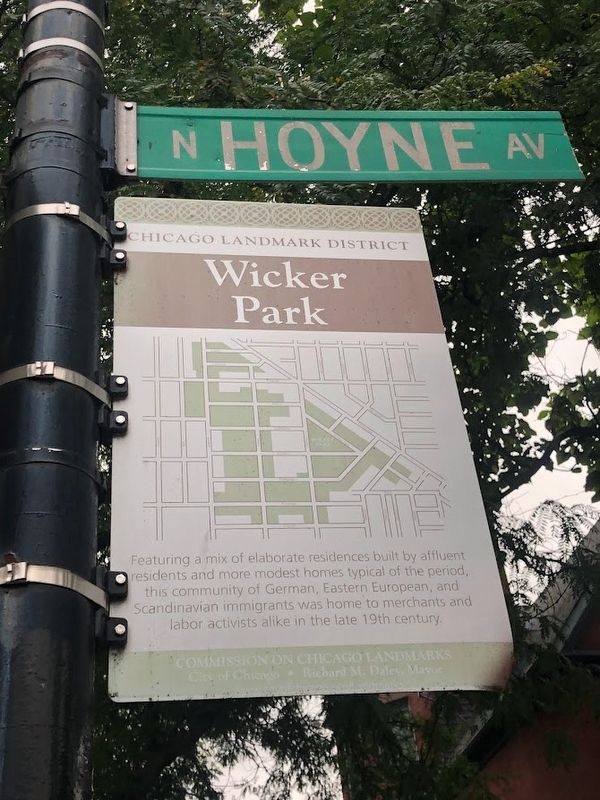
Photographed by Sean Flynn
1. Wicker Park Marker
Erected by Commission on Chicago Landmarks, City of Chicago.
Topics and series. This historical marker is listed in these topic lists: Architecture • Immigration • Settlements & Settlers. In addition, it is included in the Illinois, Chicago Landmarks Commission, and the National Register of Historic Places (NRHP) series lists. A significant historical year for this entry is 1870.
Location. 41° 54.361′ N, 87° 40.792′ W. Marker is in Chicago, Illinois, in Cook County. It is in Wicker Park. It is at the intersection of West Evergreen Avenue and North Hoyne Avenue, on the left when traveling east on West Evergreen Avenue. The marker is affixed to the light post on the northwest corner of the Hoyne-Evergreen intersection. Touch for map. Marker is in this post office area: Chicago IL 60622, United States of America. Touch for directions.

Regionally, this marker
this page online
Other nearby markers. At least 8 other markers are within walking distance of this marker: A different marker also named Wicker Park (about 600 feet away, measured in a direct line); a different marker also named Wicker Park (approx. 0.2 miles away); Nelson Algren (approx. 0.2 miles away); Unidos para Triunfar (approx. 0.2 miles away); a different marker also named Nelson Algren (approx. 0.2 miles away); Charles Gustavus Wicker (approx. 0.2 miles away); Fountain Court Enhancement (approx. 0.2 miles away); Ignacy Jan Paderewski (1860–1941) (approx. 0.2 miles away). Touch for a list and map of all markers in Chicago.
More about this marker. The marker has identical text on the front and back; the corner of it has been bent.
At least three more identical markers can be found affixed
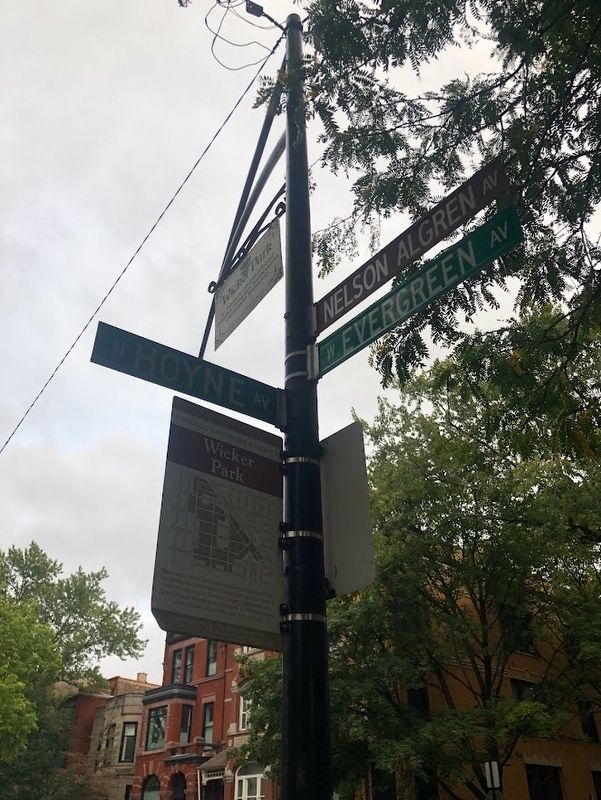
Photographed by Sean Flynn, September 27, 2023
2. Wicker Park Marker
The marker is below green Chicago street signs, a brown Chicago honorary street sign for author Nelson Algren (a long-time Wicker Park resident), and a sign in English, Polish and Spanish identifying the neighborhood as a national and city landmark.
The same lamp post has an honorary brown street sign denoting honorary Nelson Algren Avenue (above the Evergreen Avenue street sign), for the author whose final Chicago home was on Evergreen Avenue about two blocks east of here. There is also a Wicker Park neighborhood sign that notes the neighborhood's 1979 designation on the National Register of Historic Places, and its 1991 naming as a Chicago Landmark District. That sign describes Wicker Park as "an historic neighborhood" in English, Polish and Spanish.
Also see . . . Wicker Park District.
From the Chicago Landmarks Commission: "Pierce and Hoyne streets feature some of the city's largest and best examples of Victorian-era architecture and, due to the large number of brewery owners who built residences on Hoyne, that street became known as "Beer Baron Row." Early inhabitants were largely German and Scandinavian in origin, although a later influx of Polish immigrants led to the area being called the 'Polish Gold Coast.'"(Submitted on September 28, 2023, by Sean P. Flynn of Oak Park, Illinois.)
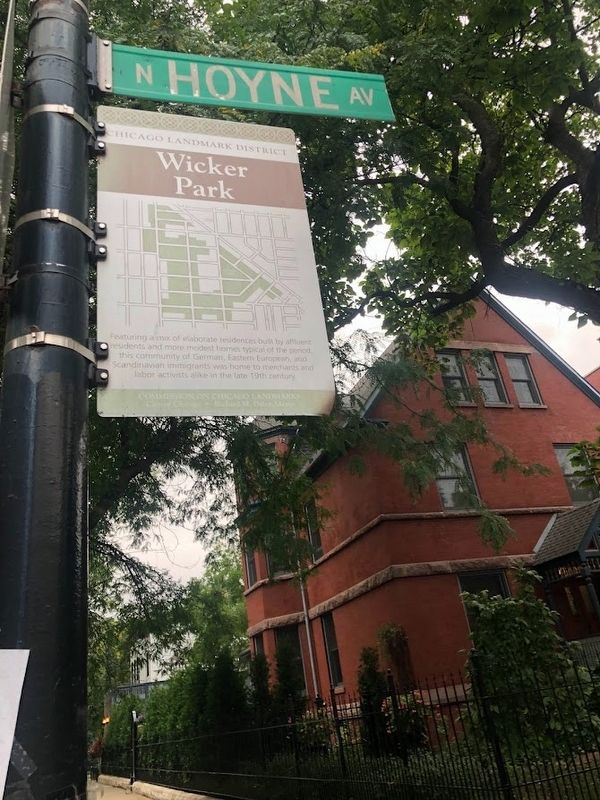
Photographed by Sean Flynn, September 27, 2023
3. Wicker Park Marker
1336 N. Hoyne Avenue is the brick residence in the background.
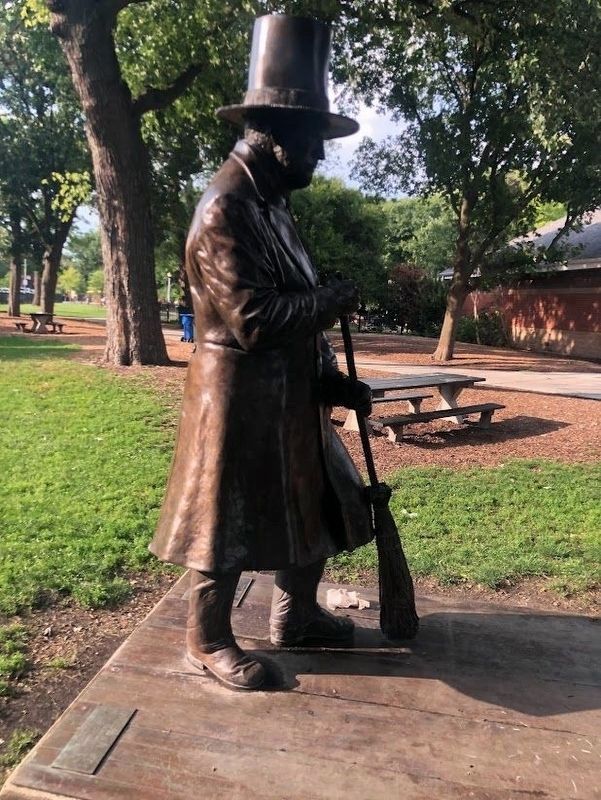
Photographed by Sean Flynn, July 26, 2023
4. Charles Gustavus Wicker statue
This statue to Charles Gustavus Wicker can be found in Wicker Park, about two blocks from the neighborhood marker. The park and its eponymous neighborhood are named after Charles and his brother Joel, who donated four acres for a park to the city in 1870.
Credits. This page was last revised on May 7, 2026. It was originally submitted on September 28, 2023, by Sean P. Flynn of Oak Park, Illinois. This page has been viewed 799 times since then and 86 times this year. Photos: 1, 2, 3, 4. submitted on September 28, 2023, by Sean P. Flynn of Oak Park, Illinois. • Andrew Ruppenstein was the editor who published this page.
