Winrock in Conway County, Arkansas — The American South (West South Central)
Rock House Cave: Rock Art
A glimpse of Arkansas's Prehistoric Heritage
Photographed by Darren Jefferson Clay, June 24, 2023
1. Rock House Cave: Rock Art Marker
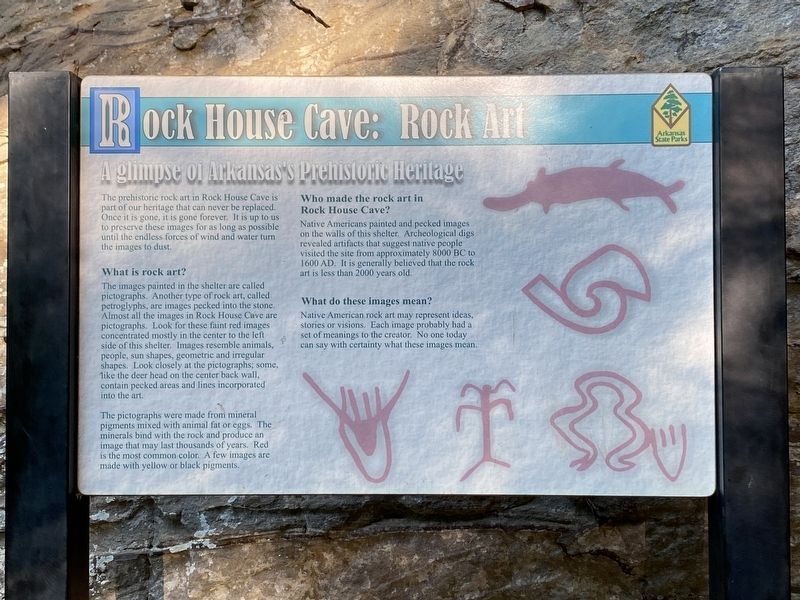
The prehistoric rock art in Rock House Cave is part of our heritage that can never be replaced. Once it is gone, it is gone forever. It is up to us to preserve these images for as long as possible until the endless forces of wind and water turn the images to dust.
What is rock art?
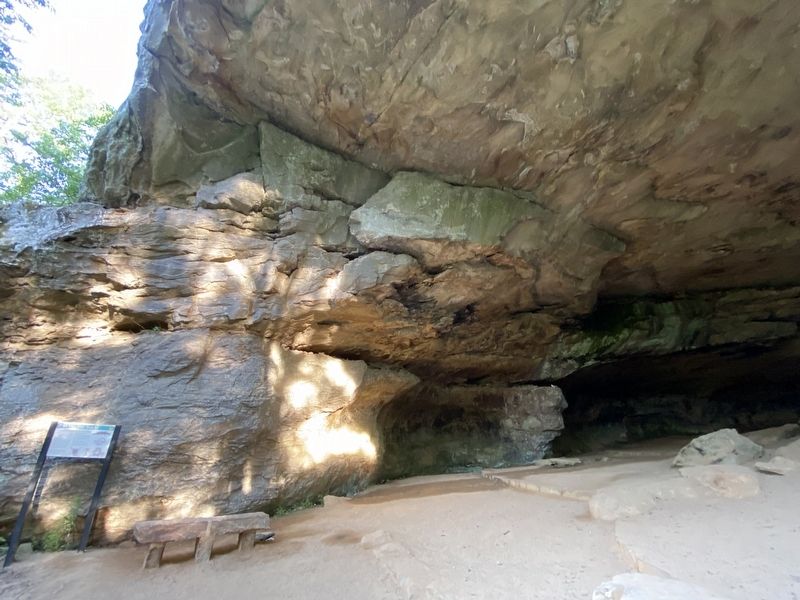
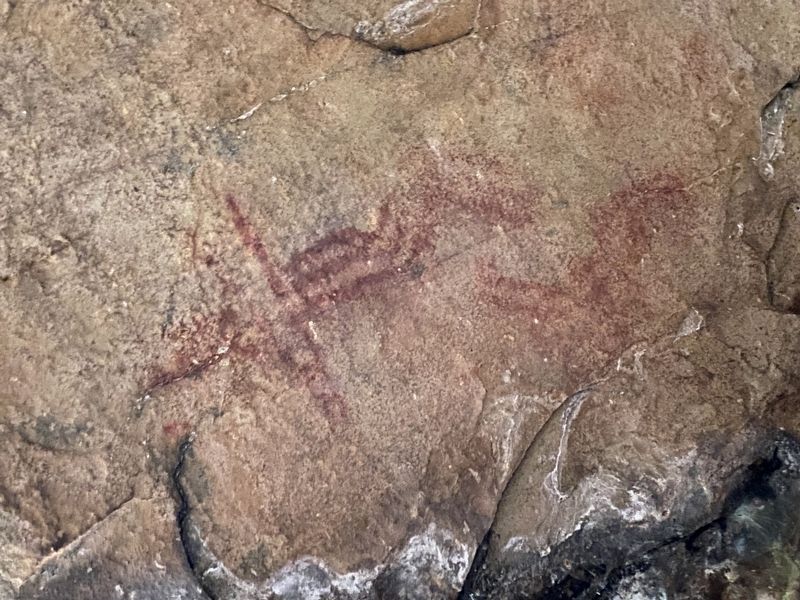
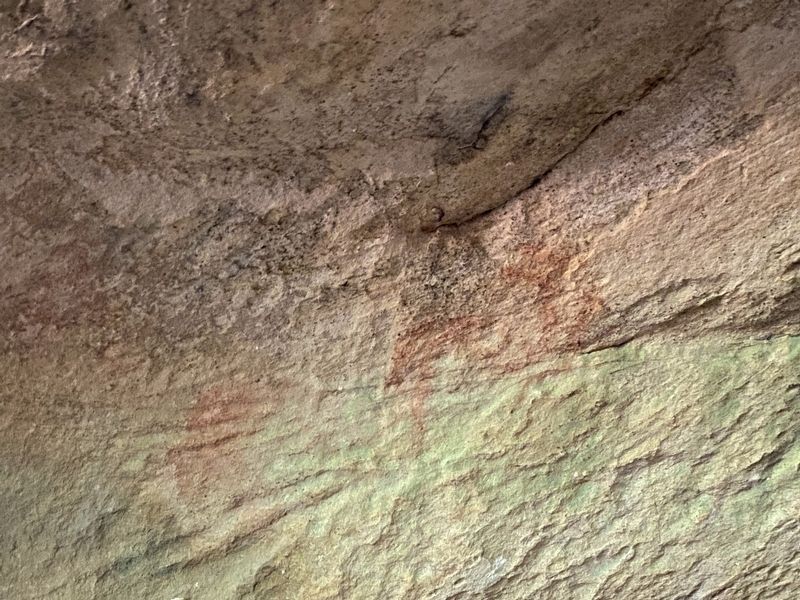
The images painted in the shelter are called pictographs. Another type of rock art, called petroglyphs, are images pecked into the stone. Almost all the images in Rock House Cave are pictographs. Look for these faint red images, concentrated mostly in the center to the left side of this shelter, Images resemble animals, people, sun shapes, geometric and irregular shapes. Look closely at the pictographs; some, like the deer head on the center back wall, contain pecked areas and lines incorporated into the art.
The pictographs were made from mineral pigments mixed with animal fat or eggs. The minerals bind with the rock and produce an image that may last thousands of years. Red is the most common color. A few images are made with yellow or black pigments.
Who made the rock art in Rock House Cave?
Native Americans painted and pecked
this page online
What do these images mean?
Native American rock art may represent ideas, stories or visions. Each image probably had a set of meanings to the creator. No one today can say with certainty what these images mean.
Erected by Arkansas State Parks.
Topics. This historical marker is listed in these topic lists: Anthropology & Archaeology • Arts, Letters, Music • Indigenous Peoples and Communities.
Location. 35° 7.308′ N, 92° 56.191′ W. Marker is in Winrock, Arkansas, in Conway County. It can be reached from Red Bluff Drive. Touch for map. Marker is in this post office area: Morrilton AR 72110, United States of America. Touch for directions.

Regionally, this marker is in the Arkansas River Valley. It is also in the American South, specifically in the Upper South, and in the Ozarks. Globally, it is in North America, the Western Hemisphere,
Photographed by Darren Jefferson Clay, June 24, 2023
2. Rock House Cave: Rock Art Marker
Other nearby markers. At least 8 other markers are within walking distance of this marker: Arkansas's First State Park (about 800 feet away, measured in a direct line); Geology of Cedar Creek Falls Overlook (about 800 feet away); Special Places to See (about 800 feet away); Two Dominant Fossils of the Area (approx. 0.2 miles away); The Old Pioneer Cabin (approx. 0.4 miles away); Cement Sculptures by Dionicio Rodriguez (approx. ¾ mile away); The CCC at Petit Jean State Park (approx. 0.8 miles away); Civilian Conservation Corps and the Building of Arkansas's First State Park (approx. 0.8 miles away). Touch for a list and map of all markers in Winrock.
More about this marker. The marker is located in Petit Jean State Park.
Photographed by Darren Jefferson Clay, June 24, 2023
3. Native American rock art
Photographed by Darren Jefferson Clay, June 24, 2023
4. Native American rock art
Credits. This page was last revised on June 16, 2024. It was originally submitted on September 29, 2023, by Darren Jefferson Clay of Duluth, Georgia. This page has been viewed 499 times since then and 94 times this year. Photos: 1, 2, 3, 4. submitted on October 3, 2023, by Darren Jefferson Clay of Duluth, Georgia. • Andrew Ruppenstein was the editor who published this page.
