Camden in Kershaw County, South Carolina — The American South (South Atlantic)
The Loyalists
Photographed by Stanley and Terrie Howard, October 11, 2009
1. The Loyalists Marker
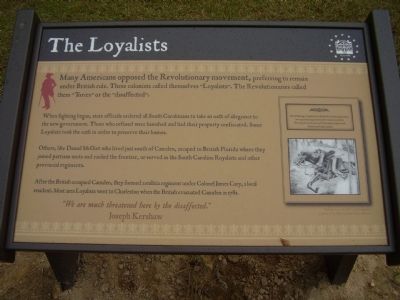
Many Americans opposed the Revolutionary movement, preferring to remain under British rule. These colonists called themselves "Loyalists". The Revolutionaries called them "Tories" or the "disaffected".
When fighting began, state officials ordered all South Carolinians to take an oath of allegiance to the new government. Those who refused were banished and had their property confiscated. Some Loyalists took the oath in order to preserve their homes. Others, like Daniel McGirt who lived just south of Camden, escaped to British Florida where they joined partisan units and raided the frontier, or served in the South Carolina Royalists and other provincial regiments.
After the British occupied Camden, they formed a militia regiment under Colonel James Cary, a local resident. Most area Loyalists went to Charleston when the British evacuated Camden in 1781.
"We are much threatened here by the disaffected"
Joseph Kershaw
Topics. This historical marker is listed in this topic list: War, US Revolutionary. A significant historical year for this entry is 1781.
Location. 34° 13.936′ N, 80° 36.166′ W. Marker is in Camden, South Carolina,
this page online

Regionally, this marker is in the Midlands and in the Olde English District. It is also in the American South and specifically in the Deep South. Globally, it is in North America, the Western Hemisphere, the Western World, and the Anglosphere. Historically, it finds itself in what was once the territory of the Mississippian Culture, one of the original Thirteen Colonies, one of the Confederate States of America, and the Antebellum South.
Other nearby markers. At least 8 other markers are within walking distance of this marker: Building Kershaw's Gunpowder Magazine (within shouting distance of this marker); Powder Magazine (within shouting distance of this marker); The Great Wagon Road (within shouting distance of this marker); Conestoga Wagons (within shouting distance of this marker); Clay Pits for Brick & Pottery (within shouting distance of this marker); Indigenous Trading Routes (within
Photographed by Anna Inbody, October 2, 2011
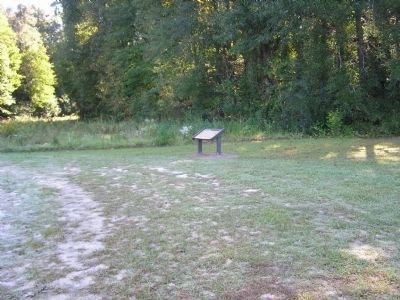
2. Overview
Photographed by Bill Coughlin, November 4, 2017
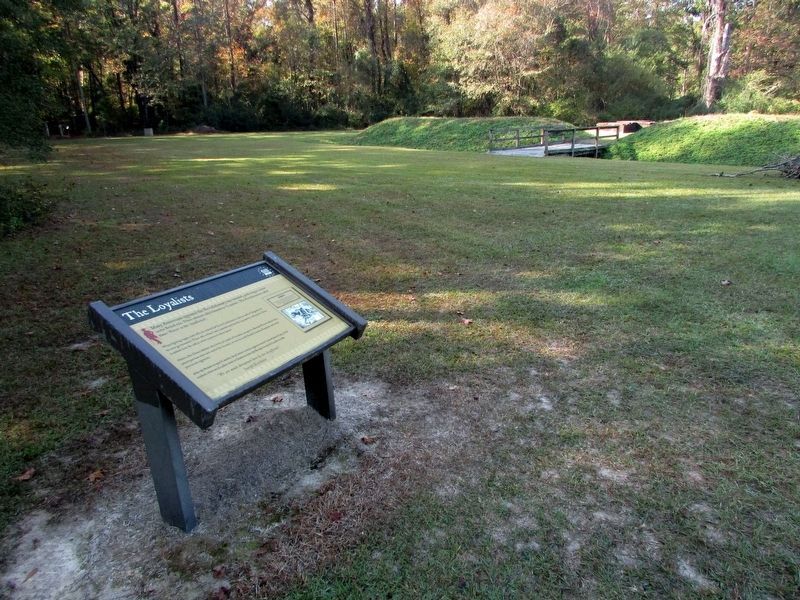
3. The Loyalists Marker
Photographed by Anna Inbody, October 2, 2011
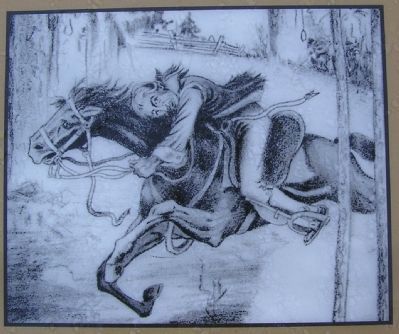
4. Picture on the marker
David Fanning, a Loyalist from the South Carolina backcountry, was repeatedly imprisoned by Revolutionary leaders. He escaped several times and led Loyalist troops in both North and South Carolina.
“Fanning, Loses the ‘Doe’”, artist unknown. Courtesy of the North Carolina State Archives
“Fanning, Loses the ‘Doe’”, artist unknown. Courtesy of the North Carolina State Archives
Credits. This page was last revised on January 19, 2026. It was originally submitted on October 17, 2009, by Stanley and Terrie Howard of Greer, South Carolina. This page has been viewed 1,211 times since then and 24 times this year. Photos: 1. submitted on October 17, 2009, by Stanley and Terrie Howard of Greer, South Carolina. 2. submitted on November 3, 2011, by Anna Inbody of Columbia, South Carolina. 3. submitted on November 7, 2017, by Bill Coughlin of Woodland Park, New Jersey. 4. submitted on November 3, 2011, by Anna Inbody of Columbia, South Carolina. • Craig Swain was the editor who published this page.
