
Centro in Donostia in Gipuzkoa, Basque Country, Spain — Southwestern Europe (Iberian Peninsula)
Cathedral of Buen Pastor
Photographed by J. Makali Bruton, August 4, 2023
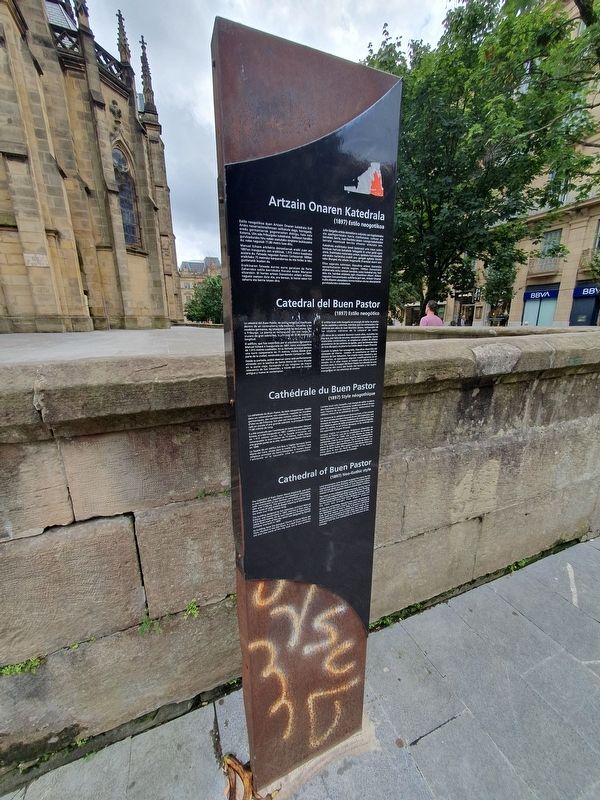
1. Cathedral of Buen Pastor Marker

(1897) Estilo neogotikoa
Estilo neogotikoa duen Artzain Onaren katedrala Erdi Aroko neoarrazionalismoan sailkatuta dago, horregatik, eredu germaniarrak gogorarazten dizkigu, hala nola Kolonia, Ulm edo Friburgoko katedralak. Soiltasun handiko gurutzadurako hiru nabez osatutako oinplano laukizuzena du; nabe nagusiak 77,80 metro luze ditu.
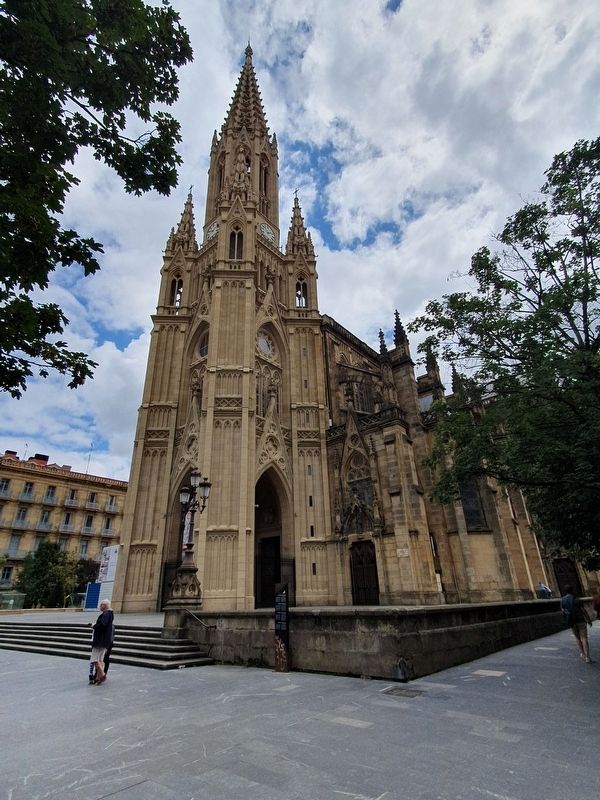
Manuel Echave arkitekto donostiarrak eraiki zuen eta 1897an inauguratu zen eraikinak, 1.915 metro koadroko azalera du. Fatxada nagusian Ramón Cortazarrek 1899an eraikitako 75 metroko kanpandorrea du eta hiriko ia leku guztietatik ikusten da.
Eraikinaren fatxada aurrez aurre geratzen da Parte Zaharreko estilo barrokoko Koruko Andre Mariaren elizarekin. Bi horien artean Donostiako ardatz erlijioso nagusia osatzen dute eta, era berean, bi horiei esker hiri zaharra eta berria lotzen dira.
(1897) Estilo neogotikoa Julio Gargallo artista donostiarra arduratu zen kapiteletako eta apaingarrietako harria zizelkatzeaz. Leihoez eta beirateez, berriz, Juan Bautista Lázaro-Leongo katedraleko beirate ospetsuak berritu zituena- arduratu zen.
Katedrala eraikitzeko lanek bederatzi urte iraun zuten, kontuan hartuta baliabide faltagatik bi urtez geldi egon zirela. Eraikitzeko materialen artean, Igeldoko harrobietatik ateratako harlandua erabili zen, gangak egiteko Ocioko toba (Burgos) eta arbela Angersetik (Frantzia) ekarri zen.
Eliza sagaratu zutenean, Gipuzkoa artean Gasteizko apezpikutzaren mende zegoen. 1949an Donostiako elizbarrutia sortu zenean izendatu zuten katedral eta, hori dela eta, hainbat aldaketa egin zitzaizkion elizari. Aldare nagusian koruarentzako aulkiteria jarri zen, Artzain Onaren irudia elizaren atzealdeko horma-hobian eta lau ebanjelariak gurutzadurako zutabeetan.
Catedral del Buen Pastor
(1897) Estilo neogótico
La catedral del Buen Pastor, de estilo neogótico, klasificada dentro de un racionalismo nee medieval, recuerda a los modelos germanos, de catedrales comb las de Colonia, Ulm o Friburgo. La planta es rectangular con tres naves ent crucero de gran sobriedad, la princip de 77,80 metros de longitud.
El edificio, que fue constráido por el arquitecto donostiarra Manuel Echave e inaugurada en 1897, tiene una superficie de 1.915 metros cuadrados. En su fachada principal destaca una torre campanario de 75 metros, visible desde gran parte de la ciudad, construida por Ramón Cortazar en 1899.
Desde su portada, podrá observar como está perfectamente alineada con la basilica de Santa Maria del Coro situada en la parte vieja, formando el eje religioso de mayor relevancia de San Sebastián, a través del cual la ciudad antigua y nueva se contemplan.
El artista local Julio Gargallo se encargó de tallar la piedra de los capiteles y adornos, mientras que los ventanales y las vidrieras son obra de Juan Bautista Lázaro, restaurador de las célebres vidrieras de la catedral de León.
obras de la catedral duraron nueve años, incluidos los (dos que, por falta de recursos, estuvieron suspendidas. Como materiales constructivos, se emplearon piedra de silleria procedente de las canteras de Igeldo, para las bóvedas toba de Ocio (Burgos) y la pizarra fue traída desde Angers (Francia).
Cuando la iglesia fue consagrada, Gipuzkoa dependia del obispado de Vitoria-Gasteiz. Al constituirse en 1949 la diócesis de San Sebastián, fue erigida como catedral y, por ese motivo, se ejecutaron algunas modificaciones en el templo. En el altar mayor se instaló una sillería para el servicio coral, la imagen del Buen Pastor fue ubicada en una hornacina del muro del fondo del templo y los cuatro evangelistas en las columnas de crucero.
Cathédrale du Buen Pastor
(1897) Style néogothique
La cathédrale du Buen Pastor, de style néogothique, classée dans un rationalisme néo-médiéval, rappelle les modèles germaniques, des cathédrales comme celles de Cologne, d'Ulm ou de Fribourg. Son plan est rectangulaire, avec trois nefs en croisée d'une grande sobriété, la principale faisant 77,80 mètres de long.
Il a été construite par l'architecte de Saint-Sébastien Manuel Echave, et a été inaugurée en 1897. L'édifice a une superficie de 1.915 mètres carrés. Sur la façade principale, est remarquable la tour-clocher de 75 mètres, visible depuis une grande partie de la ville, construite par Ramón Cortazar en 1899.
La façade de cet édifice fait face à l'église baroque Santa María del Coro, située dans la vieille ville, formant l'axe religieux principal de Saint-Sébastien, à travers lequel l'ancienne et la nouvelle ville se contemplent.
L'artiste local Julio Gargallo s'est chargé de tailler la pierre des chapiteaux et des ornements, tandis que vitres et vitraux sont l'œuvre de Juan Bautista Lázaro, restaurateur des célèbres vitraux de la cathédrale de León.
Les travaux de la cathédrale ont duré neuf ans, si l'on compte les deux années pendant lesquels ils ont été suspendus, par manque de moyens. Comme matériaux de construction, ont été utilisés la pierre de taille provenant des carrières d'igelda, pour les voûtes, le tuf d'Ocio (Burgos), et les ardoises ont été apportées d'Angers (France).
Lorsque l'église fut consacrée, Guipúzcoa dépendait de l'évêché de Vitoria. Lors de la constitution du diocèse de Saint-Sébastien, en 1949, elle a été élevée au rang de cathédrale, c'est la raison pour laquelle des modifications ont été réalisées dans le temple. Sur le maître-autel, une pierre de taille a été installée pour le service de chœur. La statue du Buen Pastor (Bon pasteur) a été placée dans une niche dans le mur du fond du temple, et les quatre évangélistes sur les colonnes du transept.
Cathedral of Buen Pastor
(1897) Neo-Gothic style
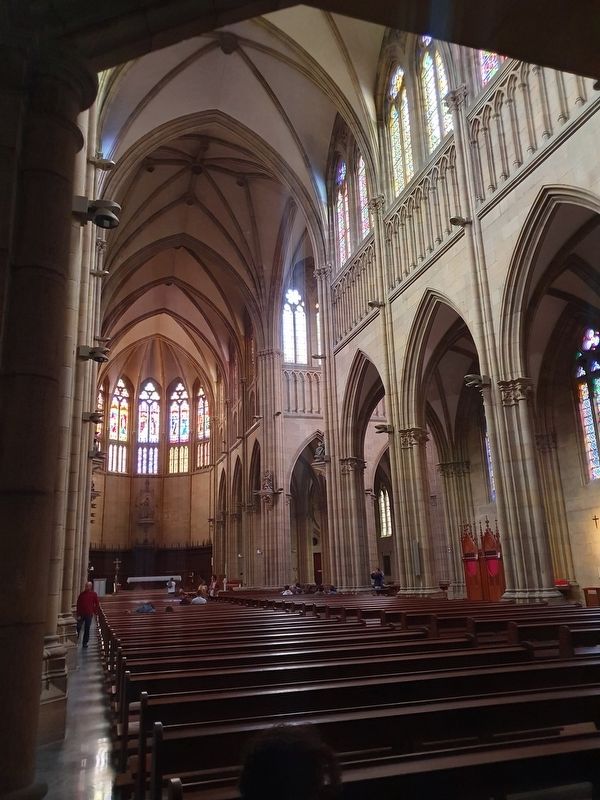
The Cathedral of Buen Pastor (Good Shepherd), was built in neo-Gothic style, classified as neo-Mediaeval rationalism, with reminiscent of the German cathedrals of Cologne, Ulm and Freiburg. The ground plan is rectangular with three naves of very austere design meeting at the transept, the main one 77.80 metres long.
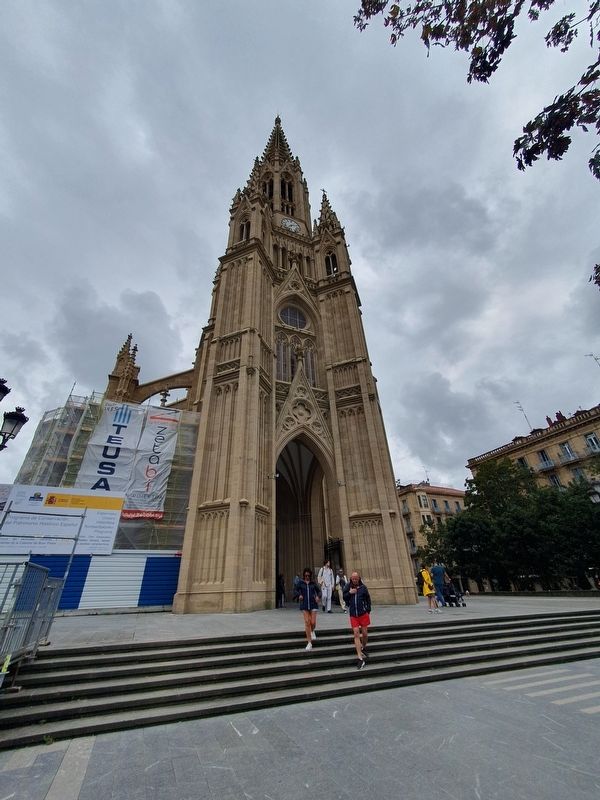
The building designed by San Sebastian architect Manuel Echave, was consecrated in 1897, and has a floor area of 1,915 square metres. On its main façade is a 75-metre belfry, visible from much of the city, which was designed by Ramón Cortazar and built in 1899.
Its building faces the Baroque Church of Santa Maria del Coro, situated in the Old Town, in a spot from which the old and new parts of the city look out at one another.
Local stonemason Julio Gargallo sculpted the stone for the capitals and decorative features, while the windows (plain and stained glass) are the work of Juan Bautista Lázaro, restorer of León Cathedral's famous stained glass windows.
The work on the cathedral lasted nine years, during two of which it was suspended pending receipt of further funding. The structural stone is ashlar from the Igeldo quarries, while for the vaults tuff stone from Ocio (Burgos) was used, and the slate was brought from Angers (France).
At the time of building, Gipuzkoa was within the bishopric of Vitoria, and this was a church. Then when the diocese of San Sebastian was formed in 1949, it became a cathedral and, for that reason, some alterations were made to it. Choir stalls were placed at the high altar the Image of the Good Shepherd in a vaulted niche in the back wall of the cathedral and the four evangelists on the columns of the transept.
Topics.
this page online
Location. 43° 19.025′ N, 1° 58.925′ W. Marker is in Donostia, Euskadi (Basque Country), in Gipuzkoa. It is in Centro. It is at the intersection of Plaza del Buen Pastor and Urbieta Kalea, on the right when traveling east on Plaza del Buen Pastor. Touch for map. Marker is at or near this postal address: Pl del Buen Pastor 6, Donostia, Euskadi 20005, Spain. Touch for directions.

Regionally, it is in the North Atlantic Region, on the Atlantic Arc, in Europe, in the European Union, in Atlantic Europe, on the Iberian Peninsula, in the Schengen Area, in a coastal Mediterranean country, and in the Western World. Historically, it finds itself in what was once the Byzantine Empire, a Spanish colony, and the Roman Empire.
Other nearby markers. At least 8 other markers are within walking distance of this marker: KMK and Post Office Buildings (about 120 meters away, measured in a direct line); Tamarix pentandra (approx. 0.4 kilometers away); Pierre Ducasse (approx. 0.4 kilometers away); Xavier María de Munibe e Idiaquez
Photographed by J. Makali Bruton, August 4, 2023
2. Cathedral of Buen Pastor and Marker
Photographed by J. Makali Bruton, August 4, 2023
3. Cathedral of Buen Pastor
Photographed by J. Makali Bruton, August 4, 2023
4. Cathedral of Buen Pastor Interior
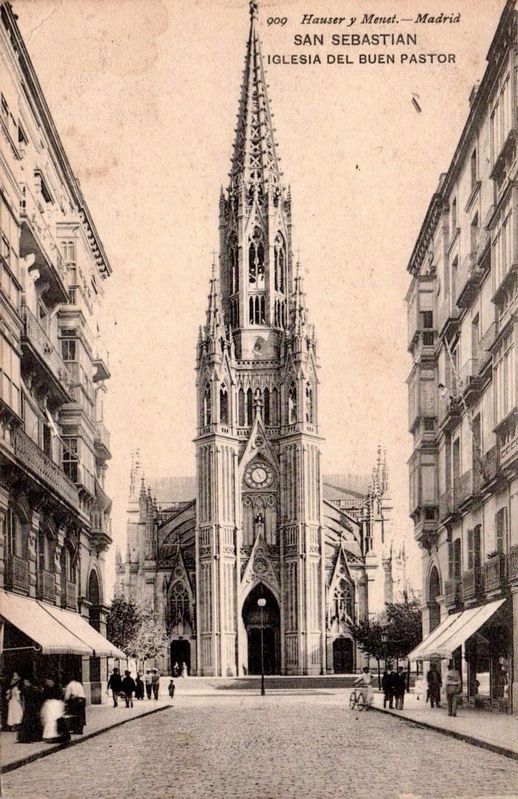
Photographed by Hauser y Menet, Madrid, circa 1905
5. Iglesia del Buen Pastor
Credits. This page was last revised on October 21, 2023. It was originally submitted on October 5, 2023, by J. Makali Bruton of Washington, District of Columbia. This page has been viewed 158 times since then and 9 times this year. Photos: 1, 2, 3, 4. submitted on October 5, 2023, by J. Makali Bruton of Washington, District of Columbia. 5. submitted on October 21, 2023.
