Casco Viejo in Donostia in Gipuzkoa, Basque Country, Spain — Southwestern Europe (Iberian Peninsula)
San Vicente Church
Photographed by J. Makali Bruton, August 4, 2023
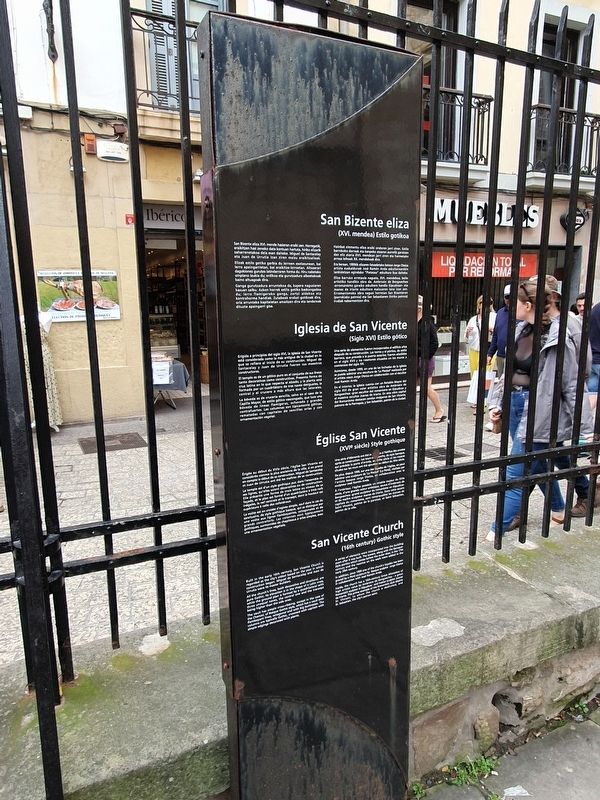
1. San Vicente Church Marker

(XVI. mendea) Estilo gotikoa
San Bizente eliza XVI. mende hasieran eraiki zen. Horregatik, eraikitzen hasi zeneko data kontuan hartuta, hiriko elizarik zaharrenetakoa dela esan daiteke. Miguel de Santacelay eta Juan de Urrutia izan ziren maisu eraikitzaileak.
Elizak estilo gotiko garbia du lerroen osotasunean, bai lerro apaingarrietan, bal eraikitze-lerroetan. Alterari dagokionez gurutze latindarraren forma du. Hiru nabetako oinplano laukia du, erdikoa eta gurutzadura alboetakoak baino altuagoak dira.
Ganga gurutzadura arruntekoa da, kapera nagusiaren kasuan salbu. Azken horrek estilo gotiko baskongadoa du; lerro flamigeroko ganga, zortzi aldekoa eta kontrahorma handiak. Zutabeak erabat gotikoak dira, orla arrunteko kapiteletan amaitzen dira eta landareak dituzte apaingarri gisa.
(XVI. mendea) Estilo gotikoa Hainbat elementu eliza eraiki ondoren jami ziren. Estile barrokoko dorreak eta kanpoko atearen aurretik geratzen den eliz ataria XVII. mendean jarri ziren eta hormetako arrosa leihoak XXX. mendekoak dira.
Era berean, 1999tik elizaren fatxadetako batean Jorge Oteiza artista
this page online
Eliza barruko erretaula nagusia, XVI. mendekoa, ballo artistiko handiko obra da. Ambrosio de Bengoechea -erromanismo garaiko eskultore handia Gipuzkoan-eta Joanes de Iriarte eskultore maisuaren lana izan zen. Erromanismoko obra nagusi horretan San Bizenteren (parrokiako patrola) eta San Sebastianen (hiriko patroia) irudiak nabarmentzen dira.
Iglesia de San Vicente
(Siglo XVI) Estilo gótico
Erigida a principios del siglo XVI, la iglesia de San Vicente está considerada como la más antigua de la ciudad en lo que se refiere al inicio de su construcción. Miguel de Santacelay y Juan de Urrutia fueron sus maestros constructores.
El templo es de un gótico puro en el conjunto de sus lineas tanto decorativas como constructivas. Presenta forma de cruz latina en lo que respecta al alzado, y la planta está formada por un cuadrilátero de tres naves desiguales, la central y el crucero a más altura que las laterales.
La bóveda es de crucería sencilla, salvo en el caso de la Capilla Mayor, de estilo gótico vascongado, que luce una

Photographed by J. Makali Bruton, August 4, 2023
2. San Vicente Church Marker
This view of the marker is from inside the church's patio looking outwards.
Una serie de elementos fueron incorporados al edificio años después de su construcción. Las torres y el pórtico, de estilo barroco, que precede a la puerta exterior, fueron añadidos en el siglo XVII y los rosetones situados en los muros a comienzos del siglo XX.
Asimismo, desde 1999, en una de las fachadas de la iglesia se puede admirar una escultura de La Piedad realizada por el artista vasco Jorge Oteiza en colaboración con el escultor Jost Ramón Anda.
En el interior, la iglesia cuenta con un Retablo Mayor del siglo XVI de gran valor artistíco obra de Ambrosio de Bengoechea - gran escultor del romanismo en Gipuzkoa - el maestro escultor Joanes de Iriarte. En esta obra capital del Romanismo destacan sendas imágenes de San Vicente, patrono de la Parroquia y San Sebastián, patrón de la cuidad.
Église San Vicente
(XVIe siècle) Style gothique
Erigée au début du XVIe siècle, l'église San Vicente est considérée comme la plus ancienne de la ville,
Photographed by J. Makali Bruton, August 4, 2023
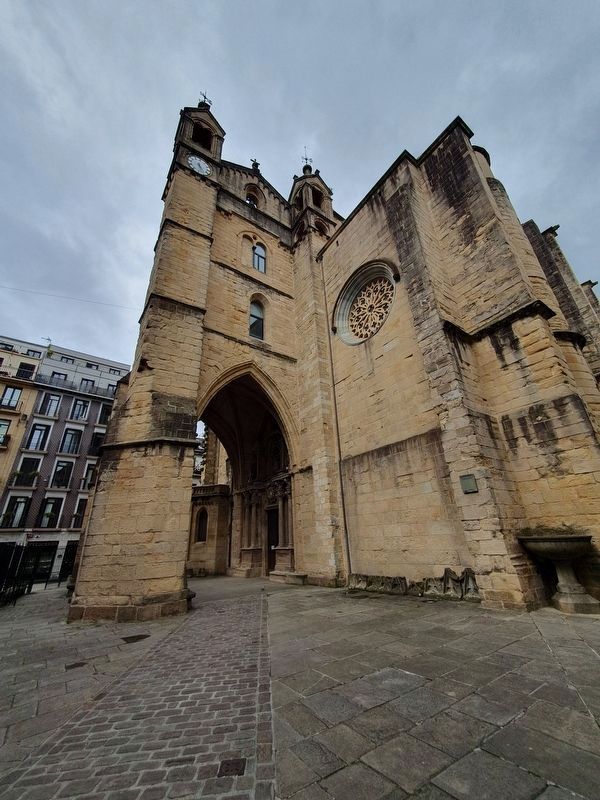
3. San Vicente Church from near the marker
Le temple est d'un style gothique pur, dans l'ensemble de ses lignes, qu'elles soient décoratives ou de construction. Elle présente une forme de croix latine au niveau de sa façade, et le plan est formé d'un quadrilatère à trois nefs inégales, la nef centrale et le transept, dont la hauteur est supérieure à celle des collatéraux.
La voûte est en croisée d'ogives simple, sauf dans le cas du sanctuaire, de style gothique basque, qui se distingue par une voûte aux lignes flamboyantes, octogonales et de grands contreforts. Les colonnes sont typiquement gothiques, surmontées de chapiteaux à orles simples, avec une ornementation végétale.
Une série d'éléments ont été incorporées a l’édifice des années après sa construction. Les tours et sa porche, de style baroque, qui précède la porte d'entrée, au XVIIe siècle et les resaces situées sur les murs ont été ajoutées au début du XXe siècle.
De plus, depuis 1999, sur une des façades de l'église, on peut admirer une sculpture de La Piedad (La Pitt),
Photographed by J. Makali Bruton, August 4, 2023
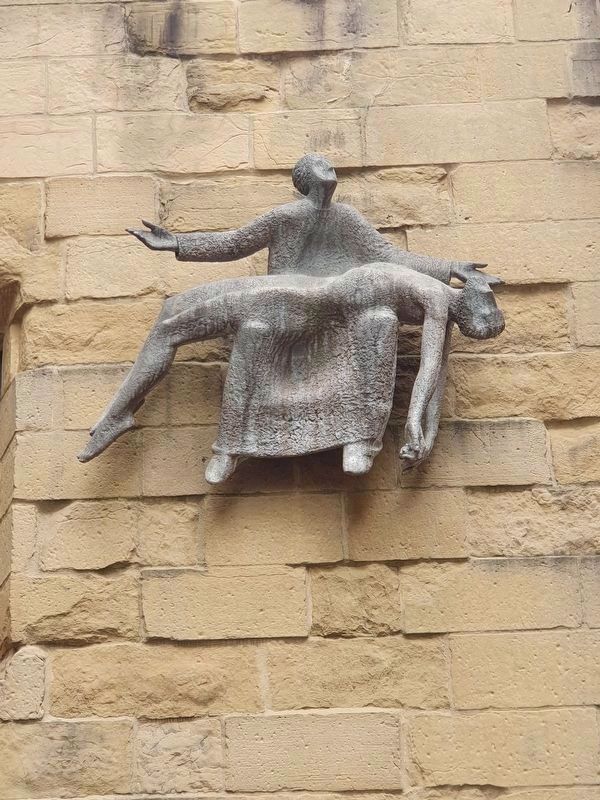
4. Pietá Sculpture near the San Vicente Church and mentioned in the text
The Pietá sculpture is by Basque sculptor Jorge Oteiza in collaboration with José Ramón Anda.
A l’intérieur, l’église possède un retable majeur du XVIe siècle, d'une grande valeur artistique, auvre d'Ambrosio de Bengoechea, grand sculpteur du romanisme en Gipuzkoa - et du maitre sculpteur Joanes de Iriarte. Dans cette oeuvre capitale du romanisme, sont remarquables les statues de Saint Vincent, patron de la paroisse, et Saint Sébastien, patron de la ville.
San Vicente Church
(16th century) Gothic style
Built in the early 16th century, San Vicente Church is regarded as the city's oldest based on the year in which construction began. Miguel de Santacelay and Juan de Urrutia were its master builders.
All the church's lines, both decorative and structural, are pure Gothic. Its elevation is in the shape of a Latin cross while the ground plan is formed by a quadrilateral with three unequal naves, the central one and the transept being higher than the side ones.
The vault has simple cross-ribbing, except in the case of the Chancel of Basque Gothic style, which has a vault with flamboyant lines, octagonal and with
circa 1905
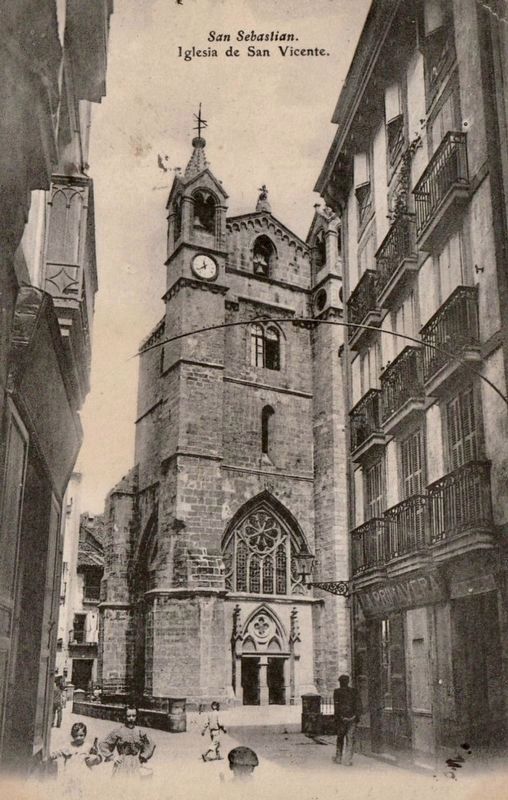
5. Iglesia de San Vicente
A series of elements were incorporated into the building years after it was built. The towers, along with the Baroque style portico which comes before the outer door in the 17th century and the rosettes on the walls were added in the early 20th century.
In addition, since 1999 one of the church's facades has been graced by a Pietá sculpture by Basque sculptor Jorge Oteiza in collaboration with José Ramón Anda.
Inside, the church has a 16th-century Great Altarpiece of high artistic value by Ambrosio de Bengoechea - a great Romanistic sculptor in Gipuzkoa - and master sculptor Joanes de Iriarte. This prime example of the Romanistic style depicts St. Vincent, to whom the church is dedicated, and St. Sebastian, the city's patron saint.
Topics. This historical marker is listed in these topic lists: Architecture • Religion & Religious Structures. A significant historical year for this entry is 1999.
Location. 43° 19.459′ N, 1° 59.064′ W. Marker is in Donostia, Euskadi (Basque Country), in Gipuzkoa. It is in Casco Viejo. It is at the intersection of Narrika Kalea and San Bizente Kalea on Narrika Kalea. Touch for map. Marker is in this post office area: Donostia, Euskadi 20003, Spain. Touch for directions.

Regionally, it is in the North Atlantic Region, on the Atlantic Arc, in Europe, in the European Union, in Atlantic Europe, on the Iberian Peninsula, in the Schengen Area, in a coastal Mediterranean country, and in the Western World. Historically, it finds itself in what was once the Roman Empire.
Other nearby markers. At least 8 other markers are within walking distance of this marker: Vicente Monterola (a few steps from this marker); The Fire of 1813 (within shouting distance of this marker); San Telmo (about 90 meters away, measured in a direct line); Basilica of Santa María del Coro (about 180 meters away); Indalezio Bizkarrondo (about 210 meters away); Town Hall (approx. 0.4 kilometers away); Xavier María de Munibe e Idiaquez (approx. 0.4 kilometers away); Victims of Terrorism and Violence (approx. 0.4 kilometers away). Touch for a list and map of all markers in Donostia.
Credits. This page was last revised on October 11, 2023. It was originally submitted on October 9, 2023, by J. Makali Bruton of Washington, District of Columbia. This page has been viewed 139 times since then and 13 times this year. Photos: 1, 2, 3, 4. submitted on October 9, 2023, by J. Makali Bruton of Washington, District of Columbia. 5. submitted on October 11, 2023.
