
Centro in Donostia in Gipuzkoa, Basque Country, Spain — Southwestern Europe (Iberian Peninsula)
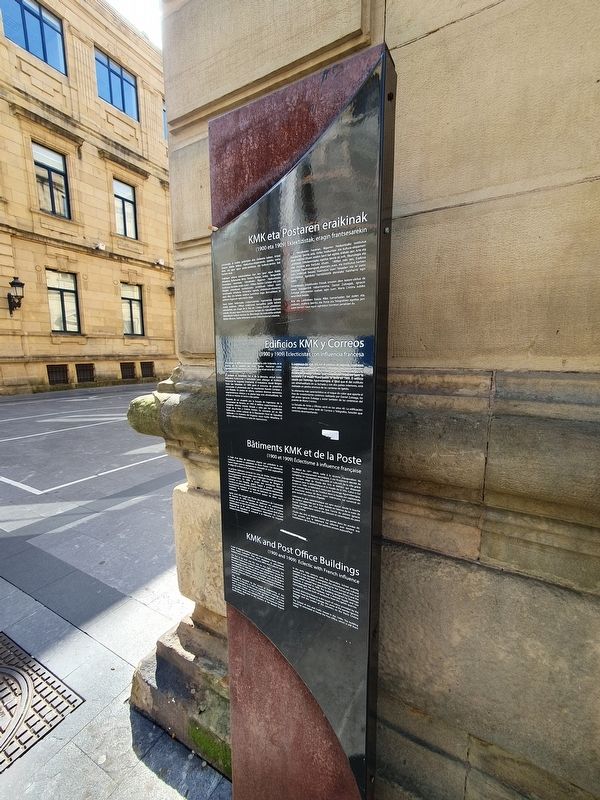
KMK and Post Office Buildings
Photographed by J. Makali Bruton, August 5, 2023
1. KMK and Post Office Buildings Marker

(1900 eta 1909) Eklektizistak, eragin frantsesarekin
Lerratutako bi eraikin gailentzen dira Urdaneta kalean, Artzai Onaren atzeko aldean. Hezkuntza-ekipamendu izateko sortu ziren, eta gaur egun posta-zerbitzua eta kultura-zentro bat hartzen dute.
Eraikitzen lehena eskuinaldekoa izan zen, gaur egun Koldo Mitxelena Kulturunea dena Hasiera batean, ordea, Bergaratik Donostiara ekarritako Gipuzkoako Bigarren Hezkuntzako Institutua hartzeko eraiki zuten. 1896an Ramón Cortázar eta Luis Elizalde arkitektoek aurkeztutako proiektuak irabazi zuen horretarako lehiaketa. Harlanduz eginda, arkitektura-elementu ugari ditu, eta beheko solairua kuxinduta dago. Barrualdean, bi patioren inguruan egituratuta dago.
Garal batez Nafarroako Unibertsitateko Ingeniaritza Eskolak erabill ondoren, 1993an eraikinaren barrualdea goitik behera zaharberritu zen Angel de la Hoz eta Cristina Fontán arkitektoen eskutik eta gaur egun KM Kulturunea hartzen du. Gipuzkoako Foru Aldundiaren kultura-zentroa da, liburutegia eta erakusketa-aretoak biltzen dituena, Koldo Mitxelena euskal hizkuntzalariari eskainia. X. mendearen hasieran, Bigarren Hezkuntzako Institutua Inauguratu berria zela, hiriko hezkuntza- eta kultura-ekipamen- duak osatuko zituen eraikin berri bat egitea erabaki zen: Arte eta Lanbideen Eskolarentzako egoitza berria ez ezik, liburutegia eta udal museoa ere hartuko zituen. 1909an ireki zen. Eraikina Domingo Aguirrebengoak diseinatu zuen, eta institutua hartzen zuen eraikinak bezala, kuxindura zuen fatxadan eta bi patio barrualdean, Igeldoko harrobietatik ateratako hareharriz egin zuten.
Zeramikazko estaldurako frisoak ematen dion kolore-ukitua da haren ezaugarririk nabarmenena. Daniel Zuloagak, Ignacio Zuloaga pintorearen osabak, egin zuen, María Cristina zubiko zeramikak bezala.
Arte eta Lanbideen Eskola 40ko hamarkadan itxi zuten eta, ondoren, eraikina berritu eta Posta eta Telegrafoen egoitza jarri zuten bertan. Gaur egun eginkizun horretan jarraitzen du.
Edificios KMK y Correos
(1900 y 1909) Eclecticistas con influencia francesa
Una pareja de edicios alineados presiden la calle Urdaneta, en la trasera de catedral del Buen Pastor. Nacieron como equipamientos educativos y hoy los ocupan el servicio de Correos yun centro cultural.
El primero en levantarse fue el de la derecha, actual Koldo Mitxelena Kulturunea y concebido para albergar el Instituto Provincial de Segunda Enseñanza, al trasladarse desde Bergara hasta San Sebastián. En 1896 ganó el concurso de proyectos convocado el presentado por los arquitectos Ramón Cortázar y Luis Elizalde. En piedra de silleria, contiene diversos elementos arquitectónicos clásicos y su planta baja está almohadillada. Se articula su Interior en torno a dos patios.
Después de ser ocupado por la Escuela de Ingenieros de la Universidad de Navarra, en 1993 el edificio experimentará una completa reforma interior levada a cabo por los arquitectos Angel de la Hoz y Cristina Fontán. Se convierte así en KM Kulturunea, centro cultural de la Diputación Foral de Gipuzkoa dedicado a la memoria del lingüista vasco Koldo Mitxelena. El centro alberga biblioteca y salas de exposiciones.
A comienzos del siglo XIX con el Instituto de Segunda Enseñanza recién inaugurado, se decidió completar los equipamientos educativos y culturales de la ciudad con una nueva sede para la Escuela de Artes y Oficios que contase con espacios para la biblioteca y el museo municipals. Se abrió en 1909. El edificio Ideadd por Domingo Aguirrebengoa, al igual que el del instituto con almohadillado en su fachada y con dos patios interiores, está realizado en piedra arenisca de las canteras de Igeldo.
Su elemento más característico es el toque de color que aporta el friso de revestimiento cerámico realizado por Daniel Zuloaga, tio del pintor Ignacio Zuloaga y autor también de las cerámicas del puente de María Cristina.
La Escuela de Artes y Oficios cerró en los años 40. La edificación sería reformada como sede de Correos y Telégrafos, función que continúa desempeñando.
Bâtiments KMK et de la Poste
(1900 et 1909) Eclectisme à influence française
Il s'agit d'un bloc de bâtiments alignés qui président la rue Urdaneta, derrière la cathédrale du Buen Pastor. Ces bâtiments furent érigés comme équipements éducatifs et sont aujourd'hui le siège de la Poste et d'un centre culturel.
Le prinier bâtiment construit fut celul de droite, l'actuel Koldo Mitxelina Kulturunea et conçu pour héberger Finstitut provincial denseignement secondaire, qui s'est déplacé de Bergara Saint-Sébastien. En 1896, le projet des architectes Ramón Cortázar et Luis Elizalde, gagna l'appel à projets convoqué. Construit en pierre de taille, renferme de nombreux éléments de Farchitecture classique et la base du bâtiment est capitonnée. Lintérieur du batiment est structuré autour de deux cours intérieures.
Après avoir été occupé par l'Ecole des ingénieurs de Funiversité de Navarre, en 1993 Fintérieur du bâtiment est entièrement réformé de la main des architectes Angel de la Hoz et Cristina Fontin, pour en faire le KM Kulturunea, centre culturel doté d'une bibliothèque et de salles d'expositions dépendant du Conseil Regional de Gipuzkoa et consacré à la mémoire du linguiste basque Koldo Mitxelena.
Au début du 19 siècle, suite à la récente Inauguration de Institut d'enseignement secondaire, il est finalement décidé de compléter les équipements éducatifs et culturels de la ville grâce au nouveau siège de l'Ecole des Arts et Métiers qui disposait d'espaces pour la bibliothèque et le musée de la ville. Celui-ci fut Ouvert en 1909. Le bâtiment conçu par Domingo Aguirrebengoa, tout comme dans le cas de l'institut dont la façade est capitonnée et structurée autour de deux cours intérieures, est construit en grès extrait des carrières d'Igeldo.
L'élément le plus caractéristique est sans aucun doute la touche de couleur apportée par la frise réalisée en faïence de la main de Daniel Zuloaga, qui n'est autre que l'oncle du peintre Ignacio Zuloaga et également auteur des faïences et céramiques du pont Maria Cristina.
L'Ecole des Arts et Métiers ferma ses portes dans les années 40. Cest ensuite que le bâtiment fut réformé puis destiné aux Installations de la Postes et qui perdure encore aujourd'hui.
KMK and Post Office Buildings
(1900 and 1909) Eclectic with French influence
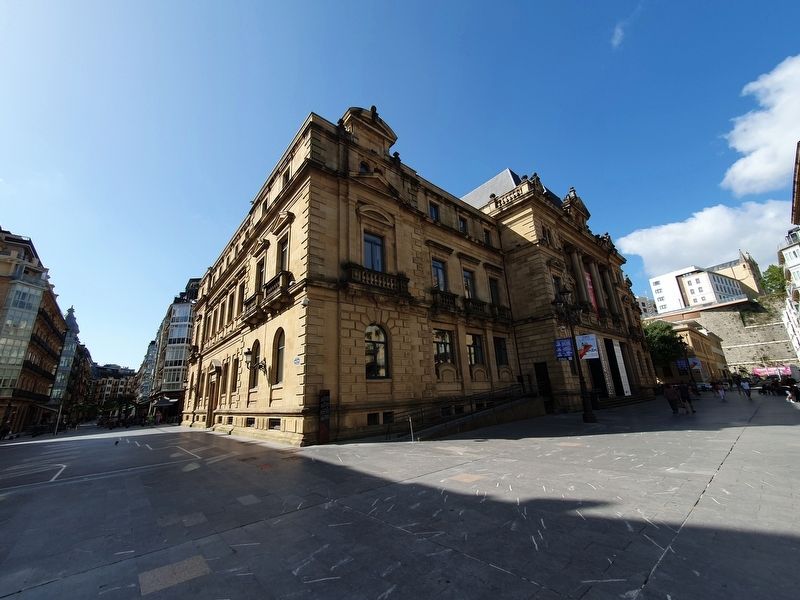
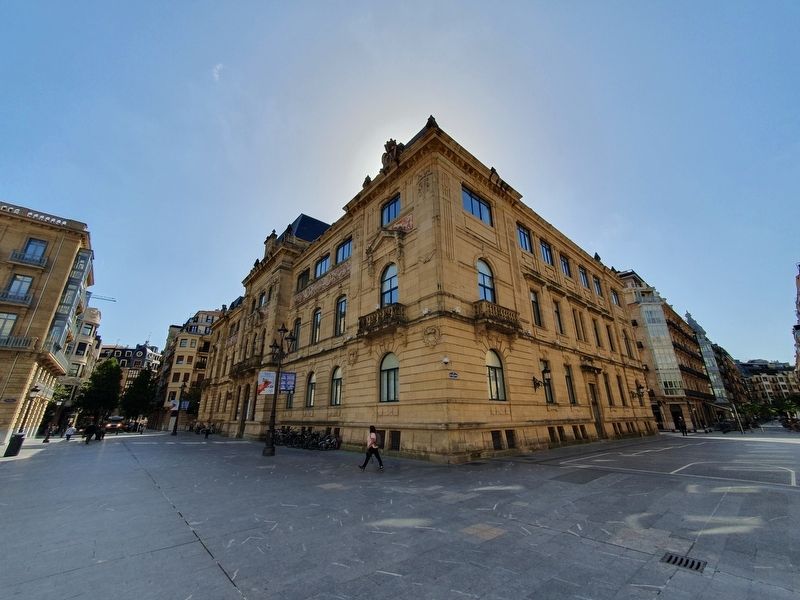
A pair of aligned buildings presides over Urdaneta Street, behind Buen Pastor Cathedral. They were designed as educational facilities and are today used as the post office and a cultural centre.
The first to be built was the one on the right, currently the Mitxelena Kulturunea (Cultural centre) and designed to house the Provincial Secondary School, which was moved from Bergara to San Sebastian. In 1856 the call for projects was won by the project submitted by the architects Ramón Cortázar and Luis Elizalde. In masonry stone, it displays various classical architectural elements and has a dressed stone ground floor. Inside it is built around two courtyards.
After being occupied by the School of Engineering of the University of Navara, in 1993 the building would undergo a full Interior renovation, by the hand of the architects Angel de la Hoz and Cristina Fortan, to turn it into KM Kulturunea, a cultural centre with a library and exhibition halls of the Provincial Council of Gipation, dedicated to the memory of the Basque linguist Valdo Mitxelena.
In the early 19th century, with the Secondary School recently opened, it was decided to complete the educational and cultural facilities in the city with a new building for the School of Arts and Crafts, which would have spaces for the municipal library and the museum. It opened in 1909. The building designed by Domingo Aguirrebengoa, like the institute, had a dressed façade and two courtyards, and was built of sandstone from the Igeldo quarries.
Its most distinctive feature is the touch of colour provided by the ceramic frieze by Daniel Zuloaga, the uncle of the painter Ignacio Zuloaga and the creator of the ceramics on the Maria Cristina Bridge.
The School of Arts and Crafts closed in the 1940s. The building would be renovated to house the Post Office, which is still there today.
Topics.
this page online
Location. 43° 18.97′ N, 1° 58.878′ W. Marker is in Donostia, Euskadi (Basque Country), in Gipuzkoa. It is in Centro. It is on Reyes Catolicos Kalea north of Sánchez Toca Kalea, on the left when traveling north. Touch for map. Marker is in this post office area: Donostia, Euskadi 20006, Spain. Touch for directions.

Regionally, it is in the North Atlantic Region, on the Atlantic Arc, in Europe, in the European Union, in Atlantic Europe, on the Iberian Peninsula, in the Schengen Area, in a coastal Mediterranean country, and in the Western World. Historically, it finds itself in what was once the Byzantine Empire, a Spanish colony, and the Roman Empire.
Other nearby markers. At least 8 other markers are within walking distance of this marker: Cathedral of Buen Pastor (about 120 meters away, measured in a direct line); Tamarix pentandra (approx. 0.6 kilometers away); Pierre Ducasse (approx. 0.6 kilometers away); Xavier María de Munibe e Idiaquez (approx. 0.6 kilometers away); Victims of Terrorism and Violence
Photographed by J. Makali Bruton, August 5, 2023
2. KMK and Post Office Buildings and Marker
Photographed by J. Makali Bruton, August 5, 2023
3. KMK and Post Office Buildings
Credits. This page was last revised on October 9, 2023. It was originally submitted on October 9, 2023, by J. Makali Bruton of Washington, District of Columbia. This page has been viewed 97 times since then and 11 times this year. Photos: 1, 2, 3. submitted on October 9, 2023, by J. Makali Bruton of Washington, District of Columbia.
