Moncks Corner in Berkeley County, South Carolina — The American South (South Atlantic)
Biggin Church
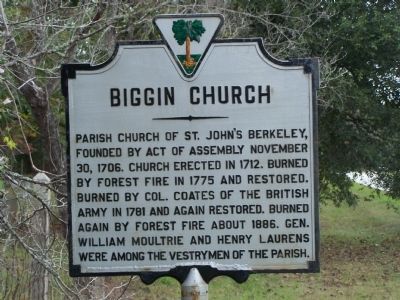
Photographed by Mike Stroud, 2009
1. Biggin Church Marker
Topics. This historical marker is listed in these topic lists: Colonial Era • Religion & Religious Structures. A significant historical date for this entry is November 30, 1917.
Location. 33° 12.779′ N, 79° 57.981′ W. Marker is in Moncks Corner, South Carolina, in Berkeley County. It is on State Highway 402, on the right when traveling south. Located between Carswell Lane and Biggins Road. Touch for map. Marker is in this post office area: Moncks Corner SC 29461, United States of America. Touch for directions.

Regionally, this marker is in the Lowcountry and in Santee Cooper Country. It is also in the American South, specifically in the Deep South, and on the Eastern Seaboard. Globally, it is in the North Atlantic Region, North America, the Western Hemisphere, the
this page online
Other nearby markers. At least 8 other markers are within 2 miles of this marker, measured as the crow flies: Santee Canal (approx. 0.8 miles away); Old Santee Canal Park (approx. 1.4 miles away); Berkeley County Confederate Monument (approx. 1.4 miles away); a different marker also named Santee Canal (approx. 1.4 miles away); Colleton House: “Unmanly Practices” or Legitimate Target? (approx. 1.4 miles away); Fort Fair Lawn: An Archeaological Treasure (approx. 1.4 miles away); Berkeley County Museum and Heritage Center: A County's Story (approx. 1.4 miles away); Too Formidable to Take (approx. 1.4 miles away). Touch for a list and map of all markers in Moncks Corner.
Regarding Biggin Church. Biggin Church Ruins are the remains of the parish church of St. John’s Parish. The church was established by an act of the South Carolina Commons House of Assembly in 1706, which divided the colony into
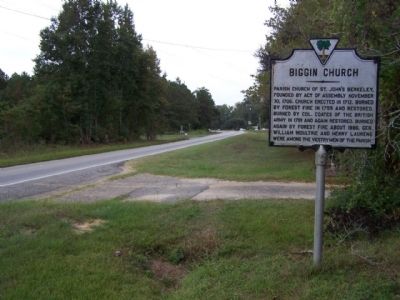
Photographed by Mike Stroud, September 20, 2009
2. Biggin Church Marker, as seen looking south along State Road 402
(South Carolina Department of Archives and History )
Related marker. Click here for another marker that is related to this marker. see Strawberry Chapel
Also see . . . Touring South Carolina's Revolutionary War Sites By Daniel W. Barefoot, page 44-45.
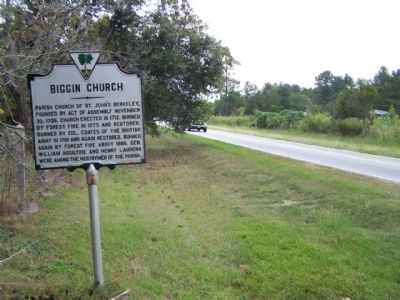
Photographed by Mike Stroud, September 20, 2009
3. Biggin Church Marker as seen looking north
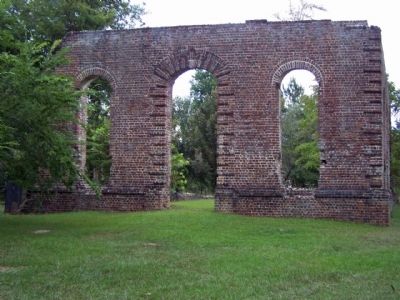
Photographed by Mike Stroud, September 20, 2009
4. Biggin Church ruins
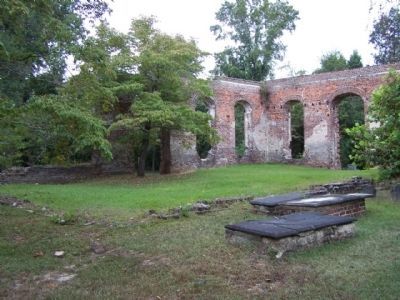
Photographed by Mike Stroud, September 20, 2009
5. Biggin Church and cemetery
National Register of Historic Places:
Biggin Church Ruins ** (added 1977 - Site - #77001215) • 2 mi. NE of Moncks Corner on SC 402, Moncks Corner • Historic Significance: Event • Area of Significance: Social History, Religion, Military • Period of Significance: 1700-1749, 1750-1799, 1800-1824, 1825-1849, 1850-1874, 1875-1899 • Owner: Private • Historic Function: Funerary, Religion • Historic Sub-function: Cemetery, Religious Structure • Current Function: Funerary • Current Sub-function: Cemetery •
Biggin Church Ruins ** (added 1977 - Site - #77001215) • 2 mi. NE of Moncks Corner on SC 402, Moncks Corner • Historic Significance: Event • Area of Significance: Social History, Religion, Military • Period of Significance: 1700-1749, 1750-1799, 1800-1824, 1825-1849, 1850-1874, 1875-1899 • Owner: Private • Historic Function: Funerary, Religion • Historic Sub-function: Cemetery, Religious Structure • Current Function: Funerary • Current Sub-function: Cemetery •
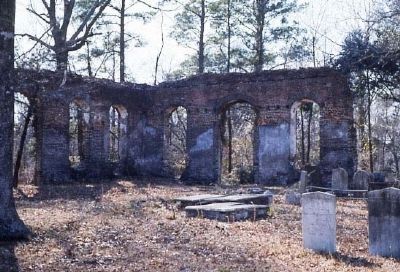
South Carolina Department of Archives and History, circa 1977
6. Biggin Church and cemetery ruins
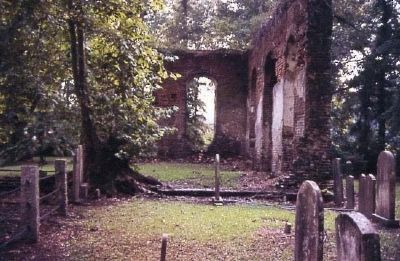
South Carolina Department of Archives and History, circa 1977
7. Biggin Church and cemetery ruons
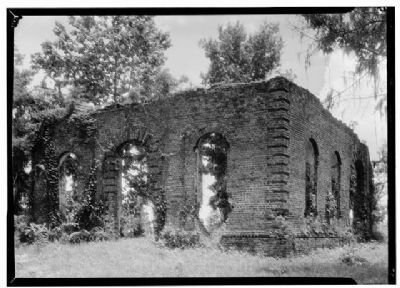
Thomas T. Waterman, Historic American Buildings Survey, circa 1939
8. Biggin Church
Historic American Engineering Record, HABS SC,8-MONCO.V,2-2
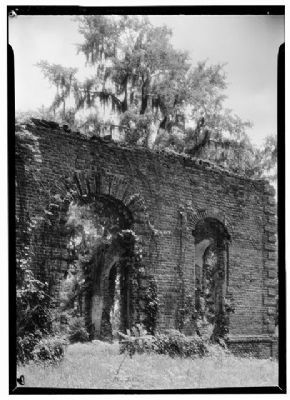
Thomas T. Waterman, Historic American Buildings Survey, circa 1939
9. Biggin Church, west front detail
Historic American Engineering Record, HABS SC,8-MONCO.V,2-3
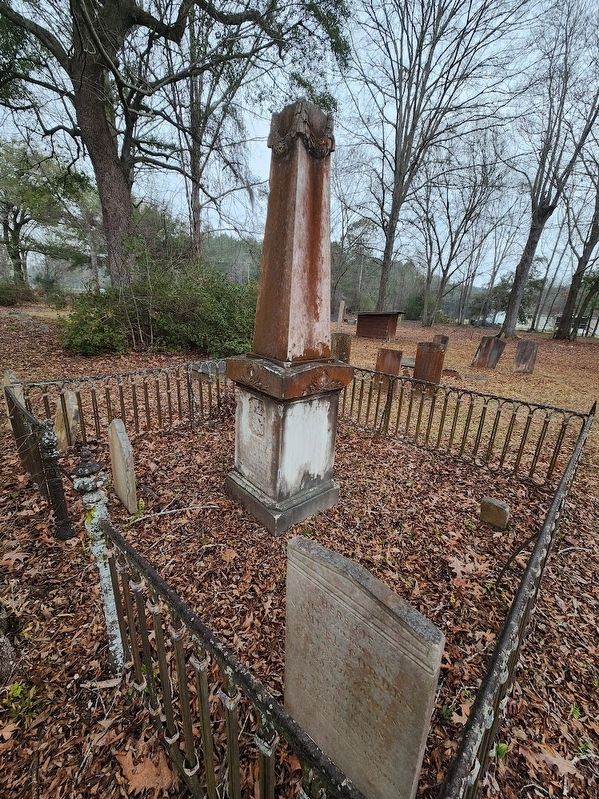
Photographed by Lea Bishop, February 20, 2025
10. Biggin Church Marker
Credits. This page was last revised on April 8, 2025. It was originally submitted on October 19, 2009, by Mike Stroud of Bluffton, South Carolina. This page has been viewed 4,219 times since then and 121 times this year. Photos: 1, 2, 3, 4, 5, 6, 7. submitted on October 19, 2009, by Mike Stroud of Bluffton, South Carolina. 8, 9. submitted on April 30, 2010, by Mike Stroud of Bluffton, South Carolina. 10. submitted on March 25, 2025, by Lea Bishop of Hopewell Junction, New York. • Craig Swain was the editor who published this page.
