Geuzenveld-Slotermeer in Amsterdam, North Holland, Netherlands — Northwestern Europe
Confucius

Photographed by Andrew Ruppenstein, October 31, 2023
1. Confucius Marker

Hij werd in 551 voor Christus geboren in de buurt van Qufu, een stad in de Chinese provincie Shandong. Hij stamde uit een oude, maar verarmde adellijke familie. Zijn vader stierf al toen hij twee jaar was waarna hij onder bescherming kwam te staan van een patroon (leermeester). Hierdoor was hij in staat zich te bekwamen in onder meer boogschieten, wagenmennen, schrijven, ceremoniën, geschiedenis en muziek. Deze onderdelen werden later bekend als 'de zes kunsten'. Hij bepaalde later dat deze kunsten onmisbaar waren voor zijn volgelingen. De leer van Confucius was er voor een groot deel op gericht de bindende kracht tussen mensen te versterken. Zijn filosofie legde verder de nadruk op de persoonlijke en bestuurlijke moraal, orde en respect voor de meerdere. In China wordt zijn verjaardag ieder jaar gevierd op de 27e dag van de 8ste maand van de Chinese kalender. Taiwan-Chinezen vieren zijn verjaardag een dag later.
(English translation:)
He was born in 551 BC near Qufu, a city in the Chinese province of Shandong. He came from an old but impoverished noble family.
this page online
Erected 2023 by Geef Straten Een Gezicht.
Topics and series. This historical marker is listed in this topic list: Arts, Letters, Music. In addition, it is included in the Give Streets a Face / Geef Straten Een Gezicht series list.
Location. 52° 22.484′ N, 4° 48.758′ E. Marker is in Amsterdam, Noord-Holland (North Holland). It is in Geuzenveld-Slotermeer. It is at the intersection of Socratesstraat and
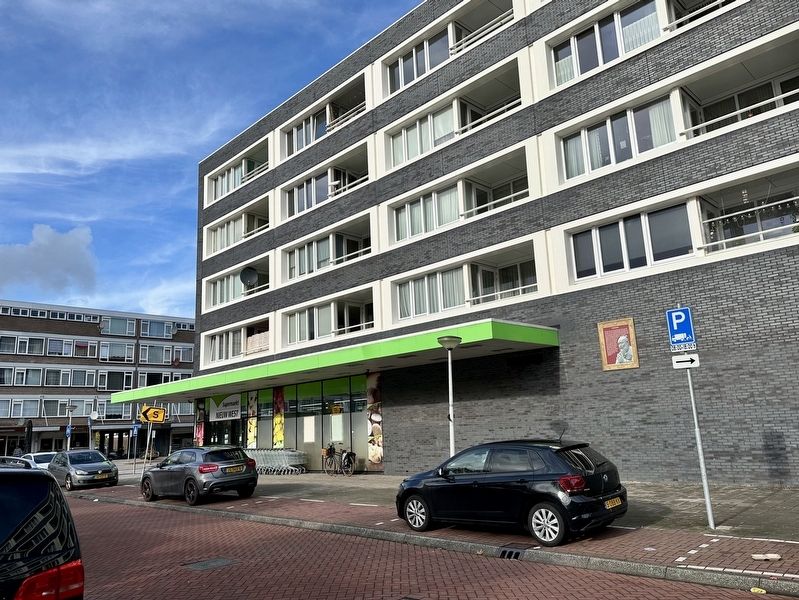
Photographed by Andrew Ruppenstein, October 31, 2023
2. Confucius Marker - wide view

Regionally, it is in Europe, the European Union, Atlantic Europe, the Benelux Low Countries, the Schengen Area, Western Europe, and the Western World. Historically, it finds itself in what was once the Holy Roman Empire.
Other nearby markers. At least 8 other markers are within walking distance of this marker: Socrates (about 120 meters away, measured in a direct line); Epicurus (about 180 meters away); Plato (about 210 meters away); Parmenides (approx. 0.3 kilometers away); Van Moerkerken (approx. half a kilometer away); Nijhoff (approx. half a kilometer away); Du Perron (approx. half a kilometer away); Alexander de Savornin Lohman (approx. half a kilometer away). Touch for a list and map of all markers in Amsterdam.
Also see . . . Confucius (Wikipedia).
Overview: Kong Fuzi (Chinese: 孔夫子), more usually Kongzi (孔子; lit. 'Master Kǒng', c. 551 – c. 479 BCE), commonly Latinized as Confucius, was a Chinese philosopher of the Spring and Autumn period who is traditionally considered the paragon of Chinese sages. Confucius's teachings and philosophy underpin East Asian culture and society, and remain influential across China and East Asia to this day. His philosophical teachings, called Confucianism, emphasized personal and governmental morality, correctness of social relationships, justice, kindness, and sincerity, as well as an emphasis on a ruler's duty to their subjects.(Submitted on October 31, 2023.)
Additional keywords. 孔子
Credits. This page was last revised on December 31, 2023. It was originally submitted on October 31, 2023, by Andrew Ruppenstein of Lamorinda, California. This page has been viewed 108 times since then and 12 times this year. Photos: 1, 2. submitted on October 31, 2023, by Andrew Ruppenstein of Lamorinda, California.
