Near Warsaw in Richmond County, Virginia — The American South (Mid-Atlantic)
Rappahannock Indians
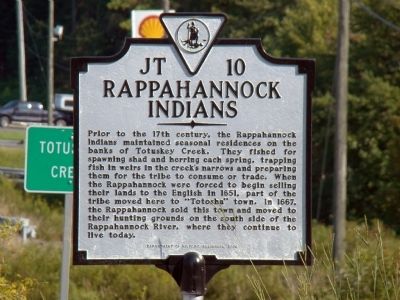
Photographed by J. J. Prats, September 5, 2009
1. Rappahannock Indians Marker
Erected 2006 by Department of Historic Resources. (Marker Number JT-10.)
Topics and series. This historical marker is listed in this topic list: Indigenous Peoples and Communities. In addition, it is included in the Virginia Department of Historic Resources (DHR) series list. A significant historical year for this entry is 1651.
Location. 37° 55.441′ N, 76° 43.283′ W. Marker is near Warsaw, Virginia, in Richmond County. It is on History Land Highway (Virginia Route 3) just east of Richmond Hill Road ( Route 620), on the right when traveling east. It is at Ruritan
this page online

Regionally, this marker is on Virginia’s Northern Neck. It is also in the American South, specifically in the Upper South, in the Tidewater, in the Chesapeake Bay Region, and on the Eastern Seaboard. Globally, it is in the North Atlantic Region, North America, the Western Hemisphere, the Western World, and the Anglosphere. Historically, it finds itself in what was once the territory of the Mississippian Culture, one of the original Thirteen Colonies, one of the Confederate States of America, and the Antebellum South.
Other nearby markers. At least 8 other markers are within 4 miles of this marker, measured as the crow flies: Saint John’s Church (approx. 2.9 miles away); Hon. William Atkinson Jones (approx. 3 miles away); Black Revolutionary War Patriots Memorial (approx. 3 miles away); Veterans Memorial (approx. 3.1 miles away); Richmond County Courthouse (approx. 3.1 miles away); Warsaw (approx. 3.1 miles away); The Saddlery Foundation Community and Veterans' Memorial Terrace
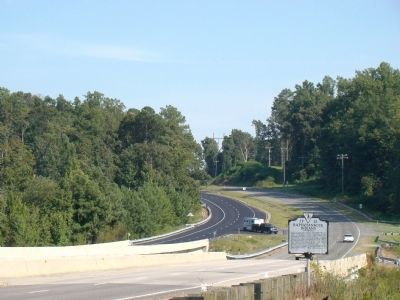
Photographed by J. J. Prats, September 5, 2009
2. Rappahannock Indians Marker
Also see . . . A Brief History of the Rappahannocks. “The Rappahannocks first met Captain John Smith in December 1607 at their capital town ‘Topahanocke’ on the banks of the river bearing their name. At the time, Smith was a prisoner of Powhatan’s brother, Opechancanough. He took Smith to the Rappahannocks for the people to determine if Smith was the Englishman who, three years earlier, had murdered their chief and kidnapped some of their people. Smith was found innocent, at least of these crimes. The perpetrator was a tall man. Smith was too short and too fat. Smith returned to the Rappahannock’s homeland in the summer of 1608. He mapped 14 fourteen Rappahannock villages on the north side of the river. The Rappahannock’s territory on the south side of the Rappahannock River was their primary hunting grounds.” (Submitted on October 23, 2009.)
Credits. This page was last revised on July 5, 2021. It was originally submitted on October 23, 2009, by J. J. Prats of Powell, Ohio. This page has been viewed 2,290 times since then and 91 times this year. Photos: 1, 2. submitted on October 23, 2009, by J. J. Prats of Powell, Ohio.
