Bentonville in Benton County, Arkansas — The American South (West South Central)
Peoples Bank
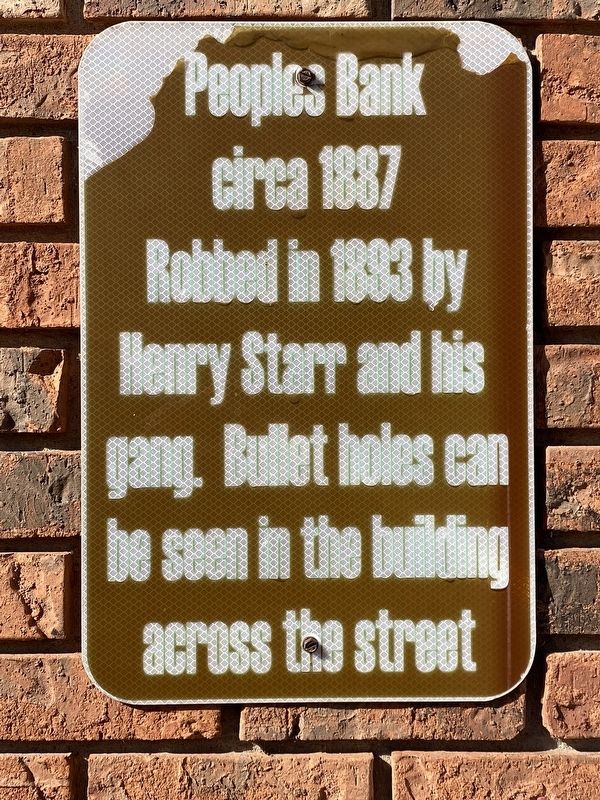
Photographed by Darren Jefferson Clay, November 10, 2023
1. Peoples Bank Marker
Topics. This historical marker is listed in these topic lists: Industry & Commerce • Notable Events.
Location. 36° 22.334′ N, 94° 12.538′ W. Marker is in Bentonville, Arkansas, in Benton County. It is on West Central Avenue, on the left when traveling north. Touch for map. Marker is at or near this postal address: 101 W Central Avenue, Bentonville AR 72712, United States of America. Touch for directions.

Regionally, this marker is in Northwest Arkansas, on the Ozark Plateau, in the Cherokee Heritage Region, and in Osage Territory. It is also in the American South, specifically in the Upper South, and in the Ozarks. Globally, it is in North America, the Western Hemisphere, the Western World, and the Anglosphere. Historically, it finds itself in what was once the territory of the Mississippian Culture, the Louisiana Purchase, one of the Confederate States of America, and the Antebellum South.
Other nearby markers. At least
this page online
Another marker is no longer nearby. Walton's 5 & 10 (was within shouting distance of this marker but has been confirmed missing).
Also see . . . Starr, Henry (Encyclopedia of Oklahoma History and Culture).
Excerpt: An outlaw who claimed to have robbed more banks "than any man in America," Henry Starr was born on December 2, 1873, near Fort Gibson in the Cherokee Nation, Indian Territory (present Muskogee County, Oklahoma). A mixed-blood Cherokee, he was a son of George "Hop"(Submitted on December 14, 2023.)and Mary Scott Starr and was a nephew of Myra Maybelle Shirley Starr, better known as "the Bandit Queen," Belle Starr. After receiving the equivalent of a sixth-grade education, Starr moved with his family to the vicinity of Nowata and worked as a cowboy. (Despite his limited schooling, Starr was an intellectual. While incarcerated, he read classical literature, studied law, wrote his autobiography, contributed newspaper articles, and tutored inmates.)Photographed by Darren Jefferson Clay, November 10, 20232. Peoples Bank Marker
After being falsely accused of stealing a horse, Starr robbed Nowata's railroad depot in summer 1892. Jailed at Fort Smith, Arkansas, he was released on bail but failed to appear in court. In December 1892 he killed a deputy U.S. marshal who attempted to detain him. After robbing a Bentonville, Arkansas, bank in June 1893, Starr was arrested in Colorado Springs, Colorado, extradited to Fort Smith, tried, and sentenced to fifteen years in prison. A model inmate, he was pardoned in 1903.
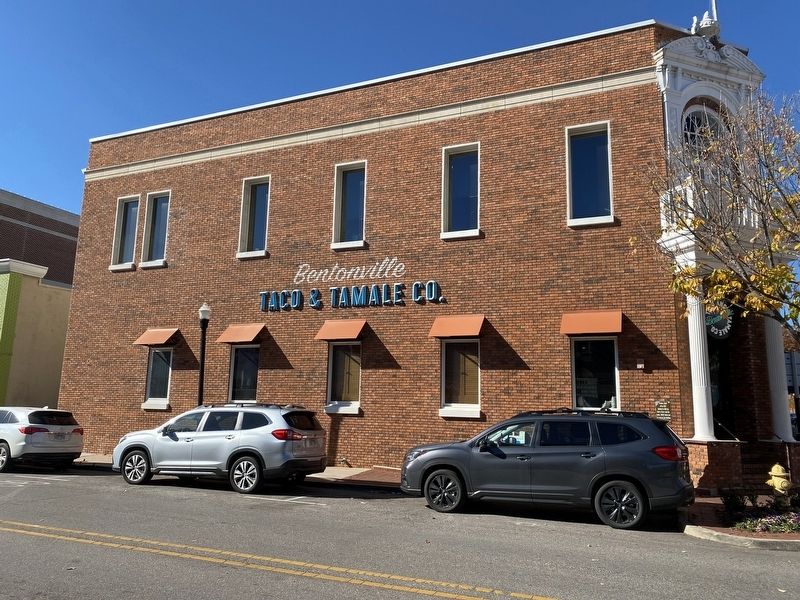
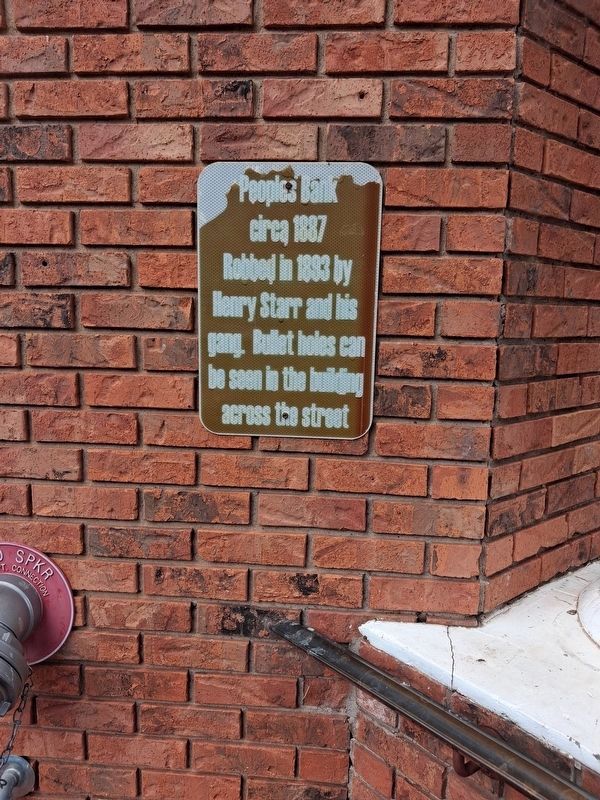
Photographed by Marc Hayot, May 29, 2026
3. Peoples Bank Marker
The color of the marker has changed from the original photo and this marker seems to be in better shape.
Credits. This page was last revised on May 30, 2026. It was originally submitted on November 27, 2023, by Darren Jefferson Clay of Duluth, Georgia. This page has been viewed 438 times since then and 72 times this year. Photos: 1, 2. submitted on December 5, 2023, by Darren Jefferson Clay of Duluth, Georgia. 3. submitted on May 29, 2026, by Marc Hayot of Siloam Springs, Arkansas. • Andrew Ruppenstein was the editor who published this page.
