Aachen, North Rhine-Westphalia, Germany — Central Europe
Alemannia Aachen Football - Main Station
⎯⎯⎯
Hauptbahnhof
| — | German Football Route NRW / Deutsche Fußball Route NRW | — |
Photographed by Andrew Ruppenstein, October 22, 2023
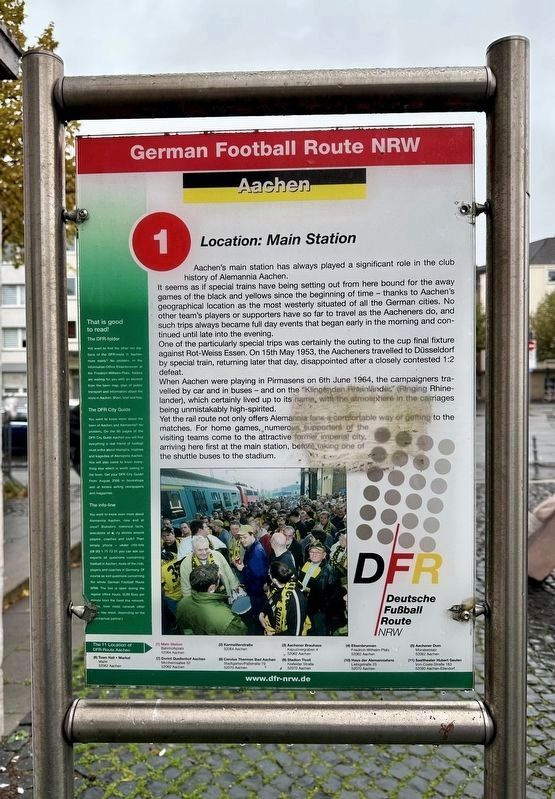
1. Alemannia Aachen Football - Main Station / Hauptbahnhof Marker - English side

Aachen's main station has always played a significant role in the club history of Alemannia Aachen.
It seems as if special trains have being setting out from here bound for the away games of the black and yellows since the beginning of time thanks to Aachen's geographical location as the most westerly situated of all the German cities. No other team's players or supporters have so far to travel as the Aacheners do, and such trips always became full day events that began early in the morning and continued until late into the evening.
One of the particularly special trips was certainly the outing to the cup final fixture against Rot-Weiss Essen. On 15th May 1953, the Aacheners travelled to Düsseldorf by special train, returning later that day, disappointed after a closely contested 1:2 defeat.
When Aachen were playing in Pirmasens on 6th June 1964, the campaigners travelled by car and in buses - and on the "Klingenden Rheinländer" (Ringing Rhinelander), which certainly lived up to its name, with the atmosphere in the carriages being unmistakably high-spirited.
Yet the rail route
this page online
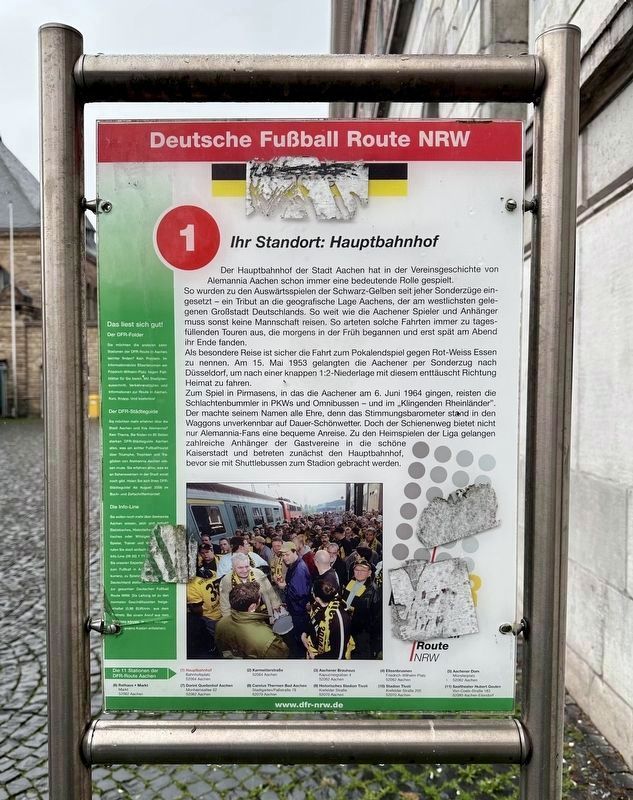
Der Hauptbahnhof der Stadt Aachen hat in der Vereinsgeschichte von Alemannia Aachen schon immer eine bedeutende Rolle gespielt.
So wurden zu den Auswärtsspielen der Schwarz-Gelben seit jeher Sonderzüge eingesetzt ein Tribut an die geografische Lage Aachens, der am westlichsten gelegenen Großstadt Deutschlands. So weit wie die Aachener Spieler und Anhänger muss sonst keine Mannschaft reisen. So arteten solche Fahrten immer zu tagesfüllenden Touren aus, die morgens in der Früh begannen und erst spät am Abend ihr Ende fanden.
Als besondere Reise ist sicher die Fahrt zum Pokalendspiel gegen Rot-Weiss Essen zu nennen. Am 15. Mai 1953 gelangten die Aachener per Sonderzug nach Düsseldorf, um nach einer knappen 1:2-Niederlage mit diesem enttäuscht Richtung Heimat zu fahren.
Zum Spiel in Pirmasens, in das die Aachener am 6. Juni 1964
Photographed by Andrew Ruppenstein, October 22, 2023
2. Alemannia Aachen Football - Main Station / Hauptbahnhof Marker - German side
(Marker Number 1.)
Topics. This historical marker is listed in these topic lists: Railroads & Streetcars • Sports. A significant historical date for this entry is May 15, 1953.
Location. 50° 46.105′ N, 6° 5.414′ E. Marker is in Aachen, Nordrhein-Westfalen (North Rhine-Westphalia). It is on Bahnhofplatz, on the left when traveling north. Touch for map. Marker is in this post office area: Aachen HE 52064, Germany. Touch for directions.

Regionally, this marker is in the German Rhineland. Globally, it is in Europe, the European Union, Atlantic Europe, Central Europe, the Schengen Area, Western Europe, and the Western World. Historically, it finds itself
Photographed by Andrew Ruppenstein, October 22, 2023
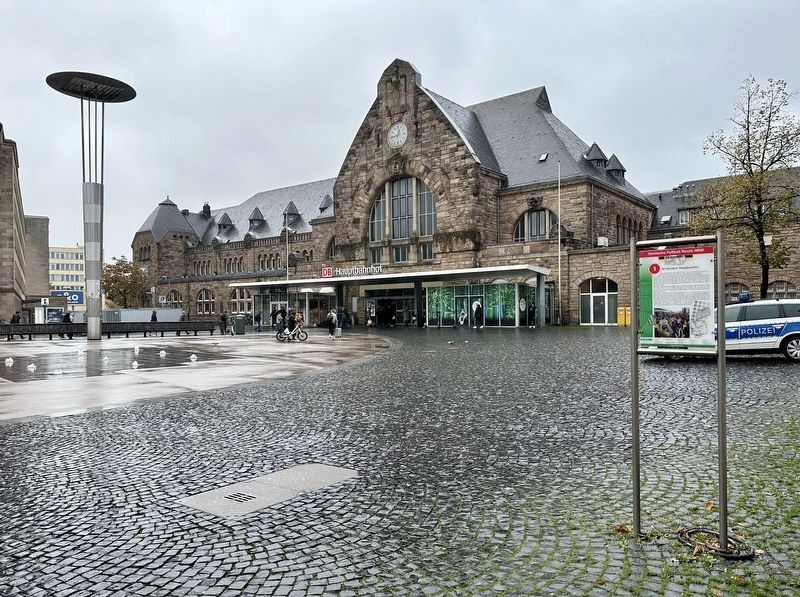
3. Alemannia Aachen Football - Main Station / Hauptbahnhof and Marker
The marker is located in the northwest section of the plaza in front of the railway station.
Other nearby markers. At least 8 other markers are within walking distance of this marker: Aachen Hauptbahnhof / Aachen Main Railway Station (within shouting distance of this marker); Mord an Behinderten / The Murder of the Disabled (within shouting distance of this marker); Der schnitzende Pennsoldat / The Whittling Soldier (about 240 meters away, measured in a direct line); GESTAPO (approx. half a kilometer away); Kreuzigungsgruppe Henger Herrjotts Fott / Crucifixion Tableau “Behind the Lord’s Buttocks” (approx. half a kilometer away); Franziska Schervier (approx. 0.6 kilometers away); Joseph Buchkremer (approx. 0.8 kilometers away); Homosexuelle / Homosexuals (approx. 0.8 kilometers away). Touch for a list and map of all markers in Aachen.
Also see . . . Alemannia Aachen (Wikipedia).
Overview: Alemannia Aachen or ATSV Alemannia 1900 is a German football club from the western city of Aachen, North Rhine-Westphalia. A long term fixture of the country's second division, Alemannia enjoyed a three-year turn in the Bundesliga in the late 1960s and, after a successful 2005–06 campaign, returned to the first division for a single season. The club has since slipped to third division play and in late 2012 entered into bankruptcy. They finished their 2012–13 3. Liga schedule before resuming play in the tier IV Regionalliga West in 2013–14.(Submitted on December 3, 2023.)
Alemannia carries the nickname "the potato beetles" (Kartoffelkäfer) because of their striped yellow-black jerseys, which make them look like the particular insects.
Credits. This page was last revised on December 3, 2023. It was originally submitted on December 3, 2023, by Andrew Ruppenstein of Lamorinda, California. This page has been viewed 166 times since then and 13 times this year. Photos: 1, 2, 3. submitted on December 3, 2023, by Andrew Ruppenstein of Lamorinda, California.
