Near Seale in Russell County, Alabama — The American South (East South Central)
The Old Federal Road
Russell County
Photographed by Butch Anthony
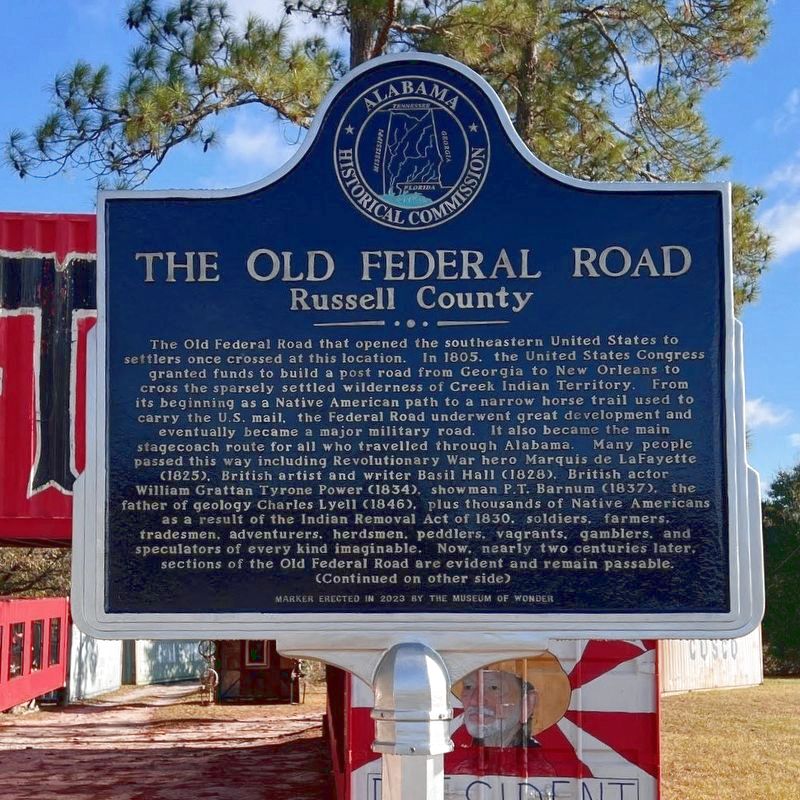
1. The Old Federal Road Marker
Inscription.
The Old Federal Road that opened the southeastern United States to
settlers once crossed at this location. In 1805, the United States Congress
granted funds to build a post road from Georgia to New Orleans to
cross the sparsely settled wilderness of Creek Indian Territory.
From its beginning as a Native American path to a narrow horse trail used to
carry the U.S. mail, the Federal Road underwent great development and
eventually became a major military road. It also became the main
stagecoach route for all who travelled through Alabama. Many people
passed this way including Revolutionary War hero Marquis de La Fayette
(1825), British artist and writer Basil Hall (1828). British actor
William Grattan Tyrone Power (1834). showman P.T. Barnum (1837), the
father of geology Charles Lyell (1846), plus thousands of Native Americans
as a result of the Indian Removal Act of 1830, soldiers. farmers,
tradesmen, adventurers, herdsmen, peddlers, vagrants, gamblers, and
speculators of every kind imaginable. Now. nearly two centuries later,
sections of the Old Federal Road are evident and remain passable.
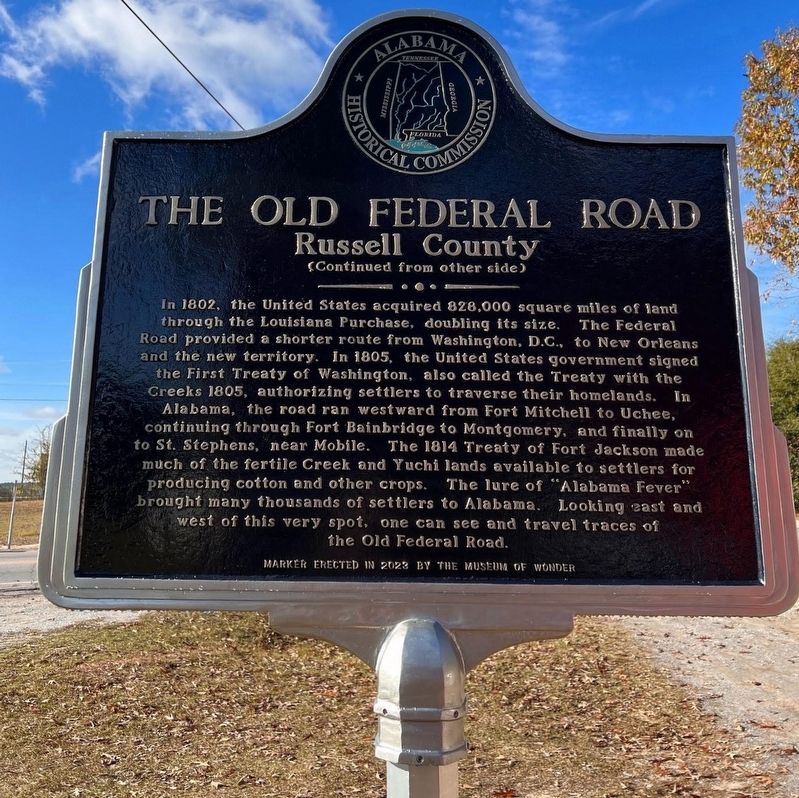
In 1802, the
Click or scan to see this page online
United States acquired 828,000 square miles of land
through the Louisiana Purchase, doubling its size. The Federal
Road provided a shorter route from Washington, D.C., to New Orleans
and the new territory. In 1805, the United States government signed
the First Treaty of Washington, also called the Treaty with the
Creeks 1805, authorizing settlers to traverse their homelands. In
Alabama, the road ran westward from Fort Mitchell to Uchee,
continuing through Fort Bainbridge to Montgomery, and finally on
to St. Stephens, near Mobile. The 1814 Treaty of Fort Jackson made
much of the fertile Creek and Yuchi lands available to settlers for
producing cotton and other crops. The lure of “Alabama Fever”
brought many thousands of settlers to Alabama. Looking east and
west of this very spot. one can see and travel traces of
the Old Federal Road.
Erected 2023 by The Museum of Wonder, and the Alabama Historical Commission.
85° 10.117′ W. Marker is near Seale, Alabama, in Russell County. It is on Alabama Route 169 just west of U.S. 431, on the right when traveling west. Touch for map. Marker is at or near this postal address: 970 Alabama 169, Seale AL 36875, United States of America. Touch for directions.
Regionally, this marker is in Greater Columbus. It is also in the American South, specifically in the Deep South, and in the Black Belt. Globally, it is in North America, a Gulf of Mexico state, the Western Hemisphere, the Western World, and the Anglosphere. Historically, it finds itself in what was once the territory of the Mississippian Culture, one of the Confederate States of America, and the Antebellum South.
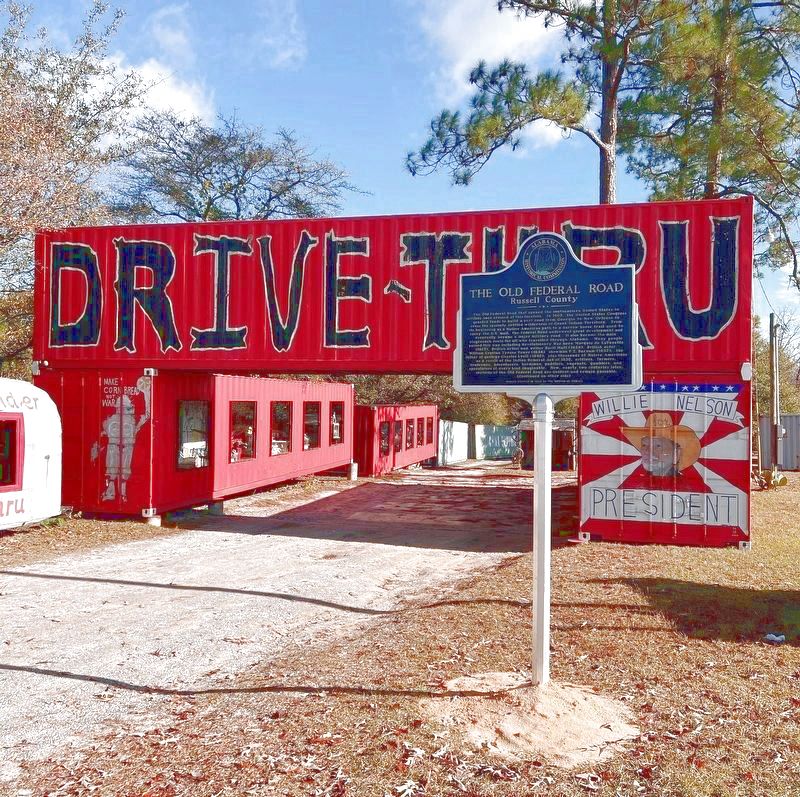
More about this marker. It is at the entrance to the Museum of Wonder.
Also see . . . Museum of Wonder. (Submitted on December 3, 2023.)
Credits. This page was last revised on December 21, 2023. It was originally submitted on December 3, 2023, by J. J. Prats of Powell, Ohio. This page has been viewed 1,443 times since then and 137 times this year. Photos:1, 2, 3. submitted on December 3, 2023, by J. J. Prats of Powell, Ohio.