Redondela in Pontevedra, Galicia, Spain — Southwestern Europe (Iberian Peninsula)
Viaduto de Pontevedra
⎯⎯⎯
Pontevedra Viaduct
Photographed by Andrew Ruppenstein, September 8, 2023
1. Viaduto de Pontevedra / Pontevedra Viaduct Marker

Viaduto de Pontevedra
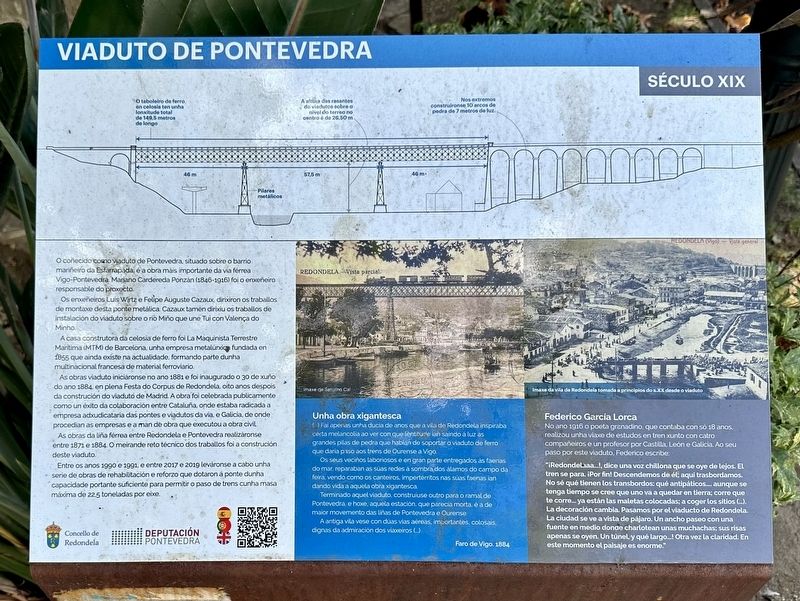
O coñecido como Viaduto de Pontevedra, situado sobre o barrio mariñeiro da Esfarrapada, é a obra máis importante da via férrea Vigo-Pontevedra Mariano Cardereda Ponzán (1846-1916) foi o enxeñeiro responsable do proxecto.
Os enxeñeiros Luís Wirtz e Felipe Auguste Cazaux, dirixiron os traballos de montaxe desta ponte metálica. Cazaux tamén dirixiu os traballos de instalación do viaduto sobre o río Miño que une Tui con Valença do Minho.
A casa construtora da celosia de ferro foi La Maquinista Terrestre Maritima (MTM) de Barcelona, unha empresa metalúrxiga fundada en 1855 que ainda exíste na actualidade, formando parte dunha multinacional francesa de material ferroviario.
As obras viaduto iniciáronse no ano 1881 e foi inaugurado o 30 de xuño do ano 1884, en plena Festa do Corpus de Redondela, oito anos despois da construción do viadutó de Madrid. A obra foi celebrada publicamente como un éxito da colaboración entre Cataluña, onde estaba radicada a empresa adxudicataria das pontes e viadutos da vía, e Galicia, de onde procedían as empresas e a man de obra que executou
this page online
As obras da liña férrea entre Redondela e Pontevedra realizáronse entre 1871 e 1884. O meirande reto técnico dos traballos foi a construción deste viaduto.
Entre os anos 1990 e 1991, e entre 2017 e 2019 leváronse a cabo unha serie de obras de rehabilitación e reforzo que dotaron á ponte dunha capacidade portante suficiente para permitir o paso de trens cunha masa máxima de 22,5 toneladas por eixe.
Unha obra xigantesca
(…) Fai apenas unha ducia de anos que a vila de Redondela inspiraba certa melancolia ao ver con que lentituce ian saindo a luz as grandes pilas de pedra que habian de soportar o viaduto de ferro que daria paso aos trens de Ourense a Vigo.
Os seus veciños laboriosos e en gran parte entregados ás faenas do mar, reparaban as súas redes à sombra dos álamos do campo da feira, vendo como os canteiros, imperterritos nas súas faenas ian dando vida a aquela obra xigantesca.
Terminado aquel viaduto, construiuse outro para o ramal de Pontevedra, e hoxe, aquela estación, que parecia morta, é a de maior movemento das liñas de Pontevedra e Ourense.
A antiga vila vese con dúas vias aéreas,
Photographed by Andrew Ruppenstein, September 8, 2023
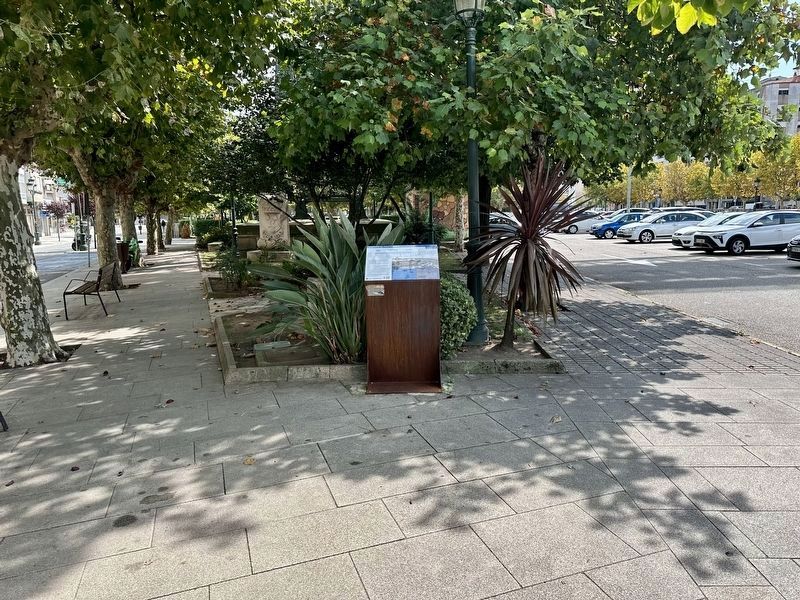
2. Viaduto de Pontevedra / Pontevedra Viaduct Marker - wide view
Faro de Vigo. 1884
Federico García Lorca
No ano 1916 o poeta granadino, que contaba con só 18 anos. realizou unha viaxe de estudos en tren xunto con catro compañeiros e un profesor por Castilla. León e Galicia. Ao seu paso por este viaduto, Federico escribe:
"¡Redondelaaa...!, dice una voz chillona que se oye de lejos. El tren se para. ¡Por fin! Descendemos de él; aqui trasbordamos. No sé qué tienen los transbordos: qué antipáticos.... aunque se tenga tiempo se cree que uno va a quedar en tierra; corre que te corre... ya están las maletas colocadas; a coger los sitios (...). La decoración cambia. Pasamos por el viaducto de Redondela. La ciudad se ve a vista de pájaro. Un ancho paseo con una fuente en medio donde charlotean unas muchachas; sus risas apenas se oyen. Un túnel, y qué largo...! Otra vez la claridad. En este momento el paisaje es enorme."
Pontrevedra Viaduct
The viaduct known as the Pontevedra viaduct, located over the seaside neighbourhood
Photographed by Andrew Ruppenstein, September 8, 2023
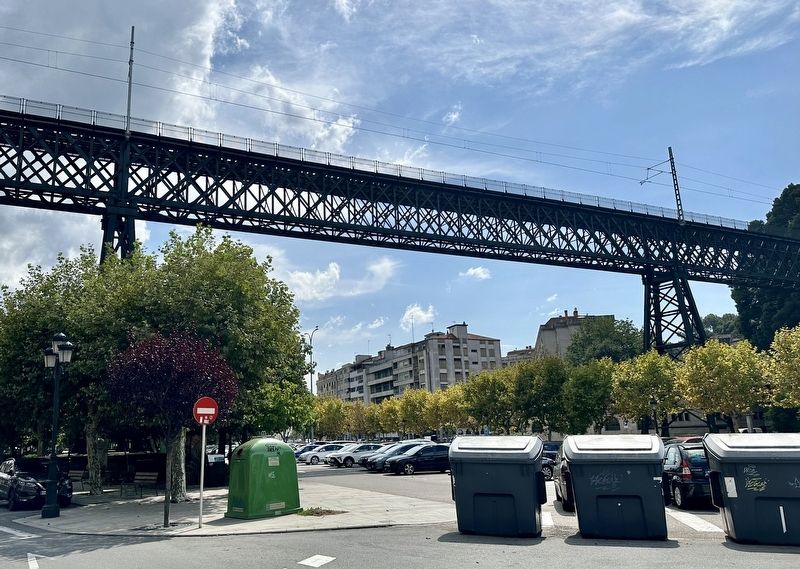
3. Viaduto de Pontevedra / Pontevedra Viaduct Marker - wider view
The marker is just visible here, a bit behind the red do not enter sign, and the viaduct is visible above.
The engineers Luis Wirtz and Felipe Auguste Cazaux directed the assembly work on this metal bridge. Cazaux also directed the installation works of the viaduct over the Miño river linking Tui with Valença do Minho.
The builder of the iron truss was Lana Maquinista Terrestre Marítima (MTM) of Barcelona, a metallurgical company founded in 1855 that still exists today, forming part of a French multinational railway material company.
Work on the viaduct began in 1881 and was inaugurated on 30 June 1884, during the Corpus Christi Festival in Redondela, eight years after the construction of the Madrid viaduct. The work was publicly celebrated as a success of the collaboration between Catalonia, where the company awarded the bridges and viaducts of the track was based, and Galicia, where the companies and the labourers who carried out the civil works came from.
The works on the railway line between Redondela and Pontevedra were carried out between 1871 and
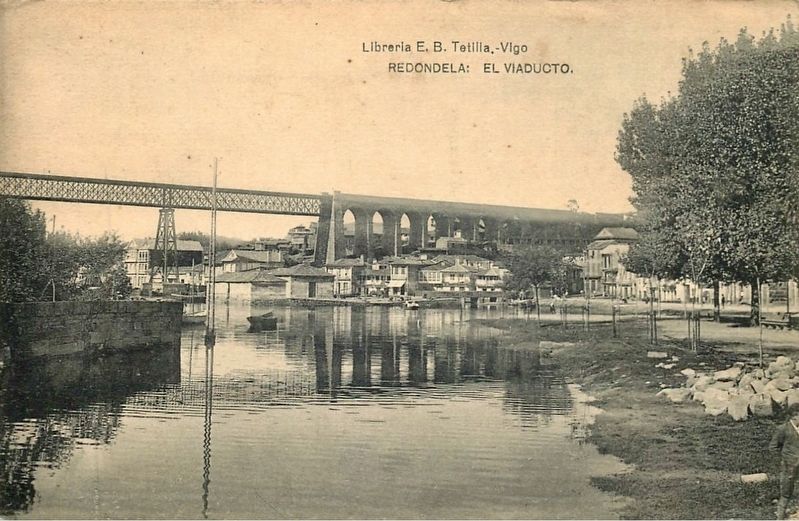
Photographed by Hauser y Menet, Madrid, circa 1905
4. Viaduto de Pontevedra / Pontevedra Viaduct postcard
Between 1990 and 1991, and between 2017 and 2019, a series of rehabilitation and reinforcement works were carried out to provide the bridge with sufficient bearing capacity to allow trains with a maximum mass of 22.5 tonnes per axle to pass over.
A gigantic work
Barely a dozen years ago, the town of Redondela inspired a certain melancholy when it saw how slowly the great stone piles that were to support the iron viaduct that would give passage to the trains from Orense to Vigo were coming into being.
Its industrious neighbours, largely devoted to the work of the sea, repaired their nets in the shade of the poplars of the fairground, watching how the stonemasons, undaunted in their work, were giving life to that gigantic work. Once that viaduct was finished, another one was built for the Pontevedra branch, and today, that station, which seemed dead, is the busiest on the Pontevedra and Orense lines.
The old town is seen with two important, colossal overhead tracks, worthy of the admiration of travellers, all the more surprising because to reach the station, both when going up from Vigo and when coming from Ourense, one passes through the Valos or Portela tunnels.
Federico García Lorca
In 1916, the poet from Granada, who was only 18 years old, made a study trip by train with four companions and a teacher through Castile, León and Galicia. On passing over this viaduct, Federico wrote: “Redondelaaa...," says a shrill voice heard from far away, "The train stops. The train stops. Finally stopped! We get off the train; here we change trains. I don't know what it is about transfers:
How unpleasant.... even if you have time, you think you're going to stay on the suitcases are already placed; let's take our places (...).
The decoration changes. We pass the Redondela viaduct. The city is seen from a bird's eye view of the city. A wide promenade with a fountain in the middle where some girls chatter; their laughter is barely audible. A tunnel, and how long...! Again, the again. At this moment the landscape is enormous.
Erected by Concello de Redondela, Deputacion Pontevedra.
Topics. This historical marker is listed in these topic lists: Bridges & Viaducts • Railroads & Streetcars. A significant historical year for this entry is 1855.
Location. 42° 17.161′ N, 8° 36.574′ W. Marker is in Redondela, Galicia, in Pontevedra. It is on Rúa Xeneral Rubín, on the left when traveling north. Touch for map. Marker is in this post office area: Redondela, Galicia 36800, Spain. Touch for directions.

Regionally, it is in the North Atlantic Region, on the Atlantic Arc, in Europe, in the European Union, in Atlantic Europe, on the Iberian Peninsula, in the Schengen Area, in a coastal Mediterranean country, and in the Western World. Historically, it finds itself in what was once the Roman Empire.
Other nearby markers. At least 8 other markers are within walking distance of this marker: Xosé L. Franco Grande (approx. 0.3 kilometers away); Igrexa de Santiago (Século XV) / Church of Santiago (15th Century) (approx. 0.3 kilometers away); Diego San José de la Torre (approx. 0.4 kilometers away); Casa da Alfóndega (approx. 0.4 kilometers away); Reveriano Soutullo (approx. 0.4 kilometers away); A Casa Da Torre / The Tower House (approx. 0.4 kilometers away); Dona Rita Otero Fernández (approx. 0.6 kilometers away); Don Jose Regojo (approx. 0.6 kilometers away). Touch for a list and map of all markers in Redondela.
Credits. This page was last revised on May 24, 2024. It was originally submitted on December 5, 2023, by Andrew Ruppenstein of Lamorinda, California. This page has been viewed 172 times since then and 43 times this year. Photos: 1, 2, 3, 4. submitted on December 5, 2023, by Andrew Ruppenstein of Lamorinda, California.
