Santiago de Compostela in A Coruña, Galicia, Spain — Southwestern Europe (Iberian Peninsula)
Colexio de San Patricio dos Irlandeses
⎯⎯⎯
Saint Patrick’s College of the Irish
| — | Itinerario Historico | — |
Photographed by Andrew Ruppenstein, September 12, 2023
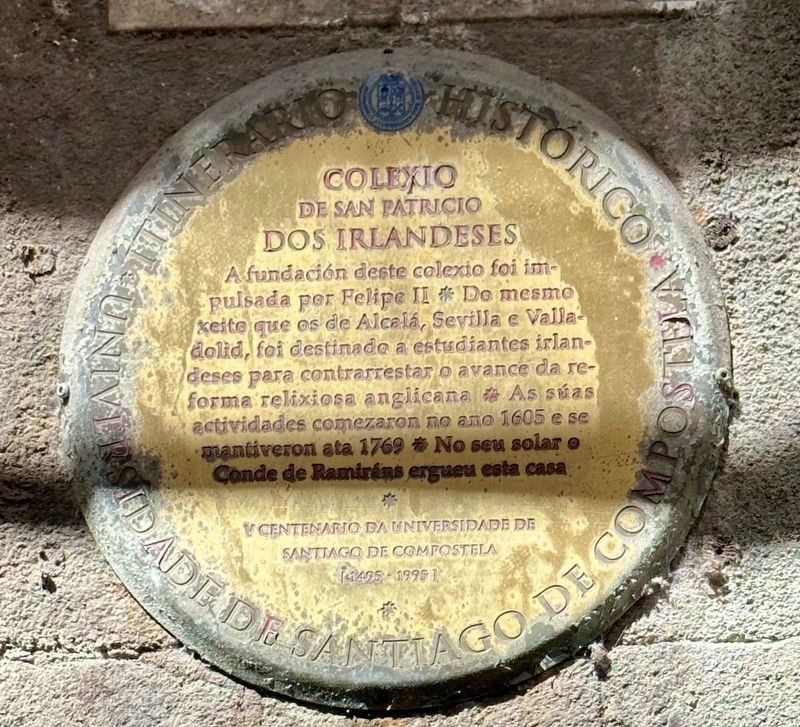
1. Colexio de San Patricio dos Irlandeses / Saint Patrick’s College of the Irish Marker

V Centenario da Universidade de Santiago de Compostela
1495-1995
The foundation of this school was promoted by Philip II * Similar to those in Alcalá, Seville and Valladolid, it was intended for Irish students to counter the advance of the Anglican religious reform * Its activities began in the year 1605 and continued until 1769 * On his lot the Conde de Ramiráns built this house *
Fifth Centenary of the University of Santiago de Compostela, 1495-1995
Erected 1995 by Universidad de Santiago de Compostela.
Topics. This historical marker is listed in these topic lists: Education • Religion & Religious Structures. A significant historical year for this entry is 1605.
Location. 42° 52.68′ N, 8° 32.644′ W. Marker is in Santiago de Compostela,
this page online

Regionally, it is in the North Atlantic Region, on the Atlantic Arc, in Europe, in the European Union, in Atlantic Europe, on the Iberian Peninsula, in the Schengen Area, in a coastal Mediterranean country, and in the Western World. Historically, it finds itself in what was once the Roman Empire.
Other nearby markers. At least 8 other markers are within walking distance of this marker: Victoriano García Martí (within shouting distance of this marker); Jose Maria Fenollera e Ibáñez (within shouting distance of this marker); Fundación e Museo Eugenio Granell / Eugenio Granell Foundation and Museum (within shouting distance of this marker); Diego Bernal López (1940-2001) (about 90 meters away, measured in a direct line); Don Antonio Lopez e Ferreiro (about 120 meters away); Anxel Casal (about 120 meters away); Rosalía de Castro and Manuel Murguia (about 150 meters away); Valle-Inclán (about 150 meters away). Touch for a list and map
Photographed by Andrew Ruppenstein, September 12, 2023
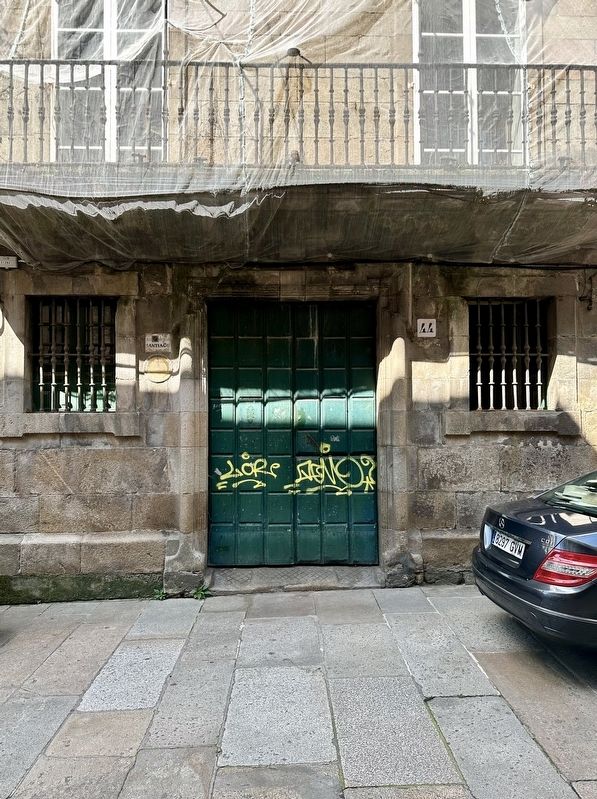
2. Saint Patrick’s College of the Irish Marker - wide view
The marker is visible here to the left of the door. The building was undergoing renovation at the time this picture was taken.
Also see . . . Colegio de San Patricio de los Irlandeses de Santiago de Compostela (Yo y mi Maleta, in Spanish). Short history of the college, plus a 3 minute video (in Spanish).
Excerpt (in translation): In this video we bring you a curiosity related to religious teaching, for this we are at number 44 Rúa Nova in Santiago de Compostela. In order to know this history, we must go back to the 16th century, when Elizabeth I of England reigned at the height of Protestantism and the persecution of Catholic communities, which led to the exile of many Irish in various European countries, including Spain.(Submitted on December 11, 2023.)
Philip II authorized the opening of several institutions, in Alcalá, Seville, Valladolid and this one in Santiago de Compostela, to house Irish students and give them a Catholic education as opposed to the Anglican education of their country of origin.
In 1605, activities began at this school, called St. Patrick of the Irish. Initially the rector was an Irish clergyman and it housed mainly the children of Irish Catholic gentlemen. This school would become dependent on the Jesuits, something that was not well received by the Irish, since they argued that the Jesuits of that country were descendants of English, whom they described as low people and accused of waging war against Ireland, so for this reason they asked Philip III that this college be reserved for laymen and jurists and not theological priests.
Among the students who trained at this school was Guillén de Lampart, also known as William Lamport, Guillén Lombardo or Lombardo de Guzmán, a poet and soldier who posed as the son of Philip III to govern the Spanish territories in North America. His lie was discovered and the Inquisition sentenced him to die at the stake.
The College of the Irish of Santiago de Compostela continued its activity until 1769.…
Credits. This page was last revised on December 20, 2023. It was originally submitted on December 11, 2023, by Andrew Ruppenstein of Lamorinda, California. This page has been viewed 126 times since then and 16 times this year. Photos: 1, 2. submitted on December 11, 2023, by Andrew Ruppenstein of Lamorinda, California.
